📌 Roasted potatoes: the baking soda hack for perfect crunch at a low price
Posted 19 March 2026 by: Admin
The Revolutionary Par-Boiling Technique: The Secret To A Perfect Crust
The excellence of roasted potatoes does not lie in the oven baking, but in a little-known preliminary step: scientifically optimized par-boiling. This technique radically transforms the external structure of the potatoes thanks to an unexpected ingredient found in every kitchen.
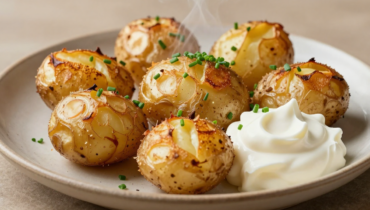
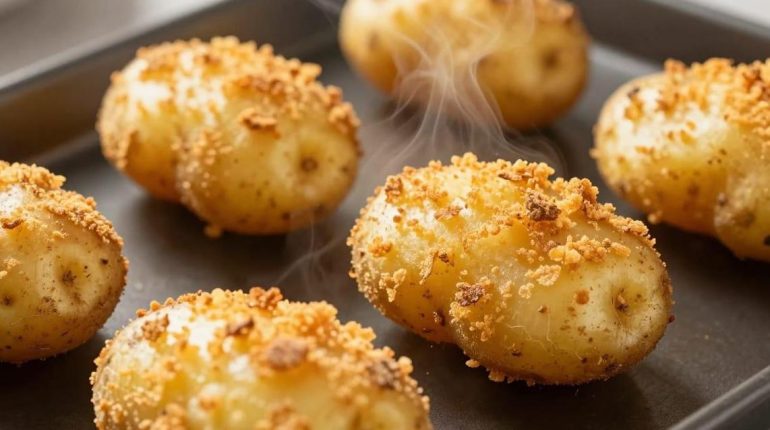
Adding ½ teaspoon of baking soda to the boiling salted water creates an alkaline environment that gently breaks down the surface of the tubers. During the 8 minutes of par-boiling, this chemical reaction softens the exterior while preserving the structural firmness needed to withstand roasting. The result: a rough, flaky, almost porous texture that will intensely capture the olive oil and seasonings.
This textured surface forms the foundation of an exceptional golden crust. The irregularities created by the baking soda catch the fat and spices much more effectively than a smooth surface, guaranteeing maximum crunch in every bite. Meanwhile, the salt added to the cooking water penetrates deep into the flesh, seasoning the potatoes from the inside out.
The key lies in the precision of the timing: the potatoes must reach fork-tenderness without falling apart. This often-overlooked preparatory step explains why some roasted potatoes reach golden perfection while others remain disappointing.
Russet Potatoes: The Economical And High-Performing Choice
This revolutionary technique finds its optimal expression with Russet potatoes, an economical variety that paradoxically surpasses its more expensive competitors. At $0.99 for four large potatoes, they consistently represent the most affordable option on the market while offering ideal structural properties for roasting.
Their composition explains this superiority: a low moisture content coupled with a high starch concentration creates the perfect conditions for developing a crispy exterior. Unlike waxy varieties like Yukon Gold or red potatoes, which retain more water, Russets release moisture during cooking, allowing their textured surface to achieve that sought-after golden crispness.
The financial calculation reinforces this choice: the complete recipe for 2 pounds costs $0.75 in total, or $0.43 per serving. This budget efficiency involves no compromise on taste. The rough edges created by par-boiling capture olive oil, garlic powder, and black pepper with remarkable efficiency, transforming a modest ingredient into an irresistible side dish.
Other varieties can certainly be used with this method, but they will rarely produce the same level of spectacular crunch. The starchy structure of Russets, combined with their surface altered by baking soda, generates that perfect alchemy between a golden exterior and a tender heart that never leaves leftovers.
The 6 Essential Steps For Golden And Crispy Potatoes
Mastering this technique relies on six critical steps that transform Russets into a spectacular side dish. The initial cutting into 1 to 2-inch pieces guarantees uniform cooking, both during par-boiling and final roasting. This calibration is not trivial: pieces that are too small disintegrate, while those that are too large remain raw in the center.
After the 8-minute par-boiling, the drained potatoes reveal that essential rough texture. Mixing with just 3 tablespoons of olive oil is a demonstration of efficiency: this minimal amount is sufficient thanks to the textured surface that holds the seasoning perfectly. The movement must remain delicate to preserve those flaky edges without crushing the pieces.
Spreading them on the tray requires particular vigilance. A single spaced layer allows roasting to occur correctly. Crowding, a frequent mistake, generates steam that softens the potatoes instead of crisping them. The temperature of 425°F for 40 minutes with turning halfway through triggers the Maillard reaction, that browning process that simultaneously develops deep golden color and complex aromas.
Monitoring remains necessary: the edges should reach an intense copper brown while the exterior becomes audibly crispy. This temporal and thermal mastery distinguishes correctly roasted potatoes from a truly exceptional result that justifies the systematic absence of leftovers.
Storage, Reheating, And Creative Variations
These roasted potatoes deliver their best sensory profile when served immediately, when the contrast between the cracking crust and the soft heart reaches its peak. Leftovers nevertheless keep for 3 to 4 days in the refrigerator in an airtight container. Reheating at 375°F in the oven or in an air fryer effectively restores that sought-after crispy texture, unlike the microwave which irremediably softens the exterior.
Freezing extends the shelf life up to 3 months, although the texture may slightly evolve after thawing. The optimal method is to freeze the potatoes after par-boiling and seasoning, but before the final cooking. Arranged on a tray, they solidify individually before being transferred to a suitable container. Roasting is then done directly from the frozen state, without prior thawing.
Seasoning lends itself to countless variations. Smoked paprika brings a warm dimension, poultry seasoning reinforces the comforting character, while onion powder intensifies the aromatic depth. Dried herbs – rosemary, thyme, oregano – transform the taste profile according to the inspiration of the moment. This flexibility allows the recipe to be adapted to any meal, from festive ham to family roast chicken, including vegetarian options like lentil loaf. Chopped leftovers even enrich vegetable pie fillings, proving that this technique transcends the simple notion of a side dish.