These skewers look like they come from a high-end catering platter. The reality: you can assemble them in twenty minutes with three ingredients, without turning on the stove once. The kind of recipe that makes you feel like you put in effort when you’ve practically done nothing.
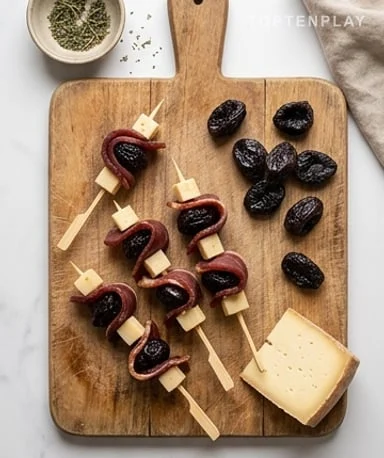
At first glance, you see the dark caramel of the prunes, the rosy slice of duck breast wrapped around, the ivory strip of fat bordering the meat. In the mouth, it’s a quick succession: the sweet compote of the prune, the salty kick of the dried meat, then the slightly tangy melt of the Ossau-Iraty that lingers. No heat, no sauce — just three textures playing off each other with every bite.
Why you’ll love this recipe
Ingredient Notes

Three ingredients, no compromise: Agen prunes, thinly sliced dried duck breast and Ossau-Iraty in small cubes.
- Pitted Agen prunes : They bring the softness and natural sweetness that balance the saltiness of the duck breast. Choose plump, dense-fleshed, shiny ones — lean or too-dry prunes tear when opened and hold the cheese filling less well. If you only have prunes with pits, pit them by making a clean lateral incision with a sharp knife.
- Dried duck breast : This structures the skewer and provides umami depth. If store-bought, slice thinly — two millimeters maximum — so it wraps without breaking. If you have twenty-one days ahead, making it at home with fresh duck breast, salt, pepper, and a cloth gives a more aromatic result and is less salty. But store-bought works very well and cuts prep time to thirty minutes.
- Ossau-Iraty : This Basque sheep’s cheese has a firm texture that cuts cleanly into small cubes without crumbling or sticking to the knife. Its slightly nutty flavor and milky sweetness soften the strength of the duck without overwhelming it. As a substitute, a half-aged Manchego or a young Comté work — avoid overly creamy cheeses that would escape at the first bite.
- Wooden appetizer picks : A practical detail that makes all the difference: picks 8 to 10 cm long keep the sliced duck breast wrapped without unrolling on the plate. Picks that are too short don’t go through the meat enough and let the skewers come apart when picked up.
Open the prune without tearing it
It seems trivial, but the incision matters. With a pointed knife, cut each prune in half without going all the way through — you want an open pocket, not two separate halves. The flesh must stay joined on one side to close over the cheese and hold without an extra pick. If the prune resists the blade, it’s too dry: soak it for ten minutes in warm water, drain carefully, then start again. An overly soft prune, on the other hand, tears easily — work with less pressure and a well-sharpened knife.

Cut the cheese methodically
Ossau-Iraty cuts better when it’s been out of the fridge for twenty minutes. Too cold, it crumbles under the knife and gives uneven cubes that stick out of the prune in all directions. The ideal size is about 1.5 cm per side: small enough to fit easily into the fruit pocket, generous enough to be clearly felt when tasting. Press the cube lightly into the open prune, close by pressing gently — the sticky, slightly moist flesh of the fruit helps hold everything together without glue or temporary toothpick.
Wrap the duck breast without breaking it
Slices of dried duck breast must be thin. Over three millimeters thick, they crack when folded and expose the dry edges of the meat, which are less pleasant in the mouth. Lay the slice flat in front of you, place the stuffed prune in the center with the opening facing down, and fold the two edges of the slice over the top, overlapping them slightly — one centimeter of overlap is enough. Then pierce diagonally through both layers of meat and the center of the prune: the pick holds everything together and prevents unrolling. If it still opens, the slice is too thick or too short.
Present and serve
Arrange the skewers on a slate or light wood board — the contrast between the warm brown of the prunes and the pink of the duck breast stands out better on a dark background than on a white plate. Take them out ten to fifteen minutes before serving: the slightly tempered cheese is much creamier, and the aromas of the duck breast release better at room temperature than straight from the fridge where the fat is solid. A drizzle of chestnut honey over the whole thing at the last moment enhances the sweet-salty and adds a shine that makes the presentation more appetizing. Count three to four skewers per person for an appetizer.

Tips & Tricks
- Cover the tray with plastic wrap after assembling if you’re not serving within an hour — the dried duck breast loses its softness on the surface very quickly in contact with air, and the texture becomes dry and tough.
- If your Ossau-Iraty is very aged and distinctly strong in flavor, slightly reduce the size of the cubes: the balance with the prune and duck breast is more fragile with a strongly flavored cheese.
- For six people as an appetizer, plan for twenty to twenty-four skewers — people go back for more, and running out when everyone still wants more is the only real risk of this recipe.
- Avoid skewering too early if the duck breast is very thin: the wooden pick absorbs some moisture from the prune after an hour and becomes difficult to hold cleanly. Assemble at most two hours ahead.

Can you prepare these skewers in advance?
Yes, up to two hours before serving. Assemble the skewers, place them on the tray and cover with plastic wrap to prevent the duck breast from drying on the surface. Take them out ten to fifteen minutes before serving so the cheese regains its creaminess — serving them straight from the fridge gives a less pleasant texture.
What cheese to use if you can’t find Ossau-Iraty?
A half-aged Manchego is the closest substitute: same firmness, same milky sheep’s sweetness. A young Comté (less than 12 months) also works for a milder, less pronounced version. Avoid soft or melting cheeses — they escape from the prune at the first bite.
How to make homemade dried duck breast?
Completely cover a fresh duck breast with coarse salt in a dish, cover with plastic wrap and leave in the fridge for 24 hours. Rinse thoroughly, dry, pepper generously on all sides, wrap in a clean cloth and let dry for three weeks in the vegetable drawer. The result is more aromatic and less salty than store-bought — the texture is also softer.
How to prevent the duck breast from unrolling when eating?
Two key points: the slice must be thin (2 mm maximum) to fold without cracking, and the pick must go diagonally through the two overlapping layers of meat. One centimeter of overlap is enough — no need to wrap several times, that thickens and makes the bite less neat.
Is there a hot version of this recipe?
Yes, and it completely changes the flavor profile. Arrange the assembled skewers on a baking sheet and place under the oven broiler for four to five minutes — the duck breast caramelizes slightly, the cheese starts to melt without running. Serve immediately, the hot prunes are much juicier.
How many skewers per person?
For a classic appetizer, three to four skewers per person are enough. As a single bite on a mixed platter, two suffice. If it’s the only offering at the appetizer, plan for five per person — this recipe is easily eaten in large quantities.
Prune, Dried Duck Breast and Ossau-Iraty Skewers
French
Appetizer
A Southwest France appetizer in three ingredients: the sweet softness of Agen prunes, the savory melt of dried duck breast and the nutty sweetness of Ossau-Iraty. No cooking, twenty minutes prep.
Ingredients
- 24 pitted Agen prunes (about 360 g)
- 200 g dried duck breast, thinly sliced (2 mm)
- 150 g Ossau-Iraty
- 24 wooden appetizer picks (8–10 cm)
- 1 tbsp chestnut honey (optional)
Instructions
- 1Take the Ossau-Iraty out of the refrigerator 20 minutes before starting — it cuts better when slightly tempered.
- 2Cut the cheese into regular cubes about 1.5 cm per side.
- 3Slit each prune on the side with a pointed knife to form a pocket without separating the two halves.
- 4Slide a cube of Ossau-Iraty into each prune and close by pressing gently.
- 5Lay a slice of duck breast flat, place a stuffed prune in the center with the opening facing down, and fold the two edges of the slice over, overlapping them by one centimeter.
- 6Pierce diagonally with a wooden pick through both layers of duck breast and the prune.
- 7Repeat for all 24 skewers and arrange on a serving board.
- 8Drizzle with chestnut honey just before serving if desired, and let sit at room temperature for 10 minutes before eating.
Notes
• To save time, use store-bought dried duck breast. Check that the slices are thin — ask the deli to slice them if needed.
• Assembled skewers keep for 2 hours in the refrigerator under plastic wrap. After that, the duck breast starts to dry out.
• Hot version: 4–5 minutes under the oven broiler to caramelize the duck breast and slightly melt the cheese. Serve immediately.
• Chestnut honey enhances the sweet-salty without weighing it down. A milder acacia honey also works if chestnut is too bitter.
Nutrition Facts (per serving, estimated)
| 245 kcalCalories | 14 gProtein | 22 gCarbs | 11 gFat |