📌 Private Property: Why Purple Paint is Replacing ‘No Trespassing’ Signs in the US
Posted 3 March 2026 by: Admin
A Color Code Replacing No Trespassing Signs
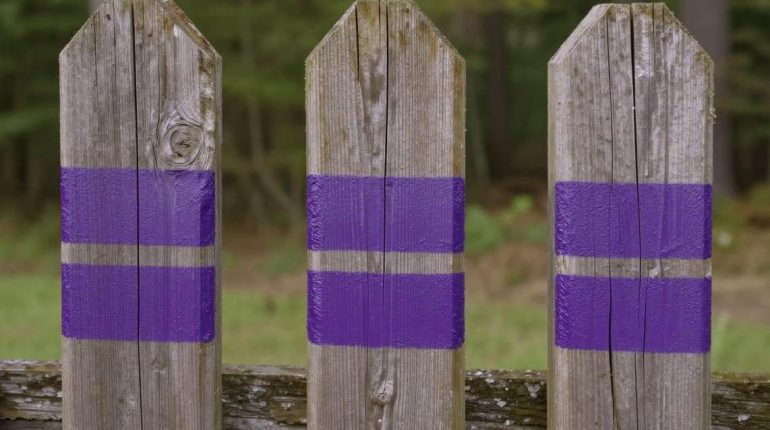
In several American states, a simple stroke of purple paint is enough to transform a fence post or a tree trunk into a legally recognized warning. This technique, little known to the general public but perfectly framed by law, allows landowners to signal the limits of their domain without resorting to traditional “No Trespassing” signs. Far from being an aesthetic whim, this practice constitutes an official substitute for classic signage, particularly popular in rural and wooded areas.
The adoption of this method responds to a concrete reality: in forest areas or vast agricultural properties, metal signs suffer repeated assaults from weather, vandalism, and lush vegetation. They fall, rust, or disappear under brambles, losing all effectiveness. Purple paint, however, adheres durably to the support and lasts through the seasons without fail. This pragmatic solution offers owners peace of mind at a lower cost, while guaranteeing constant visibility even when vegetation masks artificial structures.
But this apparent simplicity hides a requirement for precision: for the marking to have legal value, it must respect strict criteria that transform a color into a universal legal language.
Strict Rules for Legal Validity
This legal recognition is not obtained by chance. Authorities impose precise technical standards that distinguish a simple line of paint from an official warning enforceable in court. The required shape is a strictly vertical line: no informal spots, no horizontal or diagonal lines can claim validity. This verticality guarantees immediate identification and avoids any confusion with accidental markings or graffiti.
Dimensions constitute the second pillar of this regulation. Each purple band must measure at least 2.5 centimeters in width and 20 centimeters in length, thus ensuring maximum visibility even from a distance or in reduced light conditions. Too narrow, the mark would go unnoticed; too short, it would lack distinctive character. This standardization transforms the color into a universal signal, understandable without ambiguity.
Vertical positioning completes the device: the paint must appear between 90 centimeters and 1.50 meters from the ground. This height responds to a double logic: high enough to escape tall grass and brush, but low enough to remain in the natural field of vision of a walker. An owner who neglects these criteria would lose all legal protection, their marking then becoming a simple decoration devoid of legal effect. Technical precision thus becomes the foundation of land security.
Signage Spaced According to a Precise Protocol
Beyond shape and size, the effectiveness of the system relies on a calculated territorial network. Regulations impose a maximum spacing of about 30 meters between each purple mark along property boundaries. This distance responds to a mathematical logic: it guarantees that an individual progressing along the edge of the land necessarily crosses the visual field of at least one marker, eliminating any possibility of intrusion through ignorance.
This marking density transforms the invisible border into a continuous cognitive barrier. A hiker crossing a forest area will systematically encounter several purple lines before actually entering private property. The protocol anticipates natural blind spots created by dense vegetation, terrain accidents, or light variations under the canopy. Redundancy here becomes reinforced legal protection: in court, the owner can demonstrate that no person of good faith could have ignored the warning.
This delimitation method proves particularly suitable for vast rural plots where installing physical signs every 30 meters would represent a disproportionate investment. The purple system combines economy of means and legal rigor, creating a security perimeter that is both discreet and unavoidable. The apparent simplicity of the process hides regulatory engineering designed for durability and long-term effectiveness.
Why This Method Appeals to Landowners
This growing adoption of purple paint is explained first by an implacable economic reality. In rural areas exposed to the elements, metal or plastic signs undergo accelerated degradation: rust, fading under UV rays, tearing by strong winds. Their regular replacement generates recurring costs that the simple application of paint eliminates. A pot of purple paint covers several hundred meters of delimitation for a fraction of the price of traditional signage.
Beyond the budget, physical resistance is the major asset of the system. Unlike screwed or nailed signs that become targets for vandals or souvenir hunters, paint applied directly to bark or posts has no removable elements. Acts of vandalism become technically more complex and less rewarding, drastically reducing their occurrence. Weather only gradually fades the color without destroying the marking, allowing for prolonged visibility over several years.
In dense forest environments, high vegetation invariably ends up hiding signs fixed at standard height. Purple paint, strategically positioned between 90 cm and 1.50 m, remains visible even when weeds or young shoots colonize the borders. This visual permanence guarantees that the warning lasts through the seasons without human intervention, transforming each tree or post into a silent but effective sentinel. The cost-durability ratio explains why this technique is gaining ground over conventional solutions.