That familiar sound of eggs clinking in the pot. We all know this recipe by heart — and yet, how many times have we ended up with a shell that shatters into tiny pieces and a white that stays stuck to it? There are two or three tricks to know, and after that, the struggle is over.
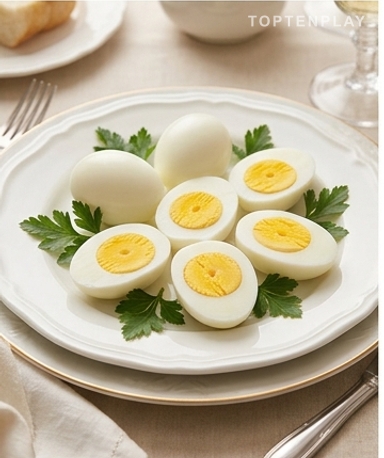
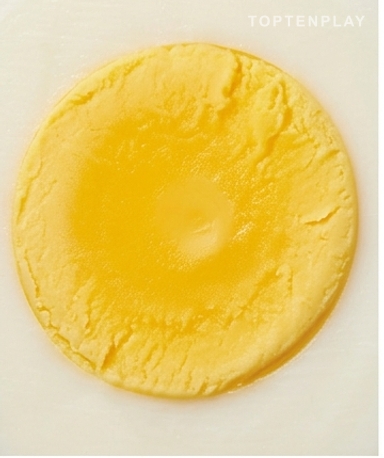
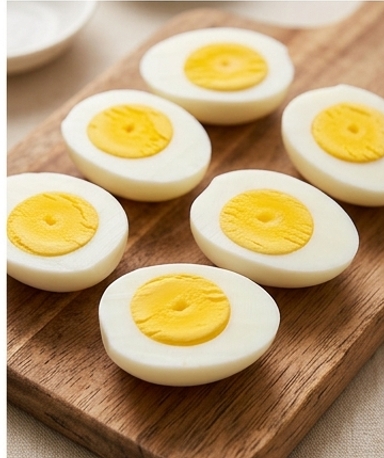
A successful hard-boiled egg is almost too simple to describe. The white is firm but not rubbery — it yields cleanly under the tooth without effort. The yolk is an intense yellow, almost orange in the center, perfectly matte, without that greenish halo that betrays overcooking. And most importantly: the shell comes off in two or three pieces, without tearing off half the white with it.
Why you’ll love this recipe
Ingredient Notes
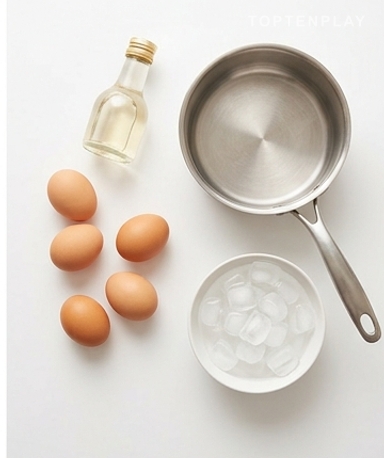
Everything you need for successful hard-boiled eggs: eggs, white vinegar, and a bowl of ice cubes.
- The eggs : Prefer eggs that are a week or two old — not fresh from the day. The older an egg gets, the more the pH of its white increases, which is exactly what prevents the membrane from sticking to the shell. A very fresh egg is a catastrophe when it comes to peeling.
- White vinegar : One tablespoon in the cooking water, no more. It slightly softens the shell and helps the white hold together if an egg cracks during boiling. And no, it doesn’t change the taste — not at all, the acidity evaporates with the steam.
- Ice cubes : A large bowl, plenty of ice cubes, cold water. This is the step everyone skips because it seems optional. Yet it’s the most important part of the whole process — without it, the eggs continue to cook off the heat.
Start cold
Place the eggs in the pot, cover with cold water, and turn on the heat. The principle of the cold water method: the eggs heat up gradually with the water, avoiding the thermal shock that cracks shells. If you take eggs directly from the fridge, let them sit for 10 minutes at room temperature before plunging them. Add the tablespoon of white vinegar to the water. You barely smell the acidity at first — it completely disappears upon boiling.
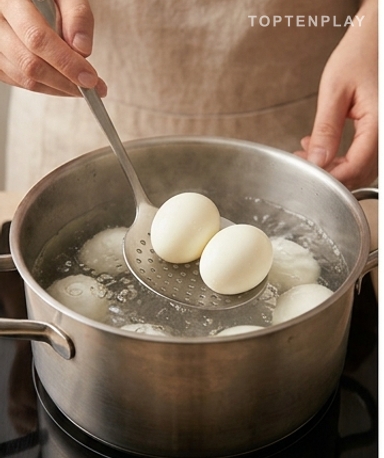
The timer is everything
As soon as the water boils, start the timer. 8 minutes for a yolk that is still slightly creamy in the center, a deep yellow almost orange. 9 to 10 minutes for a completely set, firm yolk of a pale, uniform yellow. Not 12 minutes. Not 15. Past 10 minutes, the sulfur in the white reacts with the iron in the yolk — and that’s when that unappetizing grayish ring appears. Timing is truly the only thing to respect here.
The cold bath, non-negotiable
The eggs come out of the boiling water and go straight into the bowl of ice cubes. Immediately. This temperature shock stops the cooking instantly — if you wait even two minutes, the eggs continue to cook with their residual heat. Under your fingers, the shell goes from scalding to cold in seconds. Leave them in the bath for at least 5 minutes before peeling.
The shell that yields
Gently tap the egg on the counter to crack it, then roll it briefly between your palms — the shell will crackle into a web. Start peeling from the blunt end: there’s often a small air pocket there, and the shell detaches more easily from that side. Under a thin stream of cold tap water, the rest slides off. If it still resists, the eggs were probably too fresh — that’s the only real possible problem.
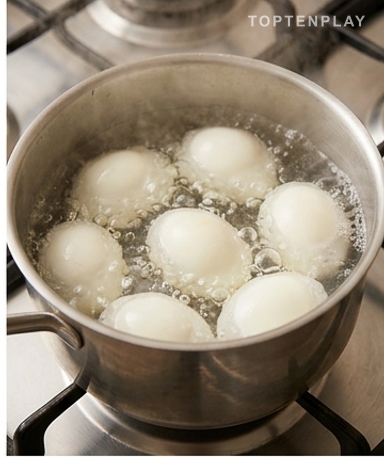
Tips & Tricks
- Use eggs at least a week old, not fresh eggs. The pH of the white increases over time, preventing the membrane from sticking to the shell — it’s chemistry, not a grandmother’s superstition.
- Peel the eggs under a stream of cold water. Water seeps between the shell and the white and makes peeling easier, especially on stubborn eggs.
- If you’re making several eggs, don’t crowd them in a pot that’s too small. They need space so they don’t bump into each other during boiling — one crack at the wrong time and the white escapes into the water.
How long do hard-boiled eggs keep?
A hard-boiled egg keeps for up to 7 days in the refrigerator, in its shell. Once peeled, they keep for a maximum of 5 days in an airtight container with a little water to prevent them from drying out. Avoid leaving them at room temperature for more than 2 hours.
Why does the shell still stick after the cold bath?
Almost always for the same reason: the eggs were too fresh. An egg that’s a day or 2-3 days old has a white with a low pH that adheres to the inner membrane. Use eggs that are at least a week old — the ice bath does the rest.
How do I avoid the famous green ring around the yolk?
It’s a chemical reaction between the sulfur in the white and the iron in the yolk, triggered by overcooking. The solution: do not exceed 10 minutes of cooking after boiling and immediately plunge the eggs into the ice bath to stop the cooking.
Can I prepare hard-boiled eggs in advance?
Yes, it’s even recommended. Cooked and kept in their shell, they can easily be prepared 3 to 5 days in advance. To take them with you, keep the shell on until the last moment — it protects the white and delays drying out.
Must I absolutely start with cold water?
It is the most reliable method for avoiding cracks from thermal shock. Plunging cold eggs into already boiling water works too, but the risk of cracking increases — especially if the eggs come directly from the fridge.
Perfect Hard-Boiled Eggs — Foolproof Method
International
Appetizer
The technique for cooking hard-boiled eggs with a perfectly centered yolk, no green ring, and a shell that comes off in two pieces.
Ingredients
- 6 eggs (preferably at least 1 week old)
- 1 tablespoon (15 ml) white vinegar
- enough to cover the eggs cold water
- 1 large bowl filled ice cubes + cold water (for the bath)
Instructions
- 1Place the eggs in a pot and cover them with cold water. Add the white vinegar.
- 2If the eggs are from the fridge, let them rest for 10 minutes at room temperature before starting.
- 3Bring the water to a boil over medium-high heat. At the first sign of boiling, start the timer.
- 4Cook for 8 minutes for a creamy yolk, 9 to 10 minutes for a completely set yolk.
- 5Immediately transfer the eggs to a large bowl of ice water. Let them rest for at least 5 minutes.
- 6Crack each egg on the counter, roll it gently between your palms, then peel under a stream of cold water starting from the blunt end.
Notes
• Storage: in their shell, hard-boiled eggs keep for 7 days in the refrigerator. Peeled, 5 days in an airtight container with a little water at the bottom.
• If the shell resists peeling despite the cold bath, next time use older eggs — that is almost always the cause.
• For salads and deviled eggs, cook for exactly 9 minutes: the yolk is firm, dry, and mixes or mashes cleanly.
Nutrition Facts (per serving, estimated)
| 78 kcalCalories | 6gProtein | 1gCarbs | 5gFat |