📌 Peanut butter fudge: why 43°C and non-stirring guarantee a perfect creamy texture
Posted 23 February 2026 by: Admin
The Traditional Candy Thermometer Recipe
The classic peanut butter fudge method relies on implacable technical precision. Unlike improvised versions, this approach requires a candy thermometer and rigorous temperature control. The process is divided into two critical phases that determine final success.
The first crucial step occurs right at the beginning: completely dissolving the sugar before the mixture reaches a boil. In a heavy-bottomed saucepan, granulated and brown sugars combine with milk and corn syrup. This total dissolution is achieved by constant stirring over medium-low heat. To check, simply dip a clean spoon into the preparation and look for the absence of grainy crystals. This initial vigilance prevents the dreaded sandy texture.
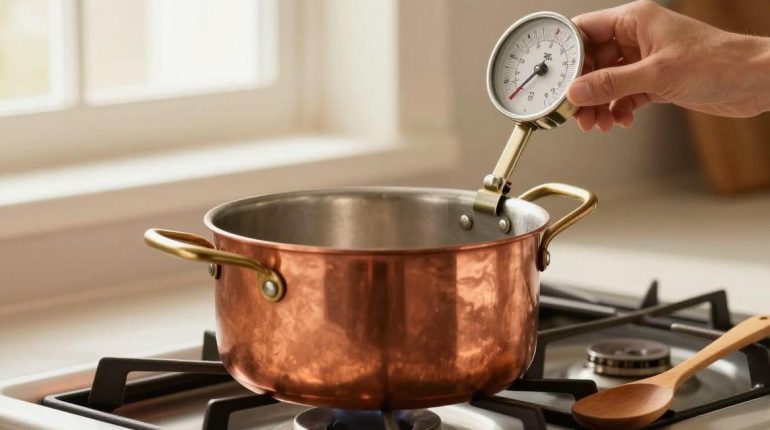
Once boiling is reached, the rule becomes absolute: do not touch. The thermometer must display between 234°F and 238°F, the “soft-ball stage” zone, during 5 to 10 minutes of passive cooking. But the true key lies in the next phase: remove from heat and let cool to 110°F without stirring, shaking, or intervening. This 45 to 60-minute wait without contact allows the sugar crystals to stabilize in a creamy rather than grainy structure.
It is only at 110°F that vigorous beating begins. The incorporation of peanut butter and vanilla then transforms the mixture: it thickens, loses its shine, and adopts a matte texture in 3 to 5 minutes. This visual change signals that the fudge will reach its characteristic smooth consistency once spread and cooled.
Ingredients and Preparation: The Fundamentals
This recipe relies on proven proportions: 2 cups of granulated sugar, 1 cup of brown sugar, 1 cup of milk, and 1 cup of peanut butter produce 64 one-inch squares. The combination of two sugars is not incidental. White sugar provides the crystalline structure, while brown sugar enriches the taste and adds a subtle caramelized note.
The choice of peanut butter proves decisive. Commercial brands like Jif or Skippy, containing stabilizers, are explicitly recommended over natural versions. These stabilizers prevent oil separation during cooking and guarantee a stable emulsion. Natural peanut butters, while healthier, compromise the texture by releasing their oil under the effect of heat.
Evaporated milk is an alternative to whole milk that deserves attention. Its concentration of fat and protein enriches the final texture, creating a superior velvety density. Corn syrup, often perceived as incidental, plays a crucial anti-crystallization role by interfering with the formation of large sugar crystals.
The total timeline breaks down as follows: 15 minutes of active preparation, 10 minutes of monitored cooking, then 2 to 4 hours of setting at room temperature. This final patience allows for controlled crystallization that gives the fudge its characteristic melting texture, distinct from undercooked versions that stay soft or overheated versions that become crumbly.
The No-Bake Express Version
This hours-long patience is not always compatible with spontaneous cravings. The “shortcut” method entirely eliminates the cooking step and temperature control, making the recipe accessible even to beginners intimidated by candy thermometers.
Five ingredients are enough: 1 cup of unsalted butter, 1 cup of creamy peanut butter, 1 teaspoon of vanilla, a pinch of salt, and 3½ to 4 cups of mandatory sifted powdered sugar. Sifting is not optional, as it prevents lumps that would ruin the desired smooth texture.
The process boils down to melting the butter, incorporating the peanut butter until homogeneous, then gradually integrating the powdered sugar. No cooking, no temperature monitoring, no risk of failed crystallization. The rich and creamy texture is guaranteed by the high proportion of fats that coat the sugar particles.
This version produces about 36 squares, almost half as many as the traditional recipe, but with a production time divided by three. The fudge sets in 1 to 2 hours in the refrigerator compared to 2 to 4 hours at room temperature for the cooked version. The difference in texture remains perceptible: less melting, denser, with a more direct sweetness than the caramelized complexity of the classic version.
Techniques and Tips for Guaranteed Success
Damage-free unmolding starts with meticulous preparation: line the 8×8 inch pan with parchment paper, leaving an overhang on two opposite sides. These extensions will serve as handles to extract the entire block without breaking the fragile edges. A light buttering of the paper prevents residual sticking.
A heavy-bottomed saucepan of at least 3 liters is not a suggestion, but a necessity. Thin bottoms create hot spots that caramelize the sugar unevenly, causing that dreaded grainy crystallization. The generous capacity prevents overflows when the mixture boils vigorously.
Beating after cooling requires attentive observation rather than strict timing. For 3 to 5 minutes, the shiny liquid mass gradually thickens, losing its luster to adopt a characteristic matte appearance. This visual change marks the exact moment when the sugar crystals form in the ideal structure: work too early and the fudge stays soft, too late and it hardens in the pan.
Cutting is performed only after complete cooling at room temperature. A long, sharp knife, cleaned between each cut, produces neat one-inch squares. Rushing this step with a still-lukewarm fudge causes fraying and irregular surfaces that betray amateurism.