📌 Peace lily without flowers: the 3 essential conditions your plant demands to bloom again
Posted 14 January 2026 by: Admin
The Real Reasons Behind The Lack Of Bloom
Months go by. Sometimes years. You water regularly, move the pot from one window to another, even whisper some encouragement to your Spathiphyllum. The foliage remains a lush green, the plant seems to thrive. Yet, no white spathe deigns to appear.
This silent frustration is shared by thousands of growers. They perform classic maintenance tasks without understanding why their peace lily stubbornly refuses to bloom. The myth persists: constantly moving the plant will eventually trigger blooming. False.
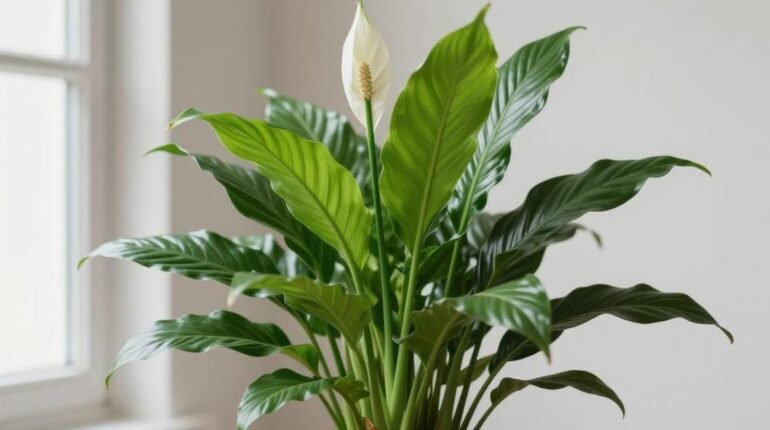
The truth lies elsewhere. Your peace lily is not trying to upset you. On the contrary, it communicates in its own way. When a white spathe finally emerges above the foliage, it conveys an unequivocal message: “You’re doing well. I’m not dying. I feel safe here.”
This blooming is neither spectacular nor rare in itself. But it validates your approach. It signals that you have crossed an invisible threshold: the one that separates the simple survival of the plant from its real flourishing.
For here is the central revelation: peace lilies want to bloom naturally. They don’t ask for the impossible. They simply wait for precise conditions that few owners correctly identify. Understanding this silent language transforms everything.
Understanding The Silent Language Of Spathiphyllum
This wait for specific conditions reveals a little-known reality: what we call a “flower” isn’t really one. The white spathe that emerges above the foliage is actually a decorative bract protecting the true inflorescence — that discreet spadix located in the center. But botany doesn’t matter. What counts is the unique psychological satisfaction its appearance provides.
Neither rare nor spectacular, this blooming nevertheless possesses a particular power: it validates. It transforms months of uncertainty into tangible confirmation. Your Spathiphyllum is no longer just surviving in your living room. It is flourishing enough to invest its energy in reproduction.
This contrast strikes all growers: lush foliage can mask a prolonged absence of flowers for years. The plant vegetates without withering, keeping its leaves green and shiny, giving the illusion of health. You continue to water, clean the leaves, sometimes even talk to it. These gestures remain insufficient.
Because the Spathiphyllum functions according to a precise biological logic. Its blooming does not respond to affection or general attention. It responds to specific environmental parameters that trigger its sense of security. When these conditions align, the plant interprets its environment as conducive to reproduction. Only then does it produce that spathe which means: “I can invest here.”
It remains to identify these parameters that most people neglect.
The Forgotten Conditions That Unlock Blooming
These neglected parameters are hidden in the gap between keeping a plant alive and making it thrive. The first approach ensures survival: regular watering, indirect light, stable temperature. The second triggers reproduction. And it is precisely this threshold that most growers never cross.
The Spathiphyllum will not bloom simply because it is healthy. It must interpret its environment as stable and favorable enough to invest energy in reproduction. This distinction changes everything: you are no longer trying to avoid the plant’s death, but to create the conditions for its complete flourishing.
Three factors trigger this shift. First, light intensity: if it’s too low, the plant concentrates all its energy on chlorophyll production to survive. Second, the nutrient cycle: insufficient reserves prevent the formation of spathes, a resource-intensive process. Finally, controlled water stress: a slight period of drought followed by generous watering simulates the natural conditions that signal the time to bloom.
“Peace lilies want to bloom. They just need the right conditions — and a little understanding.” This sentence summarizes the essential: your plant is not resisting you. It is simply waiting for you to understand its biological language.
The question is no longer why your peace lily refuses to bloom. It becomes: how to translate this understanding into concrete actions that finally trigger this long-awaited blooming.
Towards Controlled And Regular Blooming
Now that these biological mechanisms are identified, the strategy becomes clear. Gradually increase light exposure: move your Spathiphyllum 1-2 meters from an east or west-facing window, where filtered light stimulates photosynthesis without burning the foliage. This increased intensity signals to the plant that it has the energy necessary to produce spathes.
Feed it with discernment. A balanced liquid fertilizer (20-20-20) diluted by half, applied every six weeks during the growing period, replenishes mineral reserves. Avoid excess: over-fertilization produces lush but sterile foliage, diverting energy from reproduction to vegetative growth.
Controlled water stress remains your most powerful tool. Let the substrate dry slightly between waterings — the leaves should barely droop — then water generously. This cycle mimics the seasonal variations of the natural tropical habitat, triggering a hormonal response that initiates blooming.
These adjustments transform your relationship with the plant. You no longer react to its immediate needs: you anticipate its reproductive cycle. The first spathe will appear within 6 to 8 weeks following these modifications — this “vegetal thank you” that confirms you have finally deciphered its language.
One crucial question remains: how to maintain this blooming rhythm without exhausting your peace lily in the long term.