Follow us
7 June 2026

Paris-Brest with Vanilla Diplomat Cream

Prep Time
45 minutes
Cook Time
35 minutes
Total Time
3 hours 20 minutes (including 2h resting)
Servings
6 to 8 servings

The smell of choux pastry beginning to puff in the oven—a mix of melted butter and lightly caramelized egg—is one of the most satisfying signals in the kitchen. Paris-Brest is one of those desserts that seem reserved for pastry shop windows, but are actually very accessible once you understand the logic behind each step. With a vanilla diplomat cream instead of the classic praline, this version is lighter, less sweet, and frankly easier to get right.
Advertisement
Final result
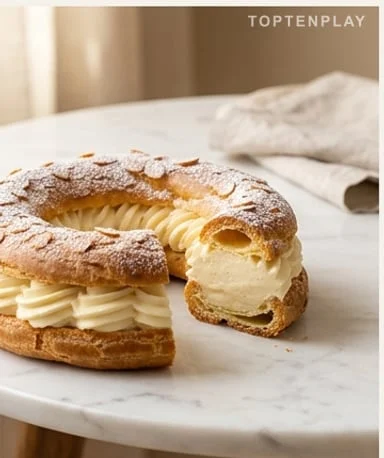
The golden crown, the toasted almonds, the cream slightly overflowing—Paris-Brest as it should be.

The crown comes out of the oven nicely golden, with the sliced almonds that have caramelized slightly on top—they crackle under your fingers when you touch them. Once cut in half, the inside is hollow and light, with that fine crust that crumbles just slightly. The diplomat cream is ivory white, almost mousse-like, with a strong vanilla scent that rises as soon as you dip the spatula in. The combination of the two—the crispness of the pastry, the airy creaminess—gives a texture rarely found in a homemade dessert.
Why you’ll love this recipe

Choux pastry is very forgiving : Unlike puff pastry, it requires neither a cold marble nor precise movements. Once you’ve understood the drying principle, it becomes very predictable.
Lighter than the praline version : Vanilla diplomat cream is less rich and less sweet than the classic filling. It’s a difference you really taste—you don’t feel weighed down after two servings.
Two parts that can be prepared separately : The pastry cream can be made the day before, the crown in the morning. Final assembly takes only 15 minutes and the Paris-Brest holds well for two hours in the fridge before serving.
The visual effect happens by itself : The crown, the cream slightly overflowing, the powdered sugar—it looks like something carefully done without a professional piping bag or pastry training.

Ingredient Notes

Ingredients

No secret technique: good fresh eggs, a real vanilla bean, and well-chilled cream make all the difference.

  • Butter (choux pastry) : It has two roles: create an emulsion with water and milk during the panade cooking, then generate steam in the oven to puff the choux. Use unsalted butter with at least 82% fat—light butter contains too much water and unbalances the dough.
  • Eggs (choux pastry) : They provide structure, shine, and lightness. Incorporate them one by one at room temperature—eggs straight from the fridge slow down the emulsion and make the batter lumpy. The final consistency should form a ribbon that falls slowly from the spatula.
  • Vanilla bean (pastry cream) : It makes all the aromatic difference. Split it and scrape the seeds into the cold milk before heating—this gives the flavor time to diffuse. Bourbon or Tahiti vanilla gives an incomparable result compared to bottled extract.
  • Cornstarch (pastry cream) : It thickens the cream without giving it the sticky texture that too much flour would. The amount is calibrated for a cream that holds when cut but remains soft under the spoon—do not reduce it or the cream will be too liquid for assembly.
  • Heavy whipping cream (chantilly) : It must be at least 35% fat and really cold—30 minutes in the freezer before whipping if possible. Cream that is too warm or too thin will not whip well and collapses quickly, ruining the final texture of the diplomat cream.
  • Sliced almonds : Not just for decoration. While baking, they provide a crunchy contrast on top of the crown and a slight toasted flavor that complements the vanilla. If you don’t have them, scattered almond powder gives a nice rustic finish.

Master your choux pastry in two steps

The base of choux pastry is a panade—a cooked mixture of water, milk, butter, and flour that forms a compact mass before receiving the eggs. Heat the water, milk, butter cut into pieces, salt, and sugar in a saucepan over medium heat until it comes to a rolling boil. Add the flour all at once off the heat, and mix vigorously with a spatula until you get a ball that pulls away from the sides. Then put it back over low heat for one to two minutes: you’ll hear a slight crackling and the dough will start to form a film on the bottom of the pan—that’s the sign it’s properly dried. This drying is crucial. Dough that is too moist won’t puff properly and will collapse when taken out of the oven, due to insufficient internal steam. Transfer it to a bowl and let it cool for two to three minutes before incorporating the eggs one by one. Each egg must be completely absorbed before adding the next—the batter goes through a granular phase and this often worries people, but it becomes smooth again with mixing.

Master your choux pastry in two steps
Piping the crown sets the tone. Regular or rustic, it will puff anyway.

Pipe and bake the crown without ever opening the oven

Preheat the oven to 180°C (fan). On a baking sheet lined with parchment paper, draw a circle about 22 cm in diameter as a guide, then flip the paper over. Pipe the dough following the outline—a first crown, then a second on top for more volume. Generously sprinkle with sliced almonds. Bake for 30 to 35 minutes without ever opening the door: a draft of cold air makes choux pastry fall, and it will not rise again. You’ll know it’s done when the crown is evenly golden, well puffed, and the almonds have turned light brown with that roasted hazelnut smell coming out of the oven. Remove and let it cool completely on a wire rack before cutting—still-warm choux pastry gets crushed under the knife.

Make your pastry cream the day before if you can

Heat the milk with the split vanilla bean over low heat—until it shimmers, not boils, which would evaporate the flavors. Meanwhile, whisk the egg yolks with the sugar until the mixture becomes slightly pale and forms a ribbon. Add the cornstarch and mix well. Then pour the hot milk gradually over this mixture—first in a thin stream to avoid cooking the yolks, then the rest at once. Pour everything back into the saucepan and cook over medium heat, stirring constantly: the cream thickens suddenly around 82-85°C, then becomes homogeneous and slightly pulls away from the edges. Off the heat, incorporate the cold butter cut into pieces—it adds shine and creaminess. Cover the cream with plastic wrap touching the surface to prevent a skin from forming, and let it cool in the refrigerator for at least two hours, ideally overnight. When you use it, it will be very firm—that’s normal and desired.

Assemble the diplomat cream just before assembly

Take the pastry cream out of the fridge and whisk it vigorously to loosen it—it goes from a compact mass to a smooth, silky cream in a few seconds. Whip the very cold heavy cream into firm chantilly: start at medium speed to create stable bubbles, then gradually increase. The chantilly is ready when it forms peaks that hold but remain slightly soft—not a greasy, grainy mass. Add the powdered sugar and whip for another ten seconds. Then fold the chantilly into the pastry cream in three additions, using a spatula, with wide, enveloping motions from bottom to top. You’re not aiming to mix thoroughly but to preserve air. The result should be light, uniform, with that vanilla scent that suddenly intensifies—it’s the signal that the two creams are well married.

Final assembly just needs a bit of generosity

Cut the cooled crown in half horizontally with a serrated knife. The base is often denser, the top more airy—keep them in the right orientation. Fill the base generously with diplomat cream: using a piping bag for a pastry-like finish with regular rosettes, or a spoon for a more rustic and generous style. The cream should overflow slightly from the crown so that each slice is well filled. Gently place the top on and press very lightly. Dust with powdered sugar at the last moment—it becomes humid quickly upon contact with the cream and disappears if you put it on too early. Refrigerate until serving.

Final assembly just needs a bit of generosity
Thirty minutes without opening the oven. That’s the golden rule of choux pastry, and it tolerates no exception.

Tips & Tricks
  • Drying the choux pastry on the stove before adding the eggs is not optional: residual moisture is the enemy of rising. Insufficiently dried dough stays soft coming out of the oven because internal steam did not form enough to make the structure puff.
  • Cover the pastry cream with plastic wrap directly on the surface, not just over the bowl: the air between the two forms a thick skin that is hard to incorporate later and gives a lumpy texture to the final diplomat cream.
  • Let the crown cool completely before cutting and filling. Still-warm choux pastry softens the cream in minutes and everything collapses when cut. This is the difference between a Paris-Brest that holds up well on the plate and one that flattens.
  • If you don’t have a piping bag, a freezer bag with a corner cut off works very well—both for piping the crown and for filling the cream. The result is visually less regular, but just as generous in taste.
Close-up
Upon cutting, the vanilla diplomat cream reveals its texture: neither too dense nor too light. A balance you never tire of rediscovering.
FAQs

Can I prepare the Paris-Brest the day before?

Yes, but in two stages. The pastry cream can be made the day before and stored covered with plastic wrap in the refrigerator. However, the final assembly—putting together the crown and the diplomat cream—must be done on the same day, at most 4 to 6 hours before eating, otherwise the choux pastry becomes soggy.

How do I know if my choux pastry has the right consistency?

Lift the spatula and let the batter fall: it should form a continuous ribbon that falls slowly and folds slightly before detaching. If it falls in a lump, it needs a bit more egg. If it flows like a cream, there is too much egg and it’s hard to fix—better to start over.

Why did my crown collapse when I took it out of the oven?

Two likely causes: the dough was not sufficiently dried on the stove before adding the eggs, or the oven was opened during baking. In both cases, the internal moisture could not turn into enough steam to maintain the structure. Also make sure the crown is really well browned—not just lightly colored—before taking it out.

Can I replace the diplomat cream with something else?

Yes. The classic filling for Paris-Brest is a praline mousseline cream, richer and firmer. You can also fill it with a simple vanilla mascarpone chantilly for an even quicker version. The diplomat cream remains the lightest in texture and the easiest to succeed at home.

How long does the Paris-Brest keep once assembled?

24 to 48 hours in the refrigerator, but it is best within the first 12 hours. After that, the choux pastry starts to absorb moisture from the cream and loses its crispness. If you want to prepare it in advance, keep the crown and cream separate and assemble at the last moment.

Can I freeze baked choux pastry?

Yes, the baked and cooled crown freezes very well, without filling. Place it flat in an airtight bag and freeze for up to a month. To thaw, put it in the oven at 160°C for 8-10 minutes to restore its crispness before assembly.

Paris-Brest with Vanilla Diplomat Cream

Paris-Brest with Vanilla Diplomat Cream

Medium
French
Dessert

Prep Time
45 minutes
Cook Time
35 minutes
Total Time
3 hours 20 minutes
Servings
6 to 8 servings

A golden choux pastry crown topped with almonds, filled with light and creamy vanilla diplomat cream. More approachable than the classic praline version, this homemade Paris-Brest impresses as much as it delights.

Ingredients

  • — Choux pastry —
  • 125 ml water
  • 125 ml whole milk
  • 100 g unsalted butter
  • 150 g all-purpose flour
  • 4 eggs
  • 1 tbsp sugar
  • 1 pinch salt
  • 30 g sliced almonds
  • — Pastry cream —
  • 500 ml whole milk
  • 1 vanilla bean
  • 4 egg yolks
  • 100 g sugar
  • 40 g cornstarch
  • 30 g unsalted butter
  • — Chantilly cream —
  • 300 ml heavy whipping cream (35% fat)
  • 30 g powdered sugar
  • — Finish —
  • 1 tbsp powdered sugar

Instructions

  1. 1Prepare the panade: in a saucepan, bring water, milk, butter cut into pieces, sugar, and salt to a boil. Add the flour off the heat all at once and mix vigorously until a ball that pulls away from the sides forms.
  2. 2Dry the dough: return to low heat for 1-2 minutes, stirring until a light film forms on the bottom of the pan and you hear a slight crackling.
  3. 3Incorporate the eggs: transfer to a bowl, let cool for 2 minutes, then add the eggs one by one, mixing well between each addition. The batter should be smooth, shiny, and form a slow-falling ribbon.
  4. 4Form the crown: preheat the oven to 180°C (fan). On a baking sheet lined with parchment paper, pipe the batter into a crown shape (two layers stacked for more volume). Sprinkle with sliced almonds.
  5. 5Bake for 30-35 minutes without opening the oven, until the crown is evenly golden and well puffed. Let cool completely on a wire rack.
  6. 6Pastry cream: heat the milk with the split and scraped vanilla bean until shimmering. Whisk the egg yolks with the sugar until pale, add the cornstarch, then gradually pour in the hot milk. Cook over medium heat, stirring constantly, until thickened. Off the heat, incorporate the butter, cover with plastic wrap touching the surface, and refrigerate for at least 2 hours.
  7. 7Chantilly cream: whip the very cold heavy cream into firm peaks, add the powdered sugar at the end.
  8. 8Diplomat cream: whisk the cold pastry cream to loosen it, then gently fold in the chantilly cream in three additions, using a spatula, with enveloping motions to preserve air.
  9. 9Assembly: cut the cooled crown in half horizontally. Generously fill the base with diplomat cream using a piping bag or spoon. Cover with the top, dust with powdered sugar at the last moment, and refrigerate until serving.

Notes

• Do not skip the step of drying the dough on the stove: it determines the rise in the oven.

• The pastry cream can be made the day before and stored covered with plastic wrap in the refrigerator—it will be easier to work with when cold.

• Whip the chantilly at the last moment, just before assembling the diplomat cream, to avoid losing volume.

• Paris-Brest is best within the first 12 hours. For advance preparation, keep the crown and cream separate and assemble before serving.

• Variation: fold a tablespoon of hazelnut paste into the cooled pastry cream before adding the chantilly.

Nutrition Facts (per serving, estimated)

560 kcalCalories 8 gProtein 45 gCarbs 38 gFat
Advertisement
Share on Facebook