📌 Orchids: why viral teaspoon remedies can kill your plants instead of making them bloom
Posted 28 February 2026 by: Admin
Demystifying Miracle Remedies For Orchids
On social media, promises fly: “Add a teaspoon of this solution to your orchid and watch it bloom without interruption!” Behind these viral posts hide household ingredients presented as blooming elixirs — Epsom salt, hydrogen peroxide, cinnamon, or banana water. However, scientific reality contradicts these claims.
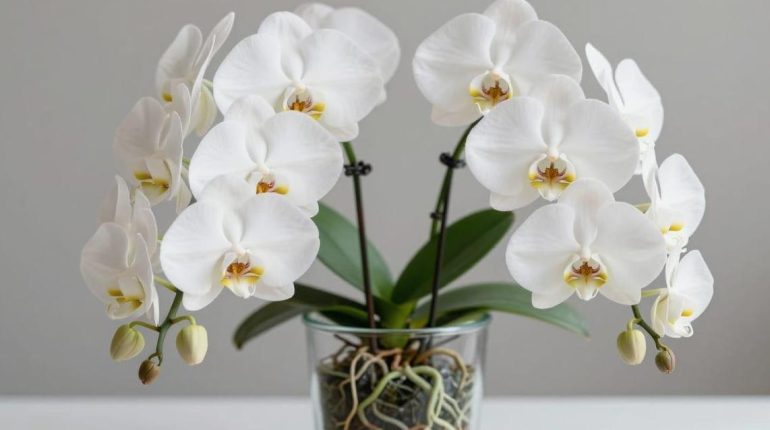
Phalaenopsis orchids, the most common indoor variety, respond to precise environmental signals, not improvised potions. Factual analysis reveals that Epsom salt only benefits plants suffering from magnesium deficiency — an exceptional situation. An excess irremediably damages delicate roots. Hydrogen peroxide, touted for “oxygenating” the substrate, actually destroys beneficial microbes essential for root balance. Cinnamon, a mild antifungal for cuts, contains no fertilizer. As for milk and banana water, their rapid decomposition turns the pot into a mold broth while providing negligible nutrients.
The conclusion is clear: no teaspoon of a household product will trigger a reliable bloom. Orchids require growing conditions that respect their natural physiology, far from illusory shortcuts. Understanding their real needs begins by examining each popularized substance and its concrete effects on the plant.
Epsom Salt: Between Myth And Reality
Magnesium sulfate, marketed as “Epsom salt,” crystallizes all the contradictions of viral horticultural remedies. Its chemical composition — magnesium and sulfur bound in soluble crystals — theoretically justifies its use in certain growing situations. But digital hype transforms a temporary correction of a mineral deficiency into a universal panacea.
Phalaenopsis orchids grown in bark substrate rarely show magnesium deficits. This micronutrient is involved in photosynthesis and chlorophyll formation: a deficiency manifests as yellowing leaves with green veins, an exceptional symptom under standard domestic conditions. Applying Epsom salt to an already balanced plant causes the opposite of the desired effect: salt accumulation gradually burns the velamen roots, those spongy tissues that absorb water from the atmosphere.
Marketing transforms this cheap substance into a miracle elixir, obscuring the risks of approximate dosing. A teaspoon diluted in a liter of water may seem harmless, but repeated every watering, it concentrates mineral salts in the substrate until it creates a toxic environment. Roots blacken, dry out, and the long-hoped-for bloom becomes biologically impossible. True floral stimulation requires a global environmental approach, not hazardous chemical supplementation.
Peroxide, Cinnamon, And Organic Solutions: Truths And Dangers
Beyond Epsom salt, other household ingredients claim to revolutionize orchid growing. Hydrogen peroxide tops viral recommendations for “oxygenating roots” and “preventing rot.” This H₂O₂ molecule, effectively used in medical disinfection, acts indiscriminately: it simultaneously eliminates pathogens and beneficial microorganisms that naturally colonize the bark substrate. These mycorrhizal fungi facilitate nutrient absorption; their destruction permanently weakens the plant. Regular application of peroxide also corrodes delicate root tissues, turning a pseudo-preventive treatment into a real chemical aggression.
Cinnamon enjoys a more nuanced reputation. Its natural antifungal properties prove truly effective when applied directly to freshly cut roots during repotting — a topical protection against infections. But this aromatic powder contains no nutritional elements capable of triggering blooming. Confusing its occasional therapeutic use with a fertilizer is a conceptual error.
As for organic solutions like diluted milk or banana water, their rapid decomposition in the warm substrate creates an ideal culture broth for mold and bacteria. These liquids provide negligible nutrients compared to fertilizers specifically formulated for epiphytic orchids, while compromising root hygiene. Blooming requires precise conditions, not hazardous fermentations.
The True Key To Abundant Blooming
These hazardous experiments mask a fundamental biological reality: Phalaenopsis orchids bloom in response to precise environmental signals, not improvised chemical stimulants. The first trigger identified by botanists remains light exposure. These epiphytic plants require bright indirect light — intense enough to cast a sharp shadow of your hand, but filtered to avoid leaf burn. Positioning near an east or west-facing window, protected by a sheer curtain, reproduces the natural conditions of tropical undergrowth where the canopy filters solar radiation.
The temperature plays an equally decisive role. The formation of flower spikes requires a nightly thermal difference of at least 5°C for two to four consecutive weeks — a gentle thermal shock that simulates the transition between wet and dry seasons in their original habitat. This natural cycle triggers the production of specific plant hormones, preparing the plant for its reproductive phase.
No teaspoon of a kitchen ingredient will reliably trigger orchid blooming. This quest for the miracle shortcut diverts attention from true physiological needs: adapted light, controlled thermal variations, measured watering according to the substrate’s drying cycle. Understanding these natural mechanisms transforms orchid care from a frustrating lottery into a manageable protocol, guaranteeing recurring blooms year after year.