📌 Orchids: why “miracle” teaspoon remedies kill your plants instead of making them bloom
Posted 13 January 2026 by: Admin
Demystifying Viral Miracle Solutions
Social media is full of enticing promises: “A teaspoon is enough to make your orchid’s bloom explode!” Behind these spectacular claims hide common household ingredients – Epsom salt, hydrogen peroxide, cinnamon, or banana water – presented as revolutionary remedies. The scientific reality is quite different.
Epsom salt, praised for its “stimulating” properties, only proves useful in cases of proven magnesium deficiency, a situation exceptionally rare in domestic orchids. Excessive use irremediably damages the root system. Hydrogen peroxide, supposed to “oxygenate the roots,” actually destroys beneficial microorganisms and burns delicate tissues. As for cinnamon, effective as a topical antifungal on cut roots, it contains no nutrients capable of triggering a bloom. Banana water or milk, presented as natural sources of potassium, degrade quickly, promoting mold and infections.
The inconvenient truth: no kitchen substance triggers reliable blooming. Phalaenopsis orchids respond exclusively to precise environmental signals – temperature, light, water cycle – and not to improvised potions. These viral “hacks” divert attention from the real success factors, sometimes to the detriment of plant health. Understanding authentic biological mechanisms remains the only path to abundant and lasting flower spikes.
The 5 Scientific Factors for Successful Blooming
Unlike express solutions, an orchid’s bloom relies on five documented environmental pillars. The first concerns light exposure: place your Phalaenopsis near an east or west-facing window, where the leaves display a characteristic olive green. Dark green foliage betrays a lack of light; reddish tints signal overexposure.
The second factor remains the most decisive: the nightly temperature drop. For two to three weeks, expose the orchid to a difference of 5 to 8°C between day and night – 24°C during the day, 15 to 18°C at night. This variation mimics the dry season conditions that biologically trigger the production of flower spikes.
Watering requires rigorous precision: intervene only when the roots turn silvery white, a sign of dehydration. Completely submerge the pot, let it drain without any stagnant water residue. Orchids hate permanent humidity.
Fertilization follows a strategic calendar. In spring and summer, apply a balanced formula (20-20-20) weekly, diluted to a quarter of the recommended dose. From autumn, switch to a high-phosphorus formula (10-30-20) specifically stimulating the emergence of flower stems. This alternation respects the natural metabolic cycle.
These protocols transform random blooming into a manageable process – provided one accepts that no result appears in 48 hours. Patience then becomes the ultimate ingredient, one that no viral tutorial can synthesize.
Root Health and Repotting: The Invisible Foundations
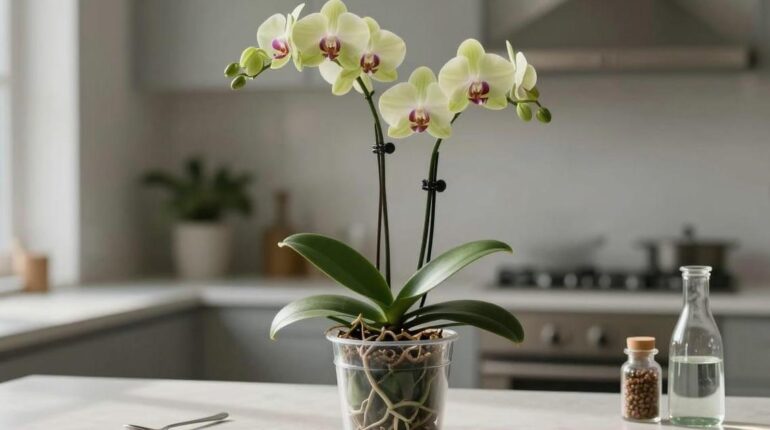
Spectacular blooming begins below the surface, where aerial roots determine the plant’s vitality. Orchid bark substrate inevitably degrades into compact dust after 12 to 24 months, gradually suffocating the root system. This compaction blocks the cellular oxygenation essential for floral energy production.
Biennial repotting in a fresh mix of medium-grade pine bark is the most underestimated intervention. Never use classic potting soil: epiphytic orchids require constant airflow around the roots, as in their natural habitat where they cling to tree trunks. A waterlogged or compressed substrate systematically cancels any blooming attempt, regardless of lighting or fertilization quality.
The exception of Epsom salt deserves clarification. Contrary to viral claims, it does not act as a universal stimulant but as a specific corrective for magnesium deficiency. The symptoms? A characteristic yellowing between leaf veins, distinct from normal aging. In this specific case, dissolve half a teaspoon in four liters of water, applying every two to three months maximum. For the majority of growers using a balanced fertilizer, this supplementation remains superfluous.
Regularly inspect the roots during watering: they reveal the overall state of health. Green and fleshy roots after soaking guarantee intact blooming capacity. Brown and soft tissues signal progressive asphyxiation that sabotages any spike production, regardless of other cultural conditions.
Post-Blooming Strategies for Repeated Cycles
Faded flowers mark a decisive crossroads rather than an end. Two pruning techniques compete, each dictating the plant’s future rhythm. Precise cutting above the second node from the base can stimulate a secondary reblooming in eight to twelve weeks, exploiting the dormant buds of the existing spike. This approach suits vigorous orchids in optimal conditions.
The radical alternative—trimming the entire stem at its base—redirects metabolic energy toward root and leaf strengthening. This strategy produces a more robust spike during the next cycle, with more flower buds. Experienced growers prefer this method after an exhausting bloom or for weakened subjects.
Realistic expectations anchor long-term success. A healthy Phalaenopsis naturally produces one to two blooms annually, each lasting two to six months depending on genetics and environment. These performances far exceed the ephemeral promises of viral hacks. The exceptional duration of orchid flowers—up to six months for some cultivars—testifies to a biology optimized by patience, not shortcuts.
The horticultural quote “the best fertilizer is the gardener’s attention” summarizes this philosophy. Daily observe leaf color, root texture, and substrate moisture. This consistent vigilance decodes the specific needs of each plant, adjusting light and watering according to its discrete signals. The orchid rewards this constancy with floral cascades that defy any improvised chemical intervention, transforming cultivation into a silent dialogue rather than the application of standardized formulas.