📌 Orange-chocolate marble cake: the technique of two colored batters for a spectacular visual effect
Posted 3 March 2026 by: Admin
The Recipe for a Revisited Classic
The traditional marble cake reinvents itself with a bold alliance: orange and dark chocolate. This sophisticated version requires 5 eggs, 125 g of flour, the same amount of melted butter and dark baking chocolate, for a result that breaks away from the blandness of classic versions. Orange zest brings a lemony freshness that contrasts with the bitterness of the cocoa, while orange and black food colorings visually accentuate this gustatory duality.
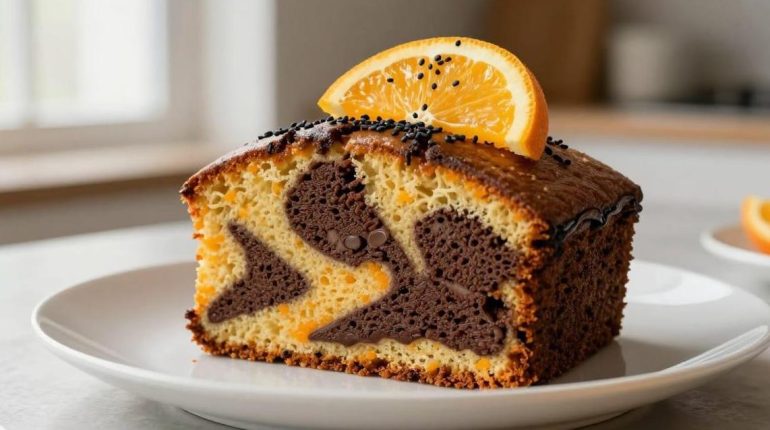
The marbling technique relies on a strategic layering: three heaping tablespoons of orange batter alternate with two of chocolate batter, poured one over the other until exhausted. This unequal distribution naturally creates a target pattern without additional manipulation, as the batter spreads itself in the buttered mold.
The incorporation of whipped egg whites distinguishes this cake from ordinary marble cakes. This step, performed delicately in each of the two separate preparations, guarantees optimal moistness after 40 minutes of baking at 180°C. The dry blade test remains the ultimate validation before unmolding on a rack.
This recipe for six people requires 80 minutes in total, but the bulk of the work lies in synchronization: while the oven preheats, the oranges slowly candy in their syrup, preparing the final touch that will transform this simple cake into a refined dessert.
Preparation of Homemade Candied Oranges
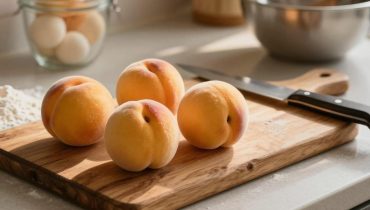
While the oven temperature rises, the preparation of the oranges begins. Two fresh citrus fruits are enough: one squeezed for its juice, the other sliced into translucent rounds using a sharp knife. The thickness matters little; only regularity counts for even cooking.
The syrup is prepared in a saucepan where 60 g of sugar dissolve in the orange juice over gentle heat. At the first signs of simmering, the slices plunge into this amber sugar bath. The simmering lasts for exactly 15 minutes, the time it takes for the peels to soak up the syrup and take on that characteristic semi-firm, semi-melting texture of successful candied fruits.
Unlike industrial techniques, these oranges cool directly in their cooking liquid. This prolonged immersion intensifies their flavor and preserves their flexibility, avoiding the drying out that threatens slices exposed to the air too soon. The remaining syrup can even be reused to lightly soak the cake before glazing.
This parallel preparation optimizes working time. While the citrus fruits slowly soak up the sugar, hands remain free to divide the batter into two distinct bases: one tinted orange and flavored with zest, the other enriched with dark chocolate melted in a double boiler. The timing adjusts naturally, with the candied oranges reaching their optimal point at the precise moment the cake comes out of the oven.
Assembly and Baking of the Marble Cake
The division of the batter marks the decisive turning point of the recipe. On one side, grated orange zest and a few drops of food coloring transform the base into a bright preparation. On the other, 125 g of dark chocolate melt in a double boiler before being incorporated with the black coloring, creating a radical visual contrast from this stage.
The four egg whites separated at the beginning of the recipe now come into play. Whipped into stiff peaks with a pinch of salt, they are delicately folded into the two preparations with enveloping movements. This airy technique directly conditions the final texture: too much vigor breaks the air bubbles, while insufficient care leaves unsightly white lumps.
The buttered and floured mold then receives the strategic alternation of batters. Three heaping tablespoons of orange preparation, then two of chocolate, poured successively into the center without manual spreading. Gravity works alone: each addition pushes the previous layers towards the edges, naturally forming those concentric circles characteristic of a successful marble cake. No fork strokes, no artificial swirls.
Baking at 180°C lasts about 30 minutes, varying according to the oven. A knife blade planted in the heart of the cake is the only reliable test: it must come out dry, without a trace of raw batter. Unmolding is done while warm on a rack, allowing the cake to cool uniformly before receiving its chocolate glaze.
The Chocolate Finish and Plating
The cake cooled on its rack now awaits its final signature. In a saucepan over a double boiler, 125 g of dark chocolate gradually liquefy. Off the heat, 90 ml of full-fat liquid cream are incorporated with circular movements until a perfectly homogeneous texture is obtained. This shiny glaze must be applied quickly before it hardens.
An offset spatula is the ideal tool to evenly distribute the glaze over the entire surface of the cake. From the center to the edges, wide and fluid gestures create a smooth layer that completely hides the underlying marble pattern. The dark chocolate thus amplifies the surprise effect upon cutting, revealing the orange-cocoa contrast hidden under this dark robe.
The candied orange slices, cooled in their syrup since the beginning of the recipe, now find their place. Arranged in a rosette or aligned according to aesthetic preferences, they bring a touch of acidity that balances the richness of the chocolate. Their caramelized translucency catches the light, transforming a classic cake into a visually remarkable pastry.
Black sesame seeds sprinkled in delicate touches add an unexpected crunchy note. This final detail, to be done just before serving, preserves their texture. The tasting then reveals the complete architecture: the two-tone moist cake, the melting glaze, the candied fruitiness, and the toasted sesame compose a symphony of textures and flavors where each element finds its justification.