Italian restaurants make you believe there’s a secret behind that little bowl of oil that comes with the bread — there isn’t. What makes the difference is the quality of the oil and twenty minutes of patience to let the aromas blend together. It’s exactly the kind of thing to prepare on a Saturday afternoon, without a watch, while the oven preheats.
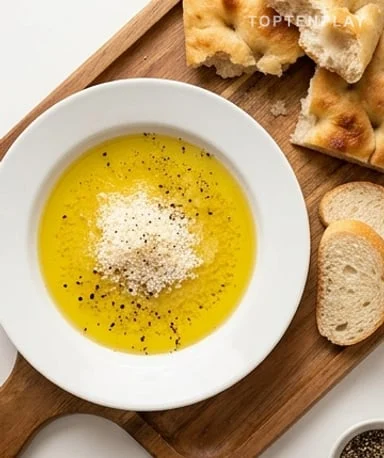
In a wide, shallow dish, the olive oil takes on a deep golden hue where green parsley flecks and garlic bits that have had time to release their pungency into the fat float. The smell is herbaceous and slightly vinegary, with that characteristic peppery background of a good extra virgin oil. When you dip a piece of still-warm baguette into it, the crumb drinks the oil in seconds, catching the herbs and salt crystals along the way. Simple, but it’s precisely this kind of simplicity that leaves a mark.
Why you’ll love this recipe
Ingredient Notes

Six simple ingredients, all capable of making a difference: choose an olive oil you really enjoy drinking.
- Extra virgin olive oil (⅔ cup) : This is the foundation — no need to look for a tasting oil at forty euros a bottle, but avoid overly neutral oils that have no personality. A good fruity table oil, slightly peppery in the throat, does the job perfectly. If yours is very aggressive, cut it with a milder oil to balance without losing character.
- Balsamic vinegar (1 tablespoon) : The vinegar provides a sharp acidity that lightens the oil’s fat and prevents the dip from feeling heavy. An ordinary balsamic works just fine here. Balsamic glaze also works but gives a sweeter, thicker result that clings more to the bread — both are valid, it’s a matter of taste.
- Garlic (2 cloves, finely chopped) : Fresh chopped garlic gives maximum intensity: pungent at first, it gradually rounds out during the resting time in the oil. If you prefer a smoother texture without chunks, replace with half a teaspoon of garlic powder — the result is more discreet but very homogeneous, handy for a mixed group.
- Italian herbs (1 teaspoon) : The dried herb blend — oregano, basil, thyme, marjoram — is the smart shortcut that replicates the aromatic profile of trattorias without having to measure six different jars. If you prefer to go by hand, two-thirds oregano and one-third dried basil gives a very close result.
- Fresh parsley (1 tablespoon, chopped) : Fresh parsley adds a lively vegetal note and some color that contrasts nicely with the golden oil. Dried parsley works just as well — it blends in more discreetly but still releases its aromas during resting. Use half the amount if using dried.
- Grated Parmesan (1 tablespoon, for garnish) : Optional but really not to be overlooked if you have it on hand. Finely grated over the surface just before serving, it adds a salty umami touch that clings to the bread pieces. Choose a real Parmigiano Reggiano grated to order — the pre-packaged powder lacks punch.
Choose your oil with as much care as your bread
The dip hides nothing — no cooking, no transformation, no strong spices that would mask a mediocre oil. What you pour into the jar, you taste directly on your bread. So open the cupboard, take out your oils, and smell them before choosing. A good extra virgin oil has real presence: fruity on the nose, with a slight pepper that stings at the back of the throat. If yours vaguely smells of fat and nothing else, it won’t carry this recipe. It’s not about budget: a decent supermarket oil is a hundred times better than a big industrial bottle with no character.

Chop the garlic at the last minute, not in advance
Freshly chopped garlic releases its aromatic compounds upon contact with the knife — that’s the moment, when the cells are opened, that the power is at its peak. If you chop it in advance and let it sit on the board, it oxidizes and takes on a slight bitterness we don’t want. So chop it just before preparing the dip. For a softer, less aggressive result, you can also crush it with the flat of the knife and a pinch of coarse salt, then scrape it into a paste — it then blends better into the oil without creating chunks that fall to the bottom of the dish.
Assemble the dip in the jar, not in a bowl
The difference between mixing in a bowl and shaking in a jar is greater than it seems. In the jar, the ingredients really distribute: the oil, vinegar, garlic, and herbs collide with each shake and already begin to emulsify slightly. In a bowl, you tend to mix too little, and the vinegar stays at the bottom. Screw on the lid and shake vigorously for about ten seconds — you’ll see the oil take on a slightly cloudy color, a sign that the aromas are circulating. Then set it on the counter and resist the urge to come back to it too soon.
Respect the resting time, even if it seems unnecessary
Thirty minutes at room temperature is when everything really happens. The garlic infuses, the herbs release their essential oils into the fat, the balsamic blends into the whole rather than floating separately. If you serve the dip immediately after shaking, you’ll have something honest but underdeveloped — the flavors will be there but they won’t have spoken to each other yet. Two hours is the maximum worthwhile: beyond that, the garlic starts to dominate a bit aggressively. The ideal window is between forty-five minutes and an hour and a half, depending on the intensity you’re looking for.
Serve in a wide dish, finish with the right details
The geography of serving matters. A wide, shallow dish — a soup plate, a small gratin dish — lets each piece of bread scrape the bottom and pick up the herbs, garlic, and peppercorns. In a small tall ramekin, the crumb only touches the surface of the oil and leaves with little garnish. Shake the jar one last time before pouring, then pour in a single motion so that the herbs and garlic settle on the surface and don’t stick to the walls. Finish with freshly grated Parmesan, a pinch of fleur de sel, and a few turns of the pepper mill — it really makes a difference.

Tips & Tricks
- Slightly warm the bread before serving, not to make it hot, but to make it warm: a cold, dense crumb absorbs oil less easily and the result is heavier. Thirty seconds in a 160°C oven is enough.
- If your oil has been in the refrigerator, take it out fifteen to twenty minutes before preparing the dip — oil that is too cold remains thick and doesn’t mix well with the vinegar and herbs. It should be fluid for the mixture to be homogeneous.
- For a spicier version without changing the proportions, add a small pinch of red pepper flakes when assembling. They diffuse their heat during resting and give a slight lingering warmth without dominating the whole.
- Store leftovers in the closed jar in the refrigerator for up to three days. The oil will partially solidify — that’s normal, it’s not a sign of poor quality. Take it out to room temperature and shake well before serving: it returns exactly to its original texture.

Can you prepare this dip in advance?
Yes, and it’s even recommended. It improves with time: 30 minutes minimum resting, but an hour or two gives an even more developed result. After two hours, the garlic starts to dominate — keep that in mind if you prepare it the day before.
Which bread to choose for this dip?
A slightly warmed baguette remains the safe bet: the crumb is porous enough to absorb the oil quickly without falling apart. Focaccia also works very well, with a denser chew. Avoid sandwich bread or very tight loaves — they slide on the oil rather than absorbing it.
Can I replace fresh garlic with garlic powder?
Absolutely, and it’s not a shameful shortcut. Garlic powder (half a teaspoon) gives a smoother dip, without chunks, with a more homogeneous and slightly less pungent flavor. It’s the best choice if you’re serving the dip to children or people sensitive to raw garlic.
What is the difference between balsamic vinegar and balsamic glaze here?
The vinegar provides sharp acidity that lightens the oil and keeps the dip very fluid. Balsamic glaze is thicker and sweeter — it clings more to the bread and gives a richer, almost caramelized aromatic profile. Both work, it’s a matter of preference.
How long does this dip keep?
Up to three days in the refrigerator in a well-sealed jar. The olive oil will partially solidify in the cold, which is normal — just take the jar out a quarter of an hour before serving and shake vigorously. It returns exactly to its original texture.
Can I add extra toppings?
Yes, the base lends itself well to variations. Finely chopped sun-dried tomatoes add umami and chew. Red pepper flakes add a progressive warmth that diffuses during resting. In summer, a few lemon zest strips finish the dip with an unexpected but very effective freshness.
Olive Oil and Balsamic Dip
Italian
Appetizer
A restaurant-style dip ready in five minutes: extra virgin olive oil, balsamic, garlic, and Italian herbs assembled in a jar, left to infuse for thirty minutes, poured into a shallow dish with good warm bread.
Ingredients
- 160 ml extra virgin olive oil
- 1 tablespoon balsamic vinegar (or balsamic glaze)
- 2 garlic cloves, finely chopped
- 1 tablespoon fresh parsley, chopped (or 1½ teaspoons dried)
- 1 teaspoon dried Italian herbs
- ¼ teaspoon fine salt
- ¼ teaspoon freshly ground black pepper
- 1 tablespoon grated Parmesan, for garnish (optional)
Instructions
- 1Finely chop the garlic and fresh parsley just before preparing the dip.
- 2In a jar with a lid, pour the olive oil, balsamic vinegar, garlic, parsley, Italian herbs, salt, and pepper.
- 3Close the jar and shake vigorously for about ten seconds until the oil takes on a slightly cloudy color.
- 4Let rest at room temperature for at least 30 minutes, up to 2 hours for a more developed flavor.
- 5Shake again before serving, then pour in one motion into a wide, shallow dish.
- 6Garnish with grated Parmesan if desired, and serve immediately with warm bread — baguette or focaccia.
Notes
• Storage: airtight jar in the refrigerator for up to 3 days. Take out 15 minutes before serving and shake well — the oil solidifies when cold, that’s normal.
• For a smoother texture without chunks, replace the 2 fresh garlic cloves with ½ teaspoon garlic powder.
• For more character: finish with a few grains of fleur de sel and a generous turn of the black pepper mill just before serving.
• Spicy variation: add a pinch of red pepper flakes when assembling — they infuse during resting and give a progressive warmth in the mouth.
Nutrition Facts (per serving, estimated)
| 331 kcalCalories | 1 gProtein | 2 gCarbs | 36 gFat |