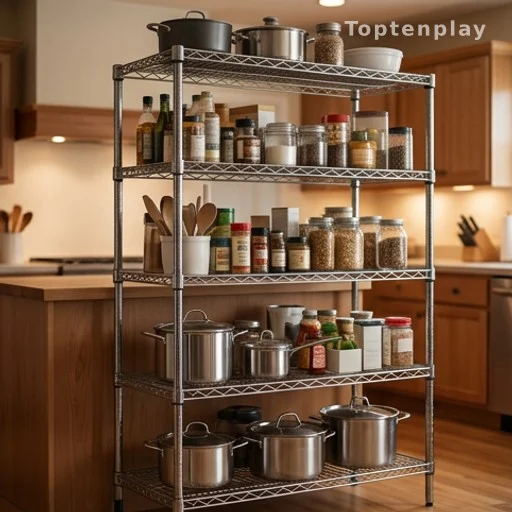
The reality is more straightforward. When a large wire rack turns up in a residential kitchen, it almost always belongs to one of three well-defined categories of practical kitchen equipment. The confusion stems largely from the fact that commercial-grade tools rarely make their way into home settings, so most people simply never encounter them.
Identifying the object correctly matters for practical reasons: it determines whether the item is worth keeping, repurposing for storage, or passing along to someone who can use it professionally.
Why professional equipment ends up in home kitchens
Restaurant supply stores have been open to the general public for decades, making it easy for home cooks to purchase commercial-grade kitchen equipment. Items like speed racks, sheet pans, and heavy-duty shelving are bought for their durability and capacity — and are often left behind when homeowners move, leaving the next occupant to puzzle over their purpose.
The most likely culprit: a commercial speed rack built to match oven width
The single most probable explanation is a commercial speed rack — also called a bakery rack. These are tall, heavy-duty wire structures manufactured to a very specific dimension: roughly 26 inches wide, which matches the exact width of a standard oven door.
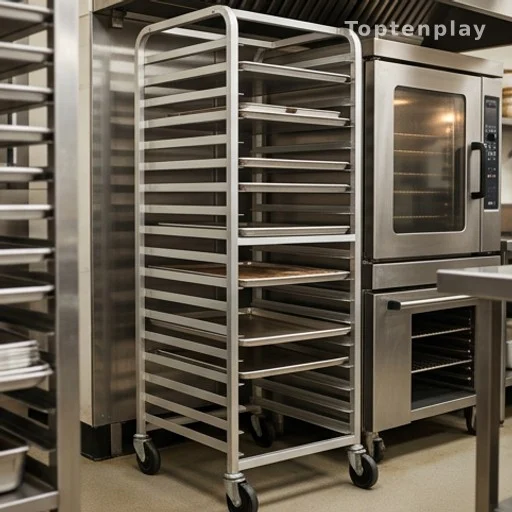
That precise sizing is intentional. In professional bakeries and restaurant kitchens, speed racks are rolled directly up to the oven so that full sheet pans can be slid in and out without lifting heavy, hot loads. Many models sit on caster wheels at the base, which is a reliable identifying feature.
Finding one in a residential kitchen points to a previous owner who was a serious home baker, a former food industry professional, or simply someone who bought the rack at a restaurant supply store to gain extra pantry storage. These racks are sold to the general public and are prized for their durability and capacity.
A baker’s rack or microwave stand: when the item looks more like furniture
If the rack looks less industrial and more like a piece of kitchen furniture — with flat or decorative wire shelves, perhaps in black wrought iron or chrome — it is most likely a baker’s rack or microwave stand.
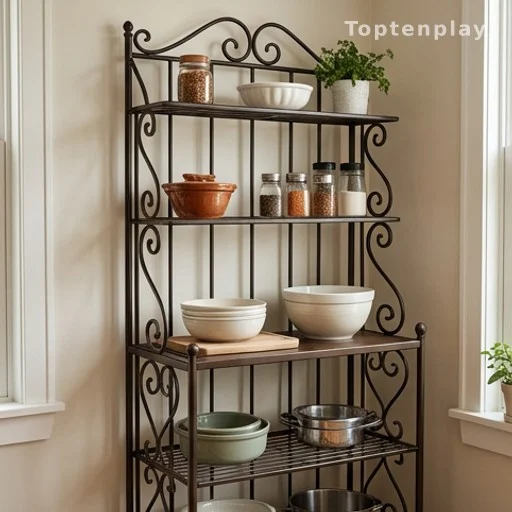
These items are traditionally designed with the same footprint as a standard oven or countertop microwave, allowing them to fit neatly into kitchen alcoves or flush against a wall. Their purpose is to provide additional vertical storage for small appliances, cookbooks, potted herbs, or pantry items without consuming extra floor space.
Suggested Posts
Can you spot the large dog hiding in this kitchen photo?
A photo shared by Christina Suvo and reported by 7 News Perth has been fooling viewers around the world: what looks like a perfectly…