📌 Moldy bread: why removing the visible part is not enough to eliminate the risk to your health
Posted 7 February 2026 by: Admin
Understanding Mold: An Invisible Danger In Your Kitchen
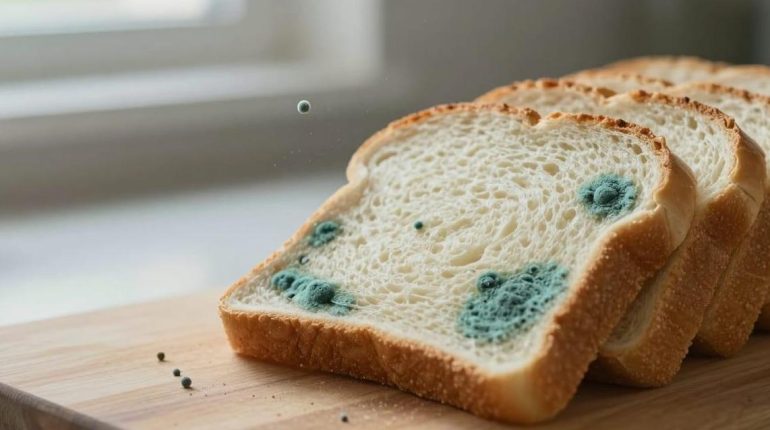
Behind the greenish spot spreading across your bread lies a far more worrying microscopic reality. This visible mold represents only the tip of the iceberg of an already widespread underground contamination. Far from being a simple aesthetic flaw, it reveals the presence of a multicellular fungus whose invisible filaments — called hyphae — have colonized the entire crumb.
Food molds fall into three main families. Penicillium, recognizable by its blue-green hue, belongs to the same lineage as the antibiotic but offers no therapeutic virtues once ingested. White molds, often confused with residual flour, signal an early stage of infection. Finally, black or gray strains — Aspergillus and Rhizopus — potentially produce mycotoxins dangerous to the body.
These fungi thrive in warm, humid environments, turning your countertop into an ideal incubator. Unlike hard cheeses where contamination remains localized, porous bread offers a propagation ground without borders. Removing the moldy area is equivalent to plucking a leaf to eliminate the roots of a tree: the invisible ramifications have already infiltrated apparently healthy areas, making any safe cutting illusory.
This silent spread exposes you to real risks, beyond simple alteration of taste.
The Three Real Threats Of Moldy Bread
This invisible contamination creates three distinct dangers, the severity of which goes far beyond simple digestive discomfort. Understanding these mechanisms helps measure why no amount of cutting guarantees food safety.
First risk: underground hyphae cross the porous structure of the bread long before visible spots appear. These microscopic filaments colonize the entire crumb, carrying fungal compounds into areas that appear perfectly healthy. Since bread is an aerated food, unlike compact cheeses, physical barriers do not exist to slow this progression.
Second threat: certain molds secrete heat-resistant mycotoxins. Toasting or cooking does not neutralize these toxic substances which, when accumulated in the body through repeated exposure, can affect the liver and weaken the immune system. Vulnerable populations — children, the elderly, immunocompromised patients — show increased sensitivity to these compounds, even at low doses.
Third danger: inhalation of spores released when handling contaminated bread. These microscopic particles trigger allergic reactions or respiratory issues without the need to consume the food. Opening the bag or cutting the moldy area is enough to disperse these pathogens into the surrounding air.
Given these facts, the only safe response is to discard the entire product at the first sign of mold.
Allergic Reactions And Respiratory Dangers
Beyond ingestion, simple contact with moldy bread exposes you to immediate respiratory risks. Spores released when opening the bag or handling the product contaminate the surrounding air and enter the airways, triggering reactions without a single bite being swallowed.
These microscopic particles cause various allergic manifestations in sensitive individuals: sneezing, nasal congestion, eye irritation, or skin itching. Individuals with asthma or pre-existing respiratory allergies suffer an aggravation of their symptoms, with potentially severe attacks sometimes requiring medical intervention.
Occasional exposure to a few spores generally remains harmless for a healthy organism. But repeated contact — for example, by keeping moldy bread in the kitchen for several days — increases the allergenic load and can progressively sensitize even initially resistant people. Young children and the elderly, whose immune systems show increased or decreased reactivity, manifest a particular vulnerability to these fungal attacks.
This airborne dimension of the danger explains why quickly eliminating contaminated bread is not just a hygienic reflex, but a concrete health protection measure. Prevention therefore begins long before consumption, with daily storage and preservation habits.
Safe Storage: Preventing Rather Than Discarding
This health-oriented approach finds its logical extension in the adoption of appropriate preservation methods. Rather than systematically managing contamination situations, an effective preventive strategy drastically reduces risks while limiting food waste.
Mold thrives in warm, humid environments. Storing bread in a sealed bag at room temperature creates exactly these ideal conditions for fungal proliferation. The refrigerator slows this process but accelerates staling. The optimal solution combines protection against humidity and a controlled temperature: slicing the bread and then immediately freezing unused portions preserves texture and freshness for several weeks while blocking spore development.
For consumption within three days, prefer a ventilated container — a perforated metal bread box or a cloth bag — which maintains sufficient air circulation without excessively drying out the crumb. Visually and olfactorily checking the bread before each use becomes a simple but crucial reflex: a sour smell or an abnormally damp texture signals early contamination, even without visible spots.
These daily actions transform bread management from a passive reaction to mold into active control of storage conditions. Food safety relies less on emergency decisions regarding a compromised product than on preventive habits rooted in the understanding of contamination mechanisms.