📌 Koulourakia — Greek Easter Orange Cookies
Posted 28 March 2026 by: Admin
Homemade holiday cookies are always better than any store-bought pastry — and Koulourakia are the proof. These buttery orange twists come from Greece, but once you taste them, you quickly understand why they have crossed borders.
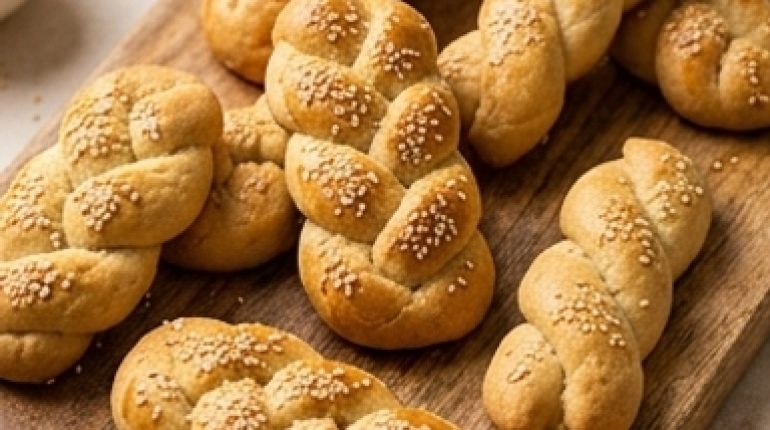
Hold one in your hand: it feels light, almost surprising for its size. The crust cracks slightly under your fingers, the sesame seeds provide a little grip. Inside, the crumb is tender, with a lingering scent of butter and orange zest. They are golden like light caramel, uniform, with those regular little twists that provide all the charm.
Why you’ll love this recipe
Ingredient Notes
Everything you need for these cookies: simple ingredients, but the result is stunning.
- The butter : Use unsalted butter, not semi-salted. Above all, take it out in advance — it must be at room temperature, soft but not melted. When you beat it, it should become pale and creamy, almost like whipped cream. This step guarantees the soft interior.
- The orange : We use both: the zest and the juice. The zest carries most of the aroma — grate it finely, avoiding the white part which is bitter. Use an organic orange if possible, otherwise rinse the skin well. The juice adds moisture and a light acidity that lightens the dough.
- The eggs : Incorporate them one by one, not all at once. This is important so the dough remains smooth and homogeneous. One of them will also be used to glaze the cookies before baking: beaten with a little milk, it gives that beautiful amber color to the surface.
- The sesame seeds : Technically optional, but hard to skip once you’ve tasted them. They add a slight crunch and a toasted nutty flavor that perfectly complements the orange. Use raw seeds — they toast during baking and the kitchen fills with the smell of oriental pastry.
Start with the butter
This is the foundation of everything. The softened butter goes into the large bowl, and we beat it for a few minutes until it is truly creamy — pale and airy. Add the sugar gradually, not all at once. The mixture gains volume. This is when we stir in the orange zest: the aroma that rises is immediate, bright, and a bit floral. Then add the eggs one by one, alternating with the orange juice and vanilla, continuing to mix between each addition so the dough doesn’t split.
Attack the dough
The flour comes last, in small quantities. Stop beating and mix with a spatula or by hand — at this stage, overworking the dough makes it hard and dry. It should be supple, slightly sticky but not liquid, and pleasant to hold. Form a ball, cover with plastic wrap, and let it rest in the fridge. Thirty minutes minimum, non-negotiable. Cold dough is much easier to shape: it no longer sticks and holds its form.
Shaping — quick and easy
Take walnut-sized portions of dough. Roll each portion into a log about twenty centimeters long between your palms — the dough is cool, soft under the fingers, a bit like high-quality modeling clay. Fold the log in half and twist the two strands around each other. Simple. The braid doesn’t need to be perfect. Small imperfections disappear during baking, and anyway, it’s this artisanal look that makes the charm.
The glaze — the detail that makes the difference
Before putting them in the oven, brush each cookie with an egg-milk wash using a pastry brush. Thirty seconds of work. This is the step that provides the color — that deep golden brown, almost like a light caramel, that makes them mouth-watering. Sprinkle with sesame. Off to the preheated oven at 190°C for ten to twelve minutes. When the edges start to take on that mahogany hue and the apartment smells like a bakery, you’ve won.
Cooling — no cheating
Out of the oven, the cookies still seem a bit soft in the center. That’s normal. They harden as they cool, and that’s when the final texture forms: crunchy on the surface, tender and slightly flaky inside. Five minutes on the tray, then on a wire rack. If you taste them while still warm, the crumb crumbles slightly and the orange scent is more intense — that’s how you measure a successful recipe.
Tips & Tricks
- Do not skip the fridge step: warm dough sticks, deforms, and the cookies spread during baking. Thirty minutes is truly the minimum — one hour is even better.
- Avoid flouring the work surface when you shape the cookies. It dries them out and changes the final texture. If the dough is still a bit sticky, put it back in the fridge for ten minutes.
- For storage, a metal tin is ideal — no plastic which makes everything soft. They stay perfectly crunchy for four to five days, making them an ideal dessert when hosting.
How long do koulourakia keep?
In an airtight metal tin at room temperature, they keep for 4 to 5 days without losing their texture. Avoid plastic or the fridge — humidity softens the crust and ruins all the work.
Can I prepare the dough in advance and freeze it?
Yes, the dough freezes very well, shaped into raw cookies on a tray, then transferred to a freezer bag. Bake them directly without thawing, adding 2 to 3 minutes of baking time. Baked cookies can also be frozen — just let them return to room temperature.
Why did my cookies spread and flatten during baking?
The dough was probably not cold enough before shaping. Warm butter melts too quickly in the oven and the cookies lose their shape. Thirty minutes in the fridge before shaping is the minimum — one hour gives better results.
Can the orange be replaced by another citrus fruit?
Absolutely. Lemon works very well and gives a brighter, less sweet result. Tangerine brings a slightly different sweetness. In any case, use both the zest and the juice so the flavor is prominent.
Are sesame seeds mandatory?
No, koulourakia also exist without them. But the sesame toasted during baking adds a crunch and nutty flavor that really complements the orange. If you don’t have any, poppy seeds or flaked almonds are a good alternative.
The dough sticks to my hands too much, what should I do?
Do not flour the work surface — it dries out the cookies and changes the texture. Simply put the dough back in the fridge for an additional 15 to 20 minutes. Cold is the only effective solution against stickiness.
Koulourakia — Greek Easter Orange Cookies
Greek
Dessert
Typical braided cookies from Greek Easter, buttery and delicately orange-flavored, crunchy outside and tender inside. Simple to make, impossible to stop eating.
Ingredients
- 500g all-purpose flour
- 200g unsalted butter, softened at room temperature
- 150g granulated sugar
- 2 whole eggs
- 60ml fresh orange juice (about 1 orange)
- 1 orange zest (preferably organic)
- 1 tsp vanilla extract
- 1 tsp baking powder
- ¼ tsp baking soda
- 1 pinch salt
- 3 tbsp sesame seeds (for topping)
- 1 egg beaten with 1 tbsp of milk (glaze)
Instructions
- 1In a medium bowl, whisk together the flour, baking powder, baking soda, and salt. Set aside.
- 2In a large bowl, beat the softened butter with an electric mixer until creamy and pale, about 2 minutes.
- 3Add the sugar gradually while continuing to beat, then incorporate the orange zest.
- 4Add the eggs one by one, alternating with the orange juice and vanilla, mixing well between each addition.
- 5Incorporate the flour in several batches with a spatula until you have a supple and homogeneous dough. Do not overwork.
- 6Form a ball, cover with plastic wrap and refrigerate for at least 30 minutes.
- 7Preheat the oven to 190°C and line two baking sheets with parchment paper.
- 8Take walnut-sized portions of dough and roll each portion into a 20 cm log between your palms.
- 9Fold each log in half and twist the two strands together. Place on the baking sheet spaced 3 cm apart.
- 10Brush each cookie with the egg-milk wash, then sprinkle with sesame seeds.
- 11Bake for 10 to 12 minutes until they are golden like light caramel. Let cool for 5 minutes on the sheet before transferring to a wire rack.
Notes
• Storage: airtight metal tin at room temperature, 4 to 5 days. Do not refrigerate.
• Make-ahead: raw shaped cookies can be frozen on a tray. Bake directly from frozen, adding 2-3 minutes.
• Variation: replace the orange juice with lemon juice for a brighter result. You can also flavor with a tsp of cinnamon in the dough for a spicier version.
Nutrition Facts (per serving, estimated)
| 130 kcalCalories | 2gProtein | 18gCarbs | 6gFat |