📌 Kitchen: why the cupboard above the fridge is the most underutilized storage space in your home
Posted 18 January 2026 by: Admin
Forgotten Appliances: Transforming A Dead Space Into A Strategic Storage Zone
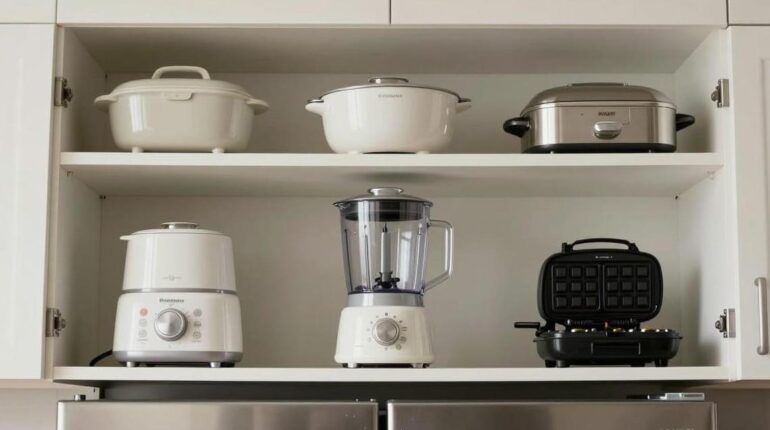
These cupboards perched above the refrigerator often collect dust, ignored by most cooks. Yet, they represent an ideal storage solution for small appliances that are only used occasionally. The food processor used only for large preparations, the blender reserved for weekend smoothies, or the waffle maker taken out three times a year are perfect candidates for this high-level relocation.
The selection logic is based on a simple criterion: frequency of use. Appliances used less than once a week deserve to be moved to these upper shelves, thus freeing up worktops and easily accessible cupboards for daily equipment. This strategic redistribution immediately transforms the ergonomics of your kitchen.
Accessibility is certainly a challenge with these high storage areas, but a stable stool or a step ladder solves this occasional constraint. The effort of a few seconds to retrieve an appliance remains negligible compared to the benefits of a now clear kitchen. Work surfaces can breathe again, drawers stop overflowing, and each zone now fulfills its optimal function.
This methodical reorganization reveals the unsuspected potential of a space deemed impractical, offering several cubic meters of additional storage without any material investment.
The Container Method: Taming Chaos With Bins And Baskets
This vertical reorganization, however, requires a rigorous structure to avoid messy accumulation. The use of bins and baskets transforms these high cupboards into truly functional storage systems, where each object finds its assigned place rather than being piled up anarchically.
The principle remains simple: group by categories in suitable containers. A basket for rarely used baking accessories, a bin for specialized utensils, another for holiday tablecloths. This segmentation avoids the dreaded avalanche effect when looking for a specific item at the back of the cupboard. Rather than moving everything to reach the desired object, simply take down the relevant container.
The dimensions of the bins deserve attention: they must slide easily into the available space while maximizing usable volume. Transparent or labeled models offer the added advantage of instantly identifying the content without unnecessary handling. This immediate visibility drastically reduces search time and associated frustrations.
This container method maintains order over time. Each object automatically returns to its place after use, guaranteeing a lasting organization that stands the test of daily life. The system regulates itself, transforming an organizational black spot into a silent asset.
Maximizing Storage Capacity: Exploiting Every Nook And Cranny
This structuring by containers naturally leads to a more ambitious vision: freeing up daily work areas by intelligently redistributing rarely used objects. The cabinets above the refrigerator then become a strategic offloading space, allowing for the clearing of cluttered worktops and saturated drawers.
Beyond appliances, these cupboards ideally accommodate seasonal utensils. The summer ice cream maker, Christmas log molds, serving dishes for special occasions: all essential items a few times a year, but bulky the rest of the time. Rather than occupying precious space at eye level, they find their natural reserve here.
The key lies in controlled accessibility. A small stable step ladder is usually enough to reach these heights without perilous acrobatics. Some even organize a seasonal rotation system: bringing down cake molds in the spring, putting up canning equipment at the end of summer. This dynamic management transforms simple storage into a living system, adapted to evolving needs.
The gain is concretely measurable: several cubic meters recovered in high-traffic areas, a visually streamlined kitchen, a regained capacity for truly daily utensils. These few centimeters above the fridge ultimately hold considerable potential.
The Art Of Optimizing Neglected Spaces: Towards A Functional Kitchen
This considerable potential fully materializes when these cupboards are integrated into a global organizational strategy. Efficiency does not lie in accumulation, but in the intelligent circulation of objects according to their frequency of use. A functional kitchen naturally prioritizes: what is used daily remains within reach, what is used occasionally migrates upwards.
The most telling example concerns tableware. Sunday plates, cocktail glasses, presentation dishes: essential pieces but mobilized only a few times a month. Storing them above the refrigerator instantly frees up two shelves in the main cupboards, now available for truly daily utensils.
This redistribution generates measurable benefits. Search time decreases drastically when each object has its defined zone. Visual stress evaporates in the face of clear worktops. Maintenance is simplified thanks to less cluttered surfaces. Some even notice a reduction in food waste, as provisions become visible again in the desaturated main cupboards.
The transformation happens gradually. Start by identifying three appliances or sets of utensils currently poorly stored. Move them upwards. Observe for two weeks. Adjust if necessary. This empirical approach quickly reveals that these few neglected cubic meters constitute one of the most accessible optimization levers in any kitchen.