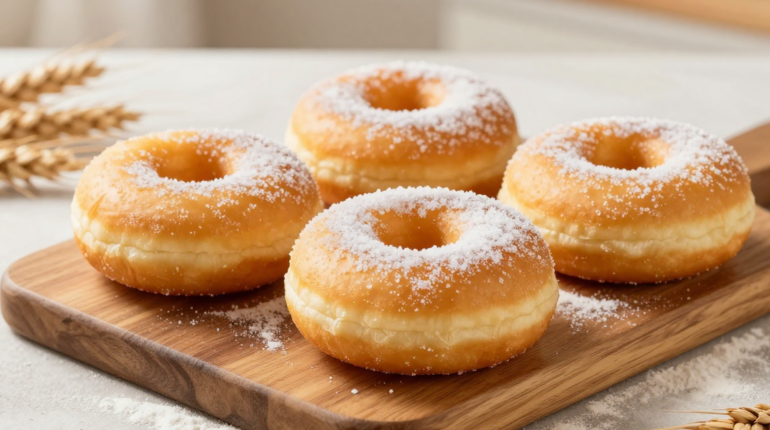
📌 Homemade stuffed donuts: the complete recipe with leavened dough and gourmet filling
Posted 3 January 2026 by: Admin
Homemade Donut Dough Recipe: The Essential Basics
Six ingredients are enough to make filled donuts worthy of a professional bakery. The recipe relies on precise proportions that guarantee an airy and soft texture: 1 cup of milk, 1 tablespoon of dry yeast, 3 tablespoons of powdered sugar, 2 tablespoons of vegetable oil, 2 1/4 cups of flour, and 1 teaspoon of salt.
Milk constitutes the essential liquid base that activates the yeast and hydrates the flour. Powdered sugar brings not only a light sweetness but also feeds the yeast to optimize fermentation. Vegetable oil plays a crucial role in obtaining a tender crumb and prolonged shelf life, while salt balances the flavors and strengthens the gluten structure.
The flour, measured exactly at 2 1/4 cups, determines the final consistency of the dough. This precise amount allows for a texture that is neither too sticky nor too dry, facilitating shaping and ensuring even cooking. Dry yeast, the key ingredient for success, will transform this simple preparation into puffed and airy donuts.
These meticulously calibrated proportions form the foundation of an accessible recipe, where each component fulfills a specific technical function to guarantee an optimal result with every preparation.
Dough Preparation: Technique and Precise Measurements
Dry yeast triggers the fermentation process that will transform these basic ingredients into a living, puffed dough. Its activation depends directly on the milk-powdered sugar mixture, which creates the warm and nutritious environment necessary for its development. This initial step determines the entire success: poorly activated yeast will produce dense and compact donuts.
Vegetable oil is then added to soften the gluten structure formed by the flour. Without it, the dough would become elastic but brittle after cooking. The 2 tablespoons of oil guarantee a soft texture that will last for several hours after preparation, preventing the rapid drying typical of amateur donuts.
The flour dosage of 2 1/4 cups represents the perfect balance between liquidity and consistency. A smaller amount would produce a dough that is too sticky, impossible to shape without excessive flour addition during kneading. Conversely, too much flour would create hard and floury donuts. This precise proportion allows for a flexible dough, slightly tacky but workable, which will rise uniformly.
Salt, although present in a small quantity, regulates yeast activity and strengthens gluten bonds. It prevents too rapid fermentation that would weaken the structure and improves preservation. This mastered base will serve as the setting for the creative fillings that will personalize each donut.
Fillings: The Customizable Element of Stuffed Donuts
Once the dough is mastered, the filling transforms these neutral donuts into distinctive gourmet creations. The source article identifies a section dedicated to filling ingredients, positioned after the basic components. This structural separation emphasizes that customization is the very essence of the stuffed donut, far beyond a simple standardized recipe.
The filling options detailed in the rest of the content promise a variety adapted to individual preferences. Unlike the dough which requires strict proportions, the filling allows for experimentation: pastry creams, fruit jams, chocolate ganaches, or original preparations. This creative freedom allows each batch to be adapted to occasions, seasons, or current cravings.
The explicit mention of filling ingredients “to follow” reveals a methodical approach: separating base manufacturing and filling elaboration avoids confusion during production. A cook can thus prepare several identical doughs, then diversify the fillings according to everyone’s taste. This modularity facilitates organization for large quantity preparations or family events.
This progressive structure naturally leads to the actual filling techniques, the final step that will require as much precision as the initial manufacturing to obtain generously filled donuts without bursting.
Structure and Organization of the Complete Recipe
This architecture in distinct sections responds to a proven culinary logic: isolating each preparation phase to avoid execution errors. The division between dough and filling allows for handling cold and hot steps separately, thus optimizing time management in the kitchen. An amateur baker can prepare the dough the day before, let it rest in the refrigerator, and then focus on the fillings on the day itself without rushing.
The progressive format across several pages is not an editorial gimmick, but a practical response to production constraints. Consulting a complete recipe on a single screen overloads attention when hands are floured. Fragmenting the process allows for step-by-step navigation, validating each phase before moving to the next. This approach reduces the risk of forgetting ingredients or confusion in the order of operations.
The methodical organization of the steps reflects the actual chronology of manufacturing: activating the yeast, rising the dough, shaping the donuts, preparing the fillings, frying, and then filling. Each section corresponds to a distinct workstation, facilitating planning for those cooking in confined spaces. This rational segmentation transforms a complex recipe into a succession of simple and manageable tasks.
This rigorous structuring leads directly to the cooking and filling techniques, where precision and timing determine the final success of the donuts.