Homemade jam is often talked about as a well-organized weekend project involving a copper basin and matching aprons. The reality? Three ingredients, an ordinary saucepan, and an hour of your time. That’s really it.
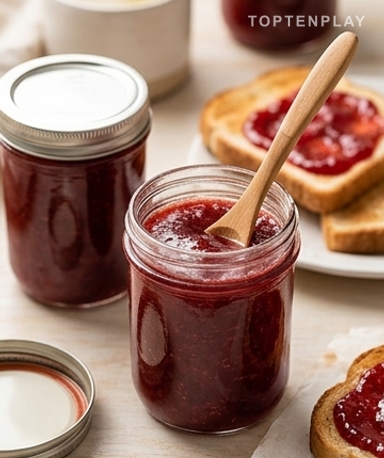
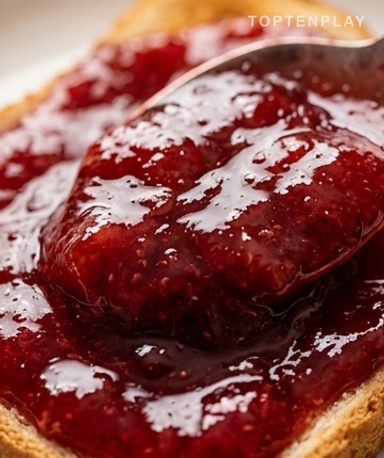
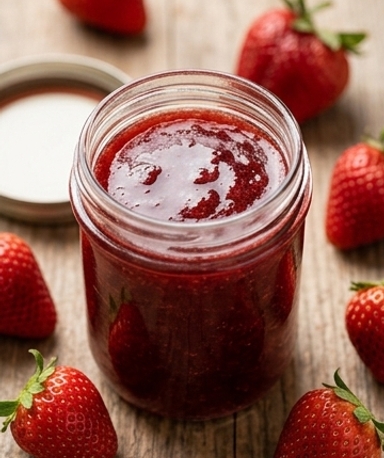
Open the jar and a puff of warm, sweet strawberry hits you right in the face — not the chemical scent of supermarket jams, but something wilder and truer. The color oscillates between cherry red and deep burgundy depending on the maturity of the fruit. Place a spoonful on your tongue: it’s dense, slightly tart at the edges, with small pieces of strawberry still resisting under your tooth. It’s like summer put into a jar.
Why you’ll love this recipe
Ingredient Notes
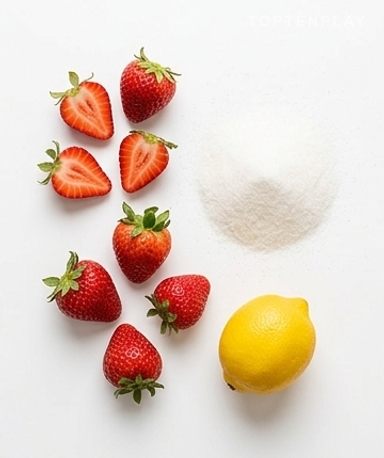
Three ingredients are enough: ripe strawberries, sugar, and a squeeze of lemon.
- Strawberries : Gariguette, Mara des Bois, Charlotte — fragrant varieties make all the difference. Avoid the large, tasteless strawberries sold year-round: they are watery and the jam will be bland. You want strawberries that are red to the core and smell strong when you hull them. They don’t need to look perfect — the small, slightly crooked ones are often the best.
- Sugar : Classic white sugar does the job perfectly. Special jam sugar with added pectin exists for a faster set, but it gives a stiffer, less natural texture. For this recipe, ordinary sugar is more than enough.
- Lemon juice : It does two things at once: it helps the jam set — strawberry’s natural pectin activates better in an acidic environment — and it protects the color during cooking. One tablespoon from half a squeezed lemon. No bottled juice; it doesn’t have the same effect.
Maceration, the step we skip too often
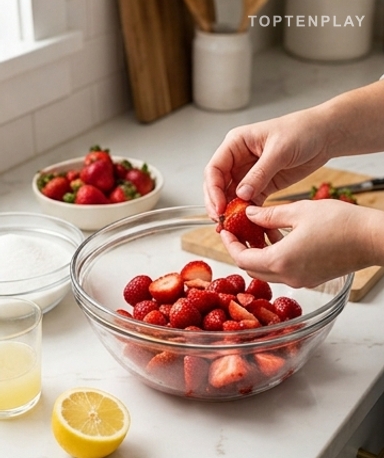
Cut your strawberries into pieces in a large bowl, pour in the sugar and lemon, and let rest for at least an hour. You’ll see the sugar slowly dissolve into a pink-red syrup rising up the sides of the bowl. This step isn’t mandatory, but it really changes the final texture. The fruits hold their shape better, the jam sets more easily, and the taste is more concentrated. If you’re in a hurry, you can skip straight to cooking — it will just be a bit more liquid at the start.
Cooking, we stay right here
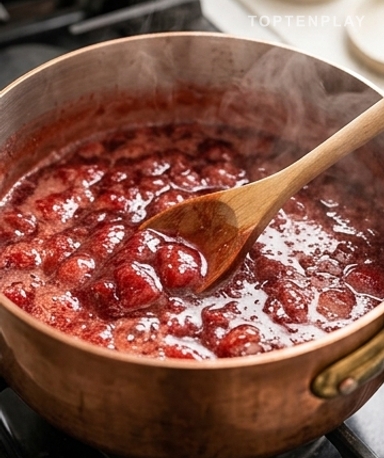
Pour everything into a heavy-bottomed saucepan. Medium heat. For the first few minutes, a pale pink foam will form on the surface — remove it with a spoon; it makes the jam clearer and less bitter. Then the mixture begins to really bubble, with that sound of thick bubbles bursting differently than simple boiling water. Stir often, especially at the end of cooking when it reduces and the bottom starts to catch. Count 20 to 30 minutes from the first boil.
The cold plate test
Put a small plate in the freezer before you start — it’s the only measurement tool you need here. When you think the jam is ready, drop half a spoonful on it and wait 30 seconds. Tilt the plate: if the jam slides slowly and forms a slightly wrinkled film, it’s good. If it runs like water, cook for another five minutes. If it’s already very firm and doesn’t move at all, you’ve slightly overcooked it — it’s not catastrophic, but note it for next time.
The jars, the moment it becomes real
Sterilize your glass jars in the oven at 100°C for ten minutes, or simply pour boiling water in them and let them air dry. Pour in the still-boiling jam, close the lids immediately, and turn the jars upside down. This inversion creates a partial vacuum that extends shelf life. Leave them like that until completely cool — you’ll hear a slight click when the lid sets inward. That’s the sound that confirms it’s well sealed.
Tips & Tricks
- Don’t cook too long ‘just to be sure’ — overcooked jam becomes gelatinous and loses the fresh strawberry taste. Slightly runny when hot, it will firm up as it cools.
- If your strawberries aren’t very fragrant, add a split vanilla bean during cooking. It doesn’t mask the strawberry; it rounds it out and gives it depth.
- For a smoother texture, mash the fruit with a fork during cooking. For whole pieces, touch it as little as possible. Both versions are good — it’s just a matter of what you like.
How long does homemade jam keep?
Properly sterilized jars, sealed hot and turned upside down, can be kept for 12 months in a cool, dry place. Once opened, the jar keeps for 2 to 3 weeks in the refrigerator. Always use a clean spoon to avoid introducing bacteria.
My jam is too liquid, what happened?
Two possible causes: it wasn’t cooked long enough, or the strawberries were too watery. Simply put the jam back on the heat for a few extra minutes and redo the cold plate test. It will also firm up slightly as it cools — wait until it is completely cold before judging.
Can I use frozen strawberries?
Yes, it works. Frozen strawberries release a lot of juice when thawing, so maceration is not necessary. The jam will be a bit more liquid at first — just extend the cooking by a few minutes. The taste will be less vibrant than with fresh seasonal strawberries, but honestly fine outside of June.
Can I reduce the amount of sugar?
Yes, down to 200 g for 500 g of strawberries if you want something very fruity. Below that, the jam sets less well and doesn’t keep as long — sugar acts as a preservative. With less sugar, consume within 3 months and keep even closed jars in the refrigerator.
Do I absolutely need a jam copper basin?
No. A large, heavy-bottomed saucepan does the job very well. Ideally, use a wide container so that water evaporates quickly and the jam thickens faster. A small, high saucepan prolongs cooking time and can result in a less clear texture.
How to sterilize jars simply?
Place open jars and their lids on the oven rack at 100°C for 10 minutes. Alternatively, fill them with boiling water, let sit for 5 minutes, empty, and let dry upside down on a clean towel. Do not wipe them dry with a towel — that reintroduces bacteria.
Homemade Strawberry Jam
French
Preserves & Jam
A 100% natural strawberry jam, without preservatives or added pectin, made with three ingredients. Fruity, slightly tart, and incomparable to industrial versions.
Ingredients
- 500g ripe fresh strawberries
- 275g white sugar (adjust between 250g and 300g to taste)
- 1 tablespoon fresh lemon juice (about 1/2 lemon)
Instructions
- 1Wash the strawberries in cold water, drain, hull, and cut into halves or quarters depending on size.
- 2In a large bowl, mix the strawberries with the sugar and lemon juice. Let macerate for 1 to 2 hours until a syrup forms.
- 3Pour everything into a heavy-bottomed saucepan. Heat over medium heat, stirring regularly.
- 4Skim off the pale pink foam that forms on the surface at the start of cooking.
- 5Cook for 20 to 30 minutes over medium-high heat, stirring often, especially towards the end of cooking.
- 6Test for setting: place a spoonful on a cold plate. If it sets slightly and forms a wrinkled film when tilting the plate, the jam is ready.
- 7Pour immediately into sterilized jars, close the lids, and turn the jars upside down until completely cool.
Notes
• Shelf life: closed jars up to 12 months in a cool, dry place. After opening, 2 to 3 weeks in the refrigerator.
• Variations: add a split vanilla bean during cooking for a smoother version, or a few fresh mint leaves at the end of cooking for a summery touch.
• Make ahead: maceration can be done overnight in the refrigerator — the fruit will be even better infused the next morning.
Nutrition Facts (per serving, estimated)
| 50 kcalCalories | 0gProtein | 13gCarbs | 0gFat |