📌 Homemade aloe vera oil: the simple recipe for stronger hair and a soothed scalp
Posted 19 February 2026 by: Admin
Aloe Vera Oil: A Natural Treasure for Your Hair
For centuries, aloe vera has held a central place in the beauty rituals of Mediterranean, African, and Asian civilizations. This is no coincidence: behind its fleshy leaves lies a nutritional composition of remarkable density.
The plant contains vitamins A, C, and E, associated with cellular renewal, as well as vitamin B12 and folic acid, directly linked to hair health. But it is its enzyme content that particularly catches the attention of specialists: these active molecules gently eliminate residues accumulated on the scalp without attacking the hair fiber. Added to this are amino acids and minerals that promote daily scalp comfort.
Raw gel, directly extracted from the leaf, is certainly effective — but difficult to apply uniformly. This is where infused oil comes in. By integrating the gel into a carrier vegetable oil, the active compounds of aloe vera combine with the nourishing fatty acids of the oil, thus optimizing the distribution of hydration along the hair shaft and on the scalp.
The result: a more practical, versatile, and better-absorbed treatment — whose potential benefits deserve precise examination.
What Aloe Vera Oil Can Really Do For Your Hair
This gel-oil combination is not just a matter of texture: it is the key that transforms a traditional treatment into a targeted and measurable one.
With regular use, aloe vera oil can reduce the appearance of excessive shedding, hydrate a dry scalp, alleviate mild discomfort, and bring softness and natural shine to the hair fiber. Concrete benefits, provided they are not confused with promises that no natural treatment can keep.
Because honesty is required here: aloe vera oil does not regrow hair, nor does it stop clinical alopecia. Any claim to the contrary is marketing, not science. What this treatment actually does is create favorable conditions for a healthier scalp — and that is precisely where its value lies.
A well-hydrated scalp, cleared of residues and soothed, is a naturally more conducive environment for visually stronger, more resistant, and less fragile hair. This indirect mechanism — supporting the hair environment rather than acting directly on growth — is common to most effective natural treatments.
Patience is therefore a full-fledged ingredient of this routine. Results are long-term, and their quality depends as much on the regularity of application as on the preparation method itself.
Step-by-Step Recipe: Making Your Own Aloe Vera Oil at Home
This quality of results begins with the preparation — and good news: the recipe is accessible to everyone.
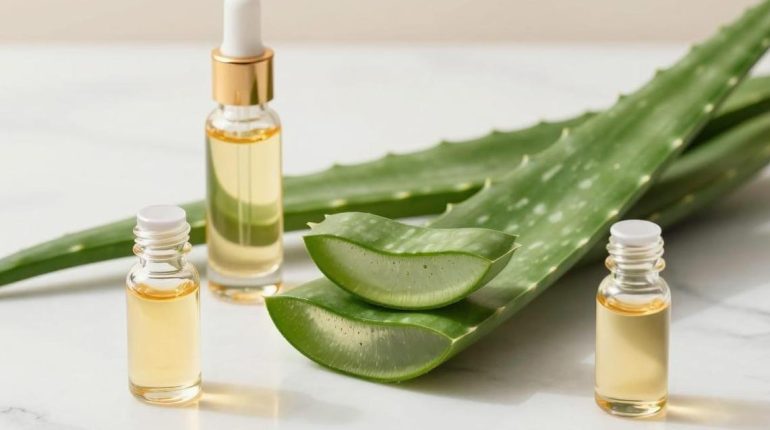
You need 2 to 3 large fresh aloe vera leaves and 1 cup of vegetable oil. Wash the leaves, remove the thorny edges, then extract the translucent gel, carefully avoiding the yellow latex layer, which is irritating to the scalp. Cut this gel into small pieces before moving to the next step.
The choice of carrier oil is not insignificant. Coconut oil penetrates deeply and is suitable for dry or thick hair. Olive oil nourishes damaged fibers. Sweet almond oil, lighter, is ideal for fine hair that fears being weighed down. Pour your chosen oil into a saucepan with the gel pieces.
Then heat over very low heat for 10 to 20 minutes, stirring occasionally. The gel will gradually darken as its water evaporates — this is the sign that the infusion is taking place. Warning: excessive heat would destroy the active compounds, making the treatment less effective.
Remove from heat, let cool slightly, then carefully filter the residues using a fine strainer or a clean cloth. Transfer the oil into an airtight glass jar, kept away from light and heat.
Correctly stored, this preparation keeps for several weeks — enough to build a regular routine and measure its first effects.
How and When to Use It for Optimal Results
The oil is ready — now you need to know how to use it wisely to get the most out of it.
Scalp massage is the most effective application. Pour a small amount into your hands, then massage the scalp for 5 to 10 minutes with gentle circular movements. Leave on for at least 30 minutes — or overnight for reinforced action — before rinsing with a sulfate-free shampoo. This leave-in time is not incidental: it directly conditions the absorption of the active ingredients.
For a more intensive treatment, mix the oil with plain yogurt, honey, or an egg according to your needs. Apply this mask to the scalp and lengths, leave for 30 to 45 minutes, then rinse thoroughly. In case of dry or unruly ends, 1 to 2 drops rubbed between the palms are enough to discipline the fiber without weighing it down.
Regarding frequency, regularity takes precedence over intensity: 1 to 2 applications per week are suitable for most profiles. Very dry scalps can tolerate a slightly more frequent rhythm, while oily scalps should start with one weekly session.
Before the first use, systematically perform a skin test. At the same time, maintain a balanced diet and good hydration: no topical treatment can compensate for nutritional deficiencies. The results of a natural routine settle in gradually — that is precisely where their solidity lies.