📌 Hard-boiled eggs: why this green ring appears and how to avoid it with the right cooking technique
Posted 10 February 2026 by: Admin
The Green Ring Phenomenon: Origin And Explanation
That greenish ring that appears around the hard-boiled egg yolk has always intrigued cooks. Far from being an isolated defect, this coloration affects all eggs, whether they are freshly laid or kept for several days. The phenomenon results from a universal chemical reaction that occurs during cooking.
Older eggs manifest this coloration more prominently, but even day-old eggs do not escape it entirely. This scientific reality demonstrates that freshness alone is not enough to prevent the appearance of the green ring. The temperature and duration of exposure to heat play a determining role in the intensity of this transformation.
The reaction is triggered when the sulfur contained in the egg white meets the iron present in the yolk. Under the effect of prolonged heat, these two elements fuse to form iron sulfide, responsible for this characteristic greenish hue. Understanding this chemical process allows for precise control of cooking conditions to avoid it.
This coloration, although harmless to health, alters the visual appearance of the egg and can slightly modify its texture. The solution lies in rigorous control of time and temperature during preparation.
The Foolproof Cooking Technique
Mastering this chemical reaction relies on a counter-intuitive method: stopping the heat source instead of maintaining the boil. Contrary to popular belief, continuous cooking promotes the formation of the green ring by prolonging exposure to high temperatures.
The technique takes place in three precise steps. First, place the eggs in a saucepan of cold water and bring to a boil. As soon as the water boils, turn off the heat immediately. Then let the eggs rest in the hot water for 9 minutes for medium eggs, 12 minutes for larger eggs.
This resting time uses the residual heat of the water to cook the eggs uniformly, without subjecting them to excessive temperatures. Cooking continues gently and homogeneously, allowing the white to coagulate perfectly while the yolk reaches the ideal consistency. This passive approach eliminates the risks of overcooking, the main cause of greenish coloration.
The simplicity of this method makes it accessible even to novice cooks. No specialized equipment is needed, just a saucepan and a timer. Precise timing is the only imperative to guarantee an optimal result. This controlled cooking prepares the final step, which is just as decisive for obtaining impeccable hard-boiled eggs.
The Saving Thermal Shock
The timer rings. It is precisely at this moment that the final success is played out: immediate cooling is the decisive step to eliminate any trace of the green ring. As soon as the resting time is over, plunge the eggs into an ice water bath or under a stream of cold water for at least 5 minutes.
This brutal thermal shock instantly stops the cooking process by lowering the temperature of the yolk from 70°C to 20°C in a few seconds. This rapid drop interrupts the chemical reaction between sulfur and iron before it produces the greenish coloration. The faster the cooling, the higher the chances of obtaining a perfectly golden yolk.
Ice water has an additional advantage: it makes peeling easier by creating a contraction between the membrane and the white. Professionals systematically use this technique in restaurant kitchens to guarantee an impeccable presentation. Some even add ice cubes directly to the cooling bath to maximize the efficiency of the thermal shock.
This final step transforms correct cooking into a perfect result. Without this immediate cooling, even the most precise resting time is not enough to completely prevent the formation of the green ring. The combination of these two principles – passive cooking and brutal cooling – ensures a professional result every time.
The Guaranteed Perfect Result
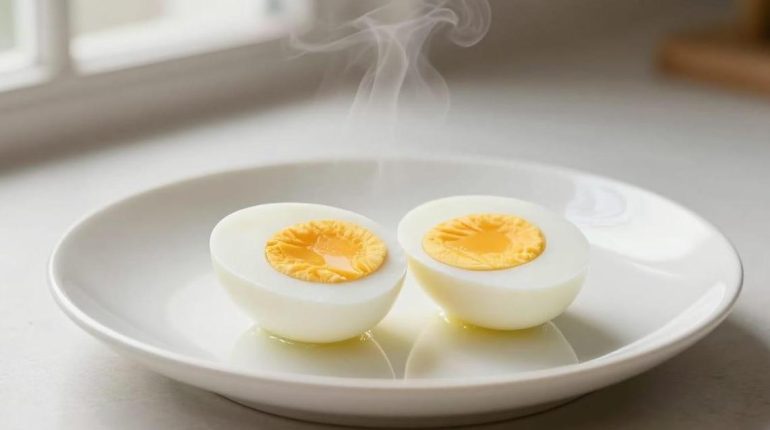
This rigorous method delivers impeccable hard-boiled eggs every time. The yolk boasts a uniform bright yellow color, without greenish traces or grayish areas, testifying to controlled cooking from start to finish. The soft and tender texture of the yolk contrasts with the delicate firmness of the white, creating the perfect balance sought by gastronomes.
The natural flavor of the egg remains intact, preserved from alterations caused by overcooking. No unpleasant sulfurous smell compromises the tasting. This gustatory purity makes all the difference in mixed salads, sandwiches, or simply plain with a pinch of salt.
The absence of a green ring also transforms the visual presentation. Cut in half to garnish a plate or sliced into rounds to decorate a dish, these eggs reveal a brilliant golden heart that stimulates the appetite. Catering professionals know the importance of this aesthetic detail that distinguishes a careful preparation from an approximate result.
The systematic application of these three principles – passive cooking, precise timing, and brutal cooling – definitively eliminates chance from the equation. Whether you are preparing two eggs for your breakfast or a dozen for a buffet, this technique guarantees professional consistency. Mastering this simple method transforms a daily culinary gesture into true gastronomic expertise.