We imagine Ham Sui Gok as a specialty reserved for dim sum chefs who have spent years perfecting their technique. The reality is far less intimidating: it’s a dough to knead, a filling to sauté, and a frying to monitor. Nothing you haven’t done before.
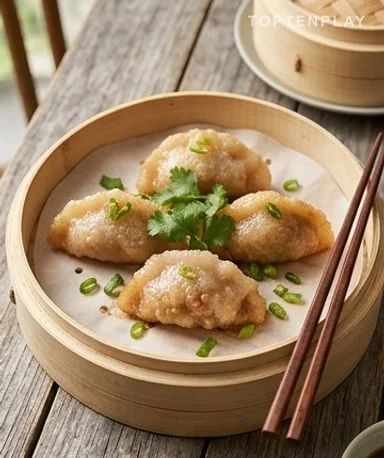
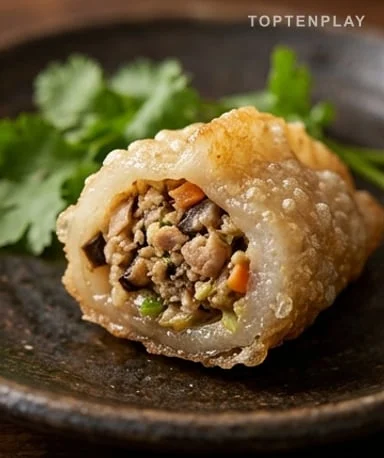
What strikes you at the first bite is the contrast. The exterior crunches crisply under your teeth — that dull, satisfying sound you expected. Then the dough gives way: elastic, slightly sticky, translucent like frosted glass. Inside, the ground turkey filling with shiitake mushrooms and dried shrimp releases a marine and earthy aroma, concentrated by cooking. It’s the kind of bite that makes you feel like you’ve understood something.
Why you’ll love this recipe
Ingredient Notes
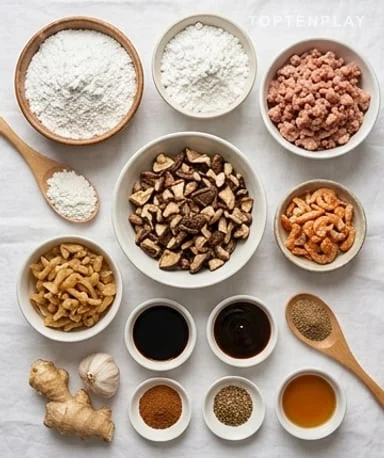
All ingredients together: glutinous rice flour, wheat starch, dried shiitake mushrooms, dried shrimp, salted turnip, and spices — the secret to an authentic dim sum filling.
- Glutinous rice flour : This gives the dough its characteristic elasticity — that chewy, slightly sticky mouthfeel. Choose an Asian brand (Erawan, Three Elephants): Western ‘gluten-free’ flours absorb water differently and yield a floury, brittle result. Do not substitute with regular rice flour, it’s not the same product at all.
- Wheat starch : Mixed with really boiling water, it gelatinizes and forms a white semi-transparent paste that gives the final dough its pearly translucency after frying. Without it, the dough stays opaque and loses some elasticity. Found in Asian grocery stores in the flour section, often next to tapioca starch.
- Dried shiitake mushrooms : Their flavor is three times more concentrated than fresh mushrooms. Soak them in cold water overnight rather than hot water: they stay firmer and retain a slightly crunchy texture in the filling. Be sure to keep the soaking liquid — it smells strongly of umami and perfectly replaces any broth in the recipe.
- Dried shrimp : They don’t provide a direct shrimp taste but a marine umami base that amplifies the whole filling without being clearly identifiable. Choose medium-sized, bright orange shrimp — avoid gray or rancid-smelling ones. A quick rinse in cold water is enough, no long rehydration needed.
- Salted turnip (châu choi) : Sold in vacuum packs in Asian grocery stores, it brings a persistent crunch and a slight fermented saltiness that cuts through the rest of the filling. Rinse it before use if you find it too salty raw. There is no truly convincing substitute: pickled cucumber changes the flavor profile too much.
- Lard : It gives the dough its suppleness and resistance to cracking during folding. You can replace it with solid vegetable shortening or deodorized coconut oil — but not with liquid oil, which would make the dough too soft and impossible to roll out properly.
The dough: two flours, one logic
The first thing to understand is that we’re working with two separate doughs that will be combined later. Wheat starch is mixed separately with really boiling water — not warm, not simmering — until it forms a white, sticky mass, covered to cool. Meanwhile, glutinous rice flour, sugar, salt, and room-temperature water are mixed in a large bowl. Then the still-warm starch mass and lard are incorporated, and you knead by hand for about ten minutes. The dough should become supple, smooth, and no longer stick to your fingers. If it cracks when folded, it lacks water — add a tablespoon at a time. If it collapses and doesn’t hold its shape, it’s too wet — a pinch of glutinous rice flour is enough to rebalance. Once well formed, the dough goes to the refrigerator for at least three hours: the cold firms it up and makes it much easier to divide and roll without sticking to hands.
The filling: everything depends on the order of additions
The filling is prepared in a wok over high heat, and the order matters. Start by sautéing garlic, ginger, and shallots in a drizzle of oil until fragrant — barely a minute, the smell should be sharp and slightly sweet, never burnt. Add the ground turkey and break it into small pieces while stirring: it must become completely opaque before incorporating other elements. Finely chopped shiitake mushrooms, dried shrimp, and salted turnip come next. The texture changes: it becomes drier, more granular, and the marine scent of shrimp rises in the steam. That’s when you moisten with the mushroom soaking liquid — which smells strongly of umami — and add dark soy sauce, oyster sauce, and five-spice powder. A few minutes of cooking concentrate everything, then the cornstarch slurry binds it. The filling should be dry and hold together in a spoon: if it runs, the dough will soften during frying. Fresh cilantro is incorporated off the heat, once the filling has completely cooled.
Folding: don’t aim for perfection on the first try
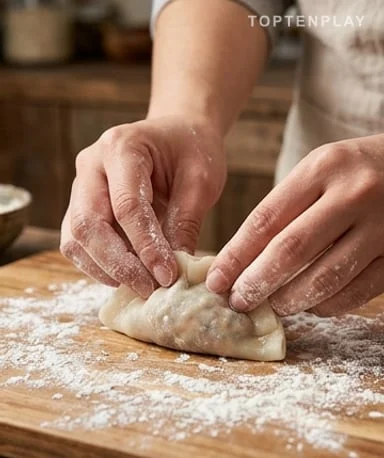
The refrigerated dough is divided into 14 equal portions — a kitchen scale avoids adjustments along the way and ensures even cooking. Each portion is rolled into a disc about 8 cm between two lightly oiled sheets of plastic wrap, or directly between the palms. The dough is supple and pleasant to work with: it doesn’t stick, it doesn’t tear at first contact. Place a generous spoonful of filling in the center, not too close to the edge, and fold into a half-moon. Pinch the edge with your fingers starting from one side and moving with small tight pleats. If the dough cracks in places, a light press is enough to seal it — it’s a forgiving dough. The finished Ham Sui Gok are lined up on a lightly oiled tray while waiting for frying. Do not stack them: they will stick.
Frying: temperature above all else
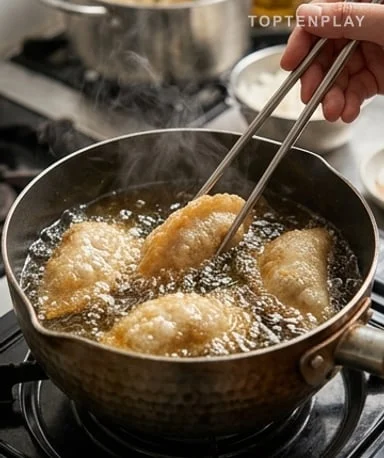
This is where most failures happen, and the reason is almost always the same: oil too hot. The frying window is tight — between 143 and 155°C — and you monitor with a thermometer, not by eye. Use a small deep pot rather than a large skillet: less oil to heat, better temperature control. Lower 4 to 5 dumplings into the oil, wait for them to stabilize, then turn off the heat after the first two minutes. The Ham Sui Gok cook in the residual heat, gradually floating to the surface. They start turning over on their own when the crust is formed — that’s the signal they’re progressing well. Turn the heat back on lightly if the temperature drops too much, but never above 165°C otherwise the dough will crack and the filling will escape into the oil. When they are uniformly golden, dark honey color, remove them onto a wire rack rather than paper towels: that avoids softening the bottom crust while they cool.
Tips & Tricks
- Weigh the dough to divide into equal portions: dumplings of different sizes won’t have the same frying time, and some will be golden while others are still raw inside.
- Do not freeze raw Ham Sui Gok: glutinous rice dough dehydrates and cracks in the freezer. Unfilled dough keeps a week in the fridge, cooked filling two days — assemble just before frying.
- Do not turn the dumplings too often in the oil: they turn themselves when ready, and too much handling damages the still fragile crust forming.
- If the cooled filling seems too dry, that’s intentional — it will soften slightly with the heat of frying. If it still sticks to your fingers after cooling, put it back in the wok for a few minutes to dry it out before assembling.
Can I replace glutinous rice flour with regular rice flour?
No — these are two fundamentally different products. Glutinous rice flour gives that elastic, sticky texture after cooking; regular rice flour produces a dry, crumbly dough that breaks when fried. Check the label carefully in the Asian grocery store, they look similar visually.
Can I freeze raw Ham Sui Gok to have them ready?
No, raw glutinous rice dough does not withstand freezing: it dehydrates, cracks, and loses elasticity. However, unfilled dough keeps in the refrigerator for up to a week. Prepare dough and filling separately, assemble just before frying.
How can I tell if the oil is at the right temperature without a thermometer?
Dip the tip of a wooden chopstick into the oil: at the right temperature, small regular bubbles appear around the wood, without frantic boiling or violent crackling. That said, a thermometer is much more reliable for this recipe — the window between 143 and 155°C is too tight to do without it confidently.
My dough cracks when I roll it out, what’s wrong?
The dough lacks moisture or hasn’t rested enough. Add a tablespoon of warm water, knead for two minutes, then refrigerate for 30 minutes before trying again. Some flour brands absorb more than others — if the problem persists, that’s often where it’s stuck.
Why do the Ham Sui Gok burst during frying?
The main cause is oil that’s too hot: the dough expands before the crust has time to form. Make sure not to exceed 155°C at the start, and turn off the heat after two minutes to finish in residual heat. A too-wet filling or dough that’s too thin on the edges can also cause cracks.
Can I cook Ham Sui Gok in the oven or air fryer?
It’s not recommended. Frying is what cooks the glutinous rice dough evenly and gives it that translucent, elastic texture. In the oven, the dough stays opaque and dry. In the air fryer, the dry heat produces a rubbery rather than crispy texture — the result is very different.
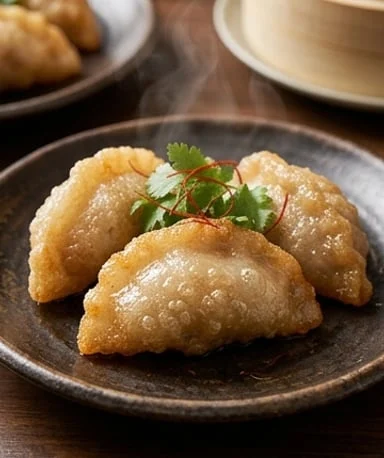
Ham Sui Gok (咸水角) – Fried Glutinous Rice Dumplings
Chinese
Starter
Cantonese fried dumplings with a crispy and translucent glutinous rice dough, filled with ground turkey, dried shiitake mushrooms, and dried shrimp. A dim sum classic achievable at home, with a dough that can be prepared the day before.
Ingredients
- 300g glutinous rice flour
- 75g wheat starch
- 90ml boiling water (for starch)
- 150ml room temperature water (for dough)
- 30g sugar
- ½ tsp salt
- 30g lard or solid vegetable shortening
- 8 dried shiitake mushrooms
- 200g ground turkey
- 30g dried shrimp
- 30g salted turnip (châu choi), rinsed
- 2 garlic cloves, finely chopped
- 1 tsp fresh grated ginger
- 2 shallots, thinly sliced
- 2 tbsp neutral oil (for filling)
- 1 tbsp dark soy sauce
- 1 tbsp oyster sauce
- ¼ tsp five-spice powder
- 1 tbsp cornstarch + 2 tbsp water
- 1 handful fresh cilantro, chopped
- 1L neutral oil for frying
Instructions
- 1Mix wheat starch with 90ml of really boiling water. Stir until the powder is fully hydrated, cover, and let rest for 10 minutes.
- 2In a large bowl, mix glutinous rice flour, sugar, salt, and room temperature water. Add the warm starch mass and lard, then knead for 10 minutes until you get a smooth, supple ball. Wrap and refrigerate for at least 3 hours.
- 3Soak dried shiitake mushrooms in cold water overnight, or 2 hours in hot water. Drain and squeeze well, chop finely. Reserve the soaking liquid.
- 4Heat oil in a wok over high heat. Sauté garlic, ginger, and shallots for 1 minute until fragrant. Add ground turkey and cook, breaking it up with a spatula, until completely opaque.
- 5Add mushrooms, dried shrimp, and salted turnip. Stir for 2 minutes, then add 60ml of the mushroom soaking liquid, dark soy sauce, oyster sauce, and five-spice powder.
- 6Pour in the cornstarch slurry, stirring until thickened. The filling should be dry and hold together in a spoon. Remove from heat, let cool completely, then stir in cilantro.
- 7Divide refrigerated dough into 14 equal portions (about 40g each). Roll each portion into an 8cm disc between two lightly oiled sheets of plastic wrap.
- 8Place a generous spoonful of filling in the center of each disc, not too close to the edge. Fold into a half-moon and pinch the edges with small tight pleats to seal tightly.
- 9Heat frying oil in a small deep pot to 150°C. Fry 4 to 5 dumplings at a time: let the crust form for 2 minutes, turn off the heat, and let cook in residual heat until uniformly dark honey colored.
- 10Drain on a wire rack (not on paper towels to avoid softening the bottom crust). Serve immediately.
Notes
• The mushroom soaking liquid perfectly replaces broth in the filling — don’t discard it.
• Unfilled dough keeps in the refrigerator for up to 1 week. Never freeze raw dumplings.
• Maintain oil between 143 and 155°C throughout frying. Above 165°C, the dough bursts.
• The dumplings float and turn over on their own in the oil when ready — avoid handling too often.
• If dough is too dry and cracks: add 1 tbsp warm water and re-knead. If too soft: add a pinch of glutinous rice flour.
Nutrition Facts (per serving, estimated)
| 320 kcalCalories | 11gProtein | 42gCarbs | 12gFat |