📌 Greek Easter Brioche (Tsoureki)
Posted 29 March 2026 by: Admin
A scent arrives before everything else — warm orange, discreet spice, something slightly resinous that you don’t immediately identify. It’s the tsoureki baking, and if you’ve never made it, welcome to your new Easter tradition. A weekend, some patience, and this Greek brioche will redefine your definition of “brioche.”
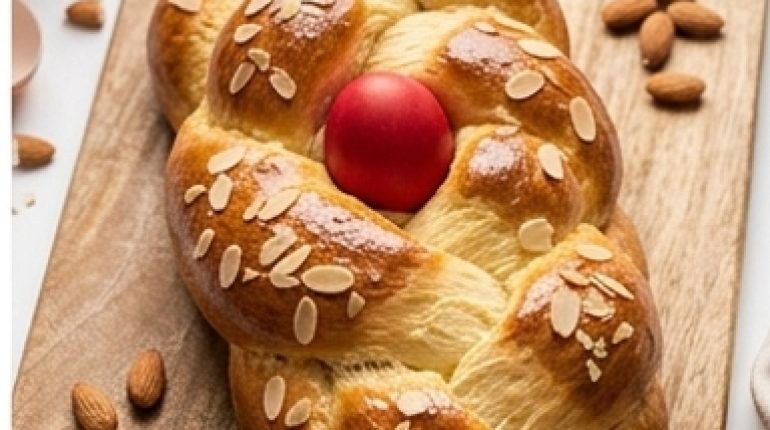
The crust comes out of the oven with that lacquered dark amber honey glaze, almost mahogany on the braided ridges. Pressing gently with a fingertip, the surface resonates slightly — a sign that the crumb is airy and stringy, nothing like a classic French brioche. The smell of mahlepi and mastic fills the room, something between sweet anise and a slightly camphorated woody undertone, totally unique. And nestled in the braid, the red egg reminds us that this recipe has hundreds of years of history behind it.
Why you’ll love this recipe
Ingredient Notes
All the tsoureki ingredients gathered: flour, eggs, milk, orange, fresh yeast, mahlepi, and mastic for that authentic Greek touch.
- Mahlepi : This is the dried seed of the pit of a wild cherry. Little known in some regions, but found in Greek or Middle Eastern grocery stores — also look for the name “mahlab.” Its taste is fruity, slightly bitter, with an almond undertone. It’s often found whole: a quick turn in a mortar or an old coffee grinder is enough. Without it, tsoureki isn’t tsoureki.
- Chios Mastic : A resin harvested on the island of Chios, Greece. The taste is camphorated, slightly resinous, very particular. You only use a little — half a teaspoon — but it changes everything. Look in the same section as mahlepi to find it. If truly unavailable, you can do without it, but the result will be less authentic.
- Fresh yeast : 50 g for 1 kg of flour. Fresh yeast gives a more regular rise and a milder taste than dry yeast. It is found in the chilled section of most supermarkets. If you only have dry yeast, divide by 3 — about 16 g — and follow the same rehydration protocol.
- Orange (juice + zest) : Preferably an organic orange, since we use the zest. The juice brings moisture and soft acidity, the finely grated zest gives the small fragrant bursts found in every bite. This is the only ingredient we don’t substitute — it is at the heart of the aromatic profile.
The starter — an hour well invested
Before thinking about the rest, we activate the yeast. In a large bowl, crumble the 50 g of fresh yeast into half of the warm milk, add 100 g of flour and mix until you get a thick, sticky paste. Cover with a cloth and let rest for 1 hour at room temperature. After an hour, the mass will have swollen and will smell slightly of alcohol — that’s exactly what we want. This pre-ferment is the foundation of the brioche: it provides lightness, flavor, and helps the dough rise correctly despite the richness of the eggs.
Building the dough
In a saucepan, heat the rest of the milk, sugar, and butter over low heat until everything melts. Do not boil — just warm, about 35-40°C. Too hot, and the yeast dies. Beat the eggs with the orange juice, grated zest, mahlepi, and mastic powder, then add this to the pre-ferment before gradually incorporating the remaining flour. Knead — by hand or with a stand mixer hook — for a solid 10 minutes. The dough should be supple, slightly sticky but pulling away from the sides. If it’s too sticky, add a few grams of flour. If it seems too stiff, a spoonful of warm milk.
The long wait — where the magic happens
Place the dough in a lightly oiled bowl, cover with cling film, and let rise for 3 hours at room temperature. It should double in volume, or even triple if the yeast is very active. Gently punch down the dough, divide it in two, and form each brioche by braiding three strands — about 50 cm each, as thick as a thumb. The braiding is simple: left to center, right to center, alternate. No need for perfection. The red eggs are inserted into the braid before the second one-hour rise, nestled tightly between two knots so they don’t escape during baking.
Baking: waiting for the right color
Preheat oven to 180°C fan. Brush the brioches with egg yolk diluted with a splash of milk — this glaze gives that characteristic bright light caramel crust. Then top with flaked almonds, which will brown and smell wonderful. Forty minutes, but start checking at 30: if the surface browns too fast, a loosely placed piece of aluminum foil solves the problem. The brioche is cooked when, tapping the bottom, it sounds hollow like an empty box. Take out of the oven. Resist cutting. Let cool for at least 20 minutes on a wire rack — the interior is still stabilizing.
Tips & Tricks
- Don’t add too much flour to make the dough less sticky: it’s precisely this moisture that guarantees the stringy crumb of the tsoureki. A dough that is too dry will result in a dense, ordinary brioche.
- Mahlepi and mastic can be found in Greek or Lebanese grocery stores, and easily online — order them together, they keep for months in a closed jar away from light.
- If the red eggs crack during baking, they probably needed another turn in boiling water before being dyed. Next time, 12 minutes of hard boiling before dyeing, and insert them well-wrapped in the dough rather than just placed on the surface.
Can I replace fresh yeast with dry yeast?
Yes, no problem. Divide the quantity by 3: 50 g of fresh yeast = about 16 g of instant dry yeast. Mix it directly with the flour without activating it in the milk first, unlike fresh yeast.
Where can I find mahlepi and mastic?
In Greek, Turkish, or Lebanese grocery stores. Otherwise, both can be easily ordered online — search for “mahlab” or “mahlepi” and “Chios mastic”. They keep for months in an airtight jar, so it’s worth getting a good quantity.
How long does tsoureki keep?
3 days well wrapped in cling film at room temperature. It’s often better the next day, once the spices have had time to diffuse. You can also freeze it in slices and reheat for 10 minutes in the oven at 150°C.
My dough isn’t rising — what’s happening?
The most common cause is liquid that was too hot and killed the yeast: the milk should not exceed 40°C when incorporated. Another possible reason: fresh yeast that is too old. To test, dissolve a little yeast in warm milk with a pinch of sugar — if it doesn’t foam in 10 minutes, the yeast is dead.
Can I prepare the dough the day before?
Yes, it’s actually a great idea. After kneading, place the covered dough in the refrigerator for a slow overnight rise. The next morning, take it out, let it come to temperature for 30 minutes, then proceed to braiding and the second rise. The flavor will be even more developed.
Are red eggs mandatory?
No, it’s a traditional symbol of Orthodox Easter but not essential to the recipe. You can omit them or replace them with naturally dyed eggs using beets. They are generally not eaten — they serve as decoration.
Greek Easter Brioche (Tsoureki)
Greek
Bread & Pastries
Greek braided brioche with mahlepi and mastic spices, featuring a stringy crumb scented with orange. The traditional Easter recipe.
Ingredients
- 50 g fresh yeast (or 16 g dry yeast)
- 250 ml whole milk, divided
- 1 kg bread flour (Type 45/Strong)
- 250 g granulated sugar
- 120 g unsalted butter
- 4 whole eggs
- 120 ml fresh orange juice (about 2 oranges)
- 1 organic orange — finely grated zest
- 10 g mahlepi powder (mahlab)
- ½ tsp Chios mastic powder
- 1 egg yolk (for glazing)
- 2 tbsp milk (to thin the glaze)
- 40 g flaked almonds
- 2 red painted eggs (decoration)
Instructions
- 1Crumble the yeast into 125 ml of warm milk, add 100 g of flour, mix into a thick paste. Cover and let rise for 1 hour.
- 2In a saucepan, heat the rest of the milk (125 ml) with the sugar and butter over low heat until everything melts. Let cool to about 38°C.
- 3Beat the 4 eggs with the orange juice, zest, mahlepi, and mastic. Incorporate into the warm milk-sugar mixture.
- 4Pour this mixture over the starter. Add the remaining flour (900 g) gradually while mixing, then knead for 10 minutes by hand or stand mixer (hook) until you get a supple and slightly sticky dough.
- 5Cover with cling film and let rise for 3 hours at room temperature, until doubled in volume.
- 6Degas the dough, divide into 2 equal portions. Divide each portion into 3 strands of 50 cm. Braid each set of 3 strands.
- 7Place the braided brioches on a tray lined with parchment paper. Push 1 red egg into the braid of each brioche. Cover and let rise for another 1 hour.
- 8Preheat the oven to 180°C fan. Mix the egg yolk and milk, brush the brioches generously. Sprinkle with flaked almonds.
- 9Bake for 40 minutes. If the surface browns too quickly after 30 minutes, cover loosely with foil. The brioche is done when the bottom sounds hollow.
- 10Let cool for 20 minutes on a wire rack before slicing.
Notes
• Storage: 3 days at room temperature wrapped in cling film. Freezes very well in slices — reheat 10 min at 150°C.
• Make ahead: the dough can do its first rise overnight in the refrigerator. Take out 30 minutes before working the next morning.
• Spice-free version: if mahlepi and mastic are unavailable, you can flavor with just orange and vanilla. It won’t be traditional tsoureki, but still a good brioche.
Nutrition Facts (per serving, estimated)
| 560 kcalCalories | 13 gProtein | 89 gCarbs | 17 gFat |