This gratin is nothing original. And that’s exactly why it wins every time. When homemade mashed potatoes meet a well-made béchamel and go into the oven wrapped in turkey, the result far exceeds the effort.
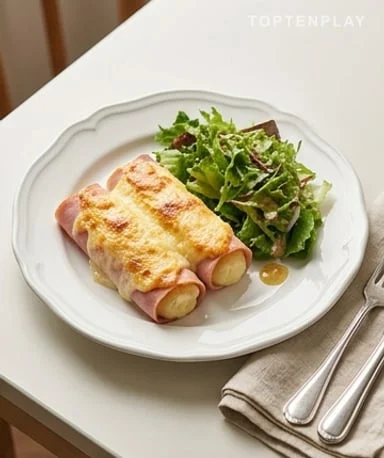
The surface comes out of the oven cracked and golden, with those little bubbles of melted cheese that have lightly browned on the edges — a sign that the heat has done its work. Underneath, the béchamel remains creamy, almost pearly, still slightly wobbly. The rolls hold their shape well, the mashed potatoes compact but soft inside. The smell of gratin filling the kitchen, that aroma of hot milk and caramelized cheese, always has the same immediate effect.
Why you’ll love this recipe
Ingredient Notes

Simple and accessible ingredients for a delicious result — mash, turkey, béchamel and Emmental.
- Potatoes (900 g) : They form the heart of the roll and provide all the texture. Choose floury varieties like Bintje or Monalisa: they mash easily and absorb butter well. Waxy varieties remain lumpy even after mashing and give a mashed potato that’s hard to roll.
- Turkey ham (5 slices) : It acts as a structural wrap around the mash. Turkey holds up well during cooking without tearing like some thinner poultry hams. If you have a choice, pick thick slices — they roll better and don’t break during assembly.
- Butter + flour (20 g each) : This duo forms the roux, the base of the béchamel. The 1:1 balance is important: too much flour makes a pasty sauce, too much butter and it won’t set. Cook the roux for a good minute before adding the milk to completely eliminate the raw flour taste, which otherwise lingers in the aftertaste.
- Whole milk (30 cl) : It gives body and velvety texture to the béchamel. Semi-skimmed milk works but gives a less rich, less coating sauce. If you want more character, replace 5 cl with light cream — the sauce becomes noticeably more indulgent.
- Grated Emmental cheese : It creates the gratin crust that is the whole visual and textural appeal of the dish. A decent quality Emmental is ample. For more sharpness and depth, mix half Emmental, half Comté — the result is significantly more complex.
- Egg (1) : Incorporated into the still-hot mash, it acts as a binder and gives a slightly firmer texture. Without it, the mash can disintegrate inside the roll during cooking — the rolls open up and the dish loses all its structure.
The mash — it starts here
Peel the potatoes, cut them into pieces about 4-5 cm and plunge them into a large pot of cold salted water — starting cold ensures more even cooking than starting at a boil, the pieces cook at the same rate without the outside crumbling before the inside is tender. Count 20 to 25 minutes after boiling. A knife should go in without resistance and come out cleanly, without having to force. Drain immediately and mash while hot — hot potato mashes easily, cold it becomes sticky and dense, hard to work. Incorporate the butter first, let it melt in the residual heat, then the beaten egg and seasoning. The texture should be soft but not runny: the mash should hold on the spoon without dripping. If it runs, the rolls will open in the oven. Better a slightly compact mash than one that’s too fluid.

Stress-free béchamel
Béchamel scares people for no reason — the technique is not complicated, it just requires you to be present. In a medium saucepan, melt the butter over medium heat until it foams slightly and starts to smell nutty: at this precise temperature, add the flour. Pour it in all at once and whisk immediately for a good minute — the roux should dry slightly and take on a very pale blonde color, almost sandy. This short step cooks the flour and eliminates that raw paste taste that can linger in the sauce if you rush. Then add the milk in three additions, whisking well between each: the first two thirds gradually hydrate the roux, the last one thins everything out. Over medium heat, the sauce thickens in 5 to 7 minutes. It’s ready when it coats the back of a spoon and a line drawn with your finger stays clean without closing. Season with salt, pepper, and a pinch of nutmeg — a béchamel without salt is bland, and it will cover the entire surface of the gratin.
Rolling — simpler than it looks
Prepare your space: clean board, turkey slices laid flat, mash within reach with a large spoon. Each slice gets two well-filled spoons of mash, slightly offset toward one edge rather than centered — starting from the filled side, the roll naturally closes on itself without effort. Roll firmly but without crushing. If mash comes out the sides, you’ve put too much. Place each roll seam-side down in a lightly buttered dish: the weight of the roll on itself is enough to keep it closed throughout cooking. Line them tightly against each other — they support each other and resist opening under heat better than spaced rolls.
Into the oven — let the heat do its work
Preheat to 180°C, fan-assisted if you have it — it evens out cooking and gratinates more evenly than static heat. Coat the rolls with béchamel, covering the ends well, which tend to dry out. Cover with a generous layer of Emmental — generous, not symbolic. After 20 minutes, the surface should be golden, the edges lightly browned, and you should hear a faint crackle: the béchamel is simmering under the cheese. If the cheese colors too quickly before the end, lower to 160°C and cover with aluminum foil. Upon removal from the oven, let rest 5 minutes before serving — the béchamel stabilizes slightly and the rolls hold better on the plate when cutting.

Tips & Tricks
- Compact mash, not creamy: the mash should hold on a spoon without running. A too-runny mash makes rolling impossible and the rolls collapse in the oven. If it’s too fluid, put it back over low heat for a minute to dry it slightly before filling the slices.
- Roux cooked a full minute: the temptation is to rush to the milk step as soon as the butter is melted and the flour incorporated. But if the flour isn’t cooked in the butter, the béchamel will have a raw paste aftertaste even after thickening. This minute makes all the difference in the final taste.
- Seam-side down: a roll placed open side up will systematically open under oven heat. Turned over, its own weight keeps it closed throughout cooking — no toothpick, no fixing of any kind.
- Nutmeg in the béchamel: a pinch is enough. It adds a slight aromatic warmth that makes the sauce less neutral without being clearly identifiable — it’s that little detail that makes people at the table say there’s something extra, without knowing what.

How to prevent the rolls from opening during cooking?
The key is twofold: mash that is sufficiently compact — holding on the spoon without running — and rolls placed seam-side down in the dish. The weight of the roll on itself is enough to keep it closed, no need to fix with a toothpick. Packing them tightly together in the dish further enhances stability.
Can this dish be prepared in advance?
Yes, and it’s convenient. You can assemble the rolls in the dish, cover with béchamel and Emmental, wrap with plastic wrap and refrigerate up to 24 hours before baking. Just take the dish out 15 minutes before putting it in the oven to avoid starting the cooking cold, which would lengthen the time and unbalance the result.
My béchamel has lumps — how to fix it?
Take the saucepan off the heat and whisk vigorously. If lumps persist, blend the sauce with an immersion blender or pass through a fine sieve — that fixes almost everything. To avoid it, always add the milk in three batches, whisking well between each, and never pour it all at once onto a hot roux.
Which potato to choose for this mash?
Floury varieties like Bintje or Monalisa are the most suitable: they mash easily and give a smooth mash without effort. Waxy varieties like Charlotte mash poorly, leave lumps and complicate the rolling.
Can this gratin be frozen?
You can freeze the assembled rolls with béchamel and cheese, raw or cooked, for up to 2 months. If raw, thaw overnight in the refrigerator before baking. If cooked, the béchamel may grain slightly upon thawing — a pass in the oven at 160°C with a drizzle of water mixed into the sauce fixes the texture well.
Gratiné Turkey Ham Rolls, Homemade Mash and Béchamel
French
Main course
Turkey slices filled with creamy homemade mash, topped with creamy béchamel and gratinated with Emmental. An unpretentious family classic, ready in 75 minutes, that satisfies every time.
Ingredients
- 900g floury potatoes (Bintje or Monalisa)
- 5 slices turkey ham (thick)
- 1 egg
- 20g butter for the mash
- 20g butter for the béchamel
- 20g flour
- 30cl whole milk
- 90g grated Emmental cheese
- 1 pinch freshly grated nutmeg
- salt and pepper
- butter for the dish
Instructions
- 1Peel the potatoes, cut them into 4-5 cm pieces and place them in a large pot of cold salted water. Bring to a boil then cook for 20 to 25 minutes until a knife goes in without resistance.
- 2Drain immediately and mash while hot. Incorporate 20g butter, let it melt in the residual heat, then add the beaten egg, salt and pepper. Mix until smooth and compact — it should hold on a spoon without running.
- 3In a saucepan, melt 20g butter over medium heat until it foams. Add the flour and whisk for 1 minute to form a pale blonde roux. Add the milk in three additions, whisking between each. Cook over medium heat for 5 to 7 minutes until the sauce coats the back of a spoon. Season with salt, pepper and nutmeg.
- 4Preheat the oven to 180°C. Lay a slice of turkey ham flat. Place two spoons of mash towards one edge of the slice and roll firmly to form a compact roll.
- 5Lightly butter a gratin dish. Arrange the rolls seam-side down, tightly packed against each other. Generously coat with béchamel, covering the ends. Top with grated Emmental.
- 6Bake for 20 minutes until the surface is golden and you hear a slight crackle. Let rest 5 minutes before serving.
Notes
• If the mash is too runny, put it back over low heat for 1 to 2 minutes to dry it before filling the slices — a runny mash makes rolling impossible.
• For a richer béchamel, replace 5cl of milk with light cream.
• For more character, mix half Emmental, half grated Comté.
• The rolls can be assembled 24 hours in advance, covered with plastic wrap and refrigerated — take the dish out 15 minutes before baking.
Nutrition Facts (per serving, estimated)
| 370 kcalCalories | 20gProtein | 35gCarbs | 16gFat |