Follow us
7 June 2026

French-Style Braised Stuffed Cabbage

Prep Time
40 minutes
Cook Time
1 hour 30 minutes
Total Time
2 hours 10 minutes
Servings
6 portions

Remember the last dish that warmed you from the inside out—not just your stomach, but something deeper? French-style stuffed cabbage has that rare ability. Not spectacular, not sophisticated, just deeply good.
Advertisement
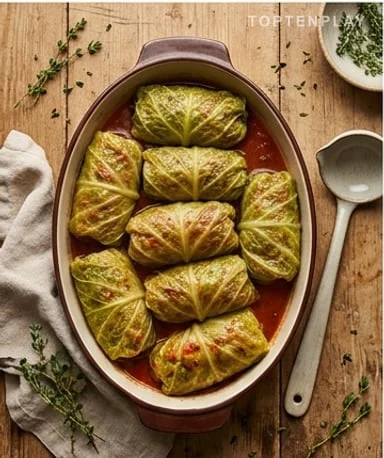
Final result
Generous stuffed cabbages in their simmered sauce—the promise of a truly warming family meal.

When the lid of the Dutch oven is lifted after an hour and a half of simmering, the escaping aroma blends thyme, tomato, and the meat juices melted into the broth. The cabbage leaves have turned from bright green to a deep translucent green, wrapping a still plump and juicy filling. The sauce, slightly reduced, coats the bottom of the pot with that natural binding only long simmering produces. It’s the kind of dish where the plate arrives simple but every bite is dense.

Why you’ll love this recipe

Even better reheated the next day : Overnight chilling lets the flavors meld. The cabbage absorbs a bit more sauce, the filling firms up. Make them the day before and you’ll have an even more cohesive dish than the same day.
A filling that stays juicy : The panade—stale bread soaked in milk—acts like a moisture sponge in the filling. It holds the meat juices during simmering instead of letting them escape as steam.
The cooking does the work for you : Once the cabbages are in the pot, you have nothing to do for 1h15. Baste twice, that’s it. The rest manages itself on low heat.
Perfect for large gatherings : Quantities easily double and the dish stays hot for a long time. It’s the kind of recipe that feeds ten people without last-minute stress.

Ingredient Notes

Ingredients

Everything you need for six stuffed cabbages: curly kale, beef-turkey filling, vegetables, and aromatics.

  • Green curly kale (1 large head) : Curly kale, unlike smooth cabbage, has more pliable and larger leaves after blanching—ideal for wrapping without tearing. Choose one with wide, tightly packed leaves. Avoid cabbages that are too small or too dense in the center, which yield unusable leaves.
  • Ground beef + veal (600 g) : Beef brings flavor, veal tenderness. A 50/50 mix gives a filling that stays moist without being dry or greasy. Avoid very lean ground beef (like 5% fat) which compacts during cooking—15 to 20% fat is ideal here.
  • Turkey sausage meat (150 g) : It acts as a fatty, aromatic binder in the filling—this is what gives that slightly melt-in-your-mouth texture. The turkey version is less fatty than classic sausage, which balances well with the beef. Buy it fresh from a butcher or the poultry deli counter.
  • Stale bread + milk (80 g + 10 cl) : The panade is the secret to a filling that doesn’t dry out during cooking. The soaked bread swells and retains the meat’s moisture. Day-old sandwich bread, stale baguette, or whole wheat bread—doesn’t matter, the key is that it’s dry enough to absorb the milk without making the filling liquid.
  • Chicken broth (30 cl) : It forms the sauce base and hydrates the cabbage from below during simmering. A too salty broth will concentrate during cooking and unbalance everything, so taste it before seasoning the filling—adjust accordingly.
  • Tomato passata (20 cl) : It brings acidity to balance the richness of the meat, and that deep mahogany color to the final sauce. A simple passata works, without added flavors. If you only have canned peeled tomatoes, coarsely blend them—works just as well.

Blanching the cabbage: a step not to be improvised

Bring a large pot of well-salted water to a boil—the whole cabbage must be fully submerged. Cook for about eight minutes until the outer leaves become pliable without falling apart, during which the water turns slightly green, releasing that warm, sweet vegetal smell, quite different from raw cabbage. Drain, let cool enough to handle without burning yourself, then carefully detach the leaves one by one—the large ones are precious. On each leaf, cut out the central V-shaped rib where the leaf is thick and tough: it prevents proper rolling and would remain hard despite long cooking. If some leaves tear slightly when detaching, overlap two—no filling will escape.

Blanching the cabbage: a step not to be improvised
Folding the cabbage leaves: a simple gesture that holds all the filling during simmering.

The filling: what you smell even before tasting

Soak the stale bread in the milk for five minutes, then squeeze it between your palms—not too hard; it should remain slightly moist in the center. In a large bowl, combine by hand the ground meat, turkey sausage meat, bread, whole egg, finely chopped garlic and onion, chopped parsley, salt, pepper, and a pinch of nutmeg. Nutmeg is discreet but fundamental: it rounds out the filling, gives it that little something you can’t name but would miss if it were absent. Mix just enough to combine—overmixing compacts the proteins and makes the filling rubbery during cooking. The final texture should be slightly sticky but not liquid. To check seasoning, take a small amount and cook it in a pan for two minutes: it’s the only reliable way to taste raw filling safely.

Forming the parcels: the technique comes down to two moves

Lay a leaf on the work surface, removed rib side toward you. Place a ball of filling in the center—about 80 to 90 grams, no more. First fold the sides of the leaf inward, then roll tightly toward you. The parcel should be compact without being crushed. If the leaf doesn’t stay closed, simple kitchen twine tied around solves the problem. Avoid wooden toothpicks that are easily forgotten on the plate. Stuffed cabbages don’t need to be perfectly identical: family cooking has its irregularities, and during cooking the sauce unifies everything visually.

Simmering: when patience becomes a real technique

Heat the butter and oil in a large, heavy-bottomed Dutch oven. Sauté the carrot small dice for two to three minutes—they should lightly color without burning, releasing that characteristic sweet aroma of caramelizing carrots. Pour in the broth, tomato passata, add the thyme and bay leaf, and stir. Gently place the stuffed cabbages seam side down so they stay closed. The liquid should come exactly halfway up: below that, they steam and absorb aromas from below; above halfway, they would boil rather than simmer and the filling would loosen. Cover, reduce to very low heat, and cook for 1h15 to 1h30. Every twenty minutes, open and baste the cabbages with the sauce from the bottom—it will gradually darken, thicken, and that shiny little crust forming on top of the parcels is a sign everything is going right.

The sauce: don’t sacrifice it when serving

At the end of cooking, the sauce should be slightly reduced, coating, deep mahogany color, with a faintly dominant thyme aroma. If it seems too thin, remove the stuffed cabbages and increase heat uncovered for two to three minutes—it will concentrate quickly. If instead it has reduced too much and is slightly sticking, add a ladle of hot broth and scrape the bottom with a wooden spoon to release the caramelized juices: that’s where the best flavor concentrates. Serve generously—two to three parcels per person, well coated with sauce, along with the tender carrots from the bottom of the pot retrieved with a spoon.

The sauce: don't sacrifice it when serving
A slow covered simmer—that’s where the magic happens. The sauce concentrates, the cabbage tenderizes.

Tips & Tricks
  • Don’t overfill the leaves: the cabbage shrinks slightly during cooking and a too voluminous filling will burst the parcel. Aim for 80 to 90 g per cabbage, no more.
  • Prepare them the day before and gently reheat covered the next day: flavors continue to develop as they rest, the sauce soaks better into the cabbage, and the filling is more tender than the same day.
  • Line the bottom of the pot with a few large blanched cabbage leaves before placing the stuffed cabbages: they protect the parcels from direct contact with the hot bottom and prevent the sauce from sticking at the end of cooking.
  • Taste the sauce before serving and adjust if needed: a squeeze of lemon juice is often enough to brighten a sauce that lacks liveliness after the long reduction, without altering the dish.
Close-up
The cut reveals the essence: a juicy filling, a tender cabbage, a sauce that has absorbed everything.
FAQs

Can stuffed cabbages be prepared in advance?

Yes, and it’s even recommended. Prepared the day before, the cabbages spend the night in their sauce in the refrigerator and gain even more flavor—the cabbage absorbs the aromas and the filling firms up. Gently reheat covered over low heat for 20 to 25 minutes before serving.

How to know when stuffed cabbages are done?

Prick a fork into the cabbage without forcing: it should sink in without any resistance. The sauce should be slightly reduced and coating. If the filling still feels firm in the center, continue cooking covered for another 15 minutes before checking again.

Can stuffed cabbages be frozen?

They freeze very well after full cooking and cooling, with their sauce, for up to 3 months. Thaw in the refrigerator overnight and reheat over low heat covered, adding a little broth if the sauce has thickened too much in the freezer.

Why do my stuffed cabbages open during cooking?

Two main reasons: the filling was too generous and the cabbage bursts under pressure, or the parcel was not tight enough to begin with. Do not exceed 90 g of filling per leaf, use kitchen twine to secure the rolls, and always place them seam side down in the pot.

Can turkey sausage meat be replaced?

If you can’t find it, use 750 g of ground beef and veal total, without sausage. The filling will be slightly less fatty but just as good. Add one teaspoon of dried thyme and one of sweet paprika directly to the filling to compensate for the aromas usually provided by the sausage.

Can stuffed cabbages be cooked in the oven instead of a Dutch oven?

Yes, at 160 °C in a covered Dutch oven for about 1h30. The result is very similar to the stovetop version, with slight caramelization on the surface if you remove the lid for the last 15 minutes. Check the liquid level halfway through and add hot broth if necessary.

French-Style Braised Stuffed Cabbage

French-Style Braised Stuffed Cabbage

Medium
French
Main course

Prep Time
40 minutes
Cook Time
1 hour 30 minutes
Total Time
2 hours 10 minutes
Servings
6 portions

Tender green curly kale leaves, a generous beef-turkey filling, and a slow simmer in a herbed tomato-broth sauce. The great classic of French countryside cuisine, can be made the day before and even better reheated.

Ingredients

  • 1 large green curly kale
  • 600 g ground beef + veal (15% fat)
  • 150 g turkey sausage meat
  • 2 onions, finely chopped
  • 2 cloves garlic, chopped
  • 2 carrots, diced small
  • 1 whole egg
  • 80 g stale bread
  • 10 cl milk
  • 2 tbsp fresh parsley, chopped
  • 1 pinch nutmeg
  • salt and pepper to taste
  • 30 cl chicken broth
  • 20 cl tomato passata
  • 1 bay leaf
  • 1 sprig fresh thyme
  • 20 g butter
  • 1 tbsp neutral oil

Instructions

  1. 1Bring a large pot of well-salted water to a boil. Submerge the whole cabbage for 8 minutes, drain and let cool. Gently detach the large leaves and cut out the central V-shaped rib on each.
  2. 2Soak the stale bread in the milk for 5 minutes, then squeeze lightly between your palms—it should remain slightly moist, not liquid.
  3. 3In a large bowl, combine by hand the ground meat, turkey sausage meat, squeezed bread, egg, chopped garlic and onions, parsley, salt, pepper, and nutmeg. Mix just enough to combine without overmixing.
  4. 4Lay a cabbage leaf on the work surface. Place 80 to 90 g of filling in the center, fold the sides then roll tightly. Secure with kitchen twine if necessary. Repeat until filling is used up.
  5. 5In a large Dutch oven, heat the butter and oil. Sauté the carrot dice for 2 to 3 minutes over medium heat. Pour in the chicken broth and tomato passata, add the thyme and bay leaf, and stir.
  6. 6Place the stuffed cabbages seam side down. The liquid should come exactly halfway up the parcels. Cover and simmer over very low heat for 1h15 to 1h30, basting the cabbages with the sauce every 20 minutes.
  7. 7At the end of cooking, the cabbage should be very tender and the sauce slightly reduced. Adjust seasoning if needed and serve generously, coated with sauce and the carrots from the bottom.

Notes

• Prepare them the day before and gently reheat covered the next day: flavors develop as they rest and the dish is only better.

• Line the bottom of the pot with a few large blanched cabbage leaves before adding the sauce: they protect the parcels from the hot bottom and prevent the sauce from sticking at the end of cooking.

• Freezes very well after full cooking, with the sauce, for up to 3 months. Thaw in the refrigerator and reheat over low heat, adding a splash of broth if the sauce has thickened.

Nutrition Facts (per serving, estimated)

340 kcalCalories 29 gProtein 21 gCarbs 15 gFat
Advertisement
Share on Facebook