📌 Frankincense: how AKBA reduces tumor cell proliferation according to new clinical studies
Posted 4 February 2026 by: Admin
Frankincense Olibanum: From Ancestral Resin To Modern Scientific Study Object
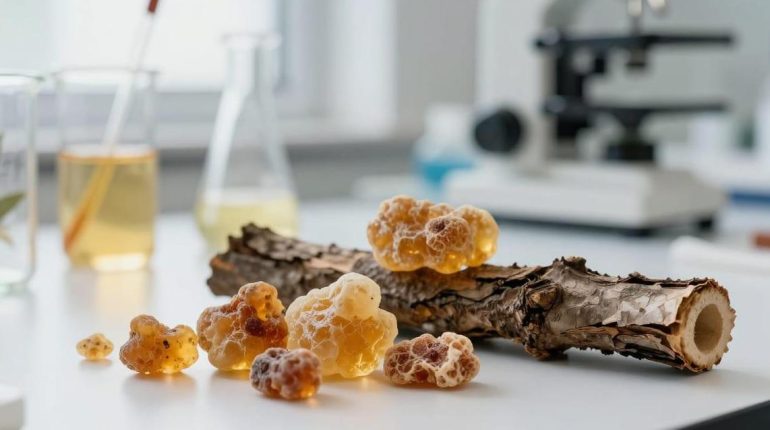
While medical research relentlessly explores new therapeutic avenues, a millennial substance is resurfacing in laboratories: frankincense olibanum. This aromatic resin extracted from Boswellia trees, cultivated for centuries in the Middle East and East Africa, is now transcending its status as a ritual ingredient to integrate the most rigorous scientific protocols.
The shift occurred with the identification of its active compounds: boswellic acids, and more specifically AKBA (acetyl-11-keto-β-boswellic acid). These triterpenes exert a documented action on inflammatory pathways and cellular signaling, transforming an ancestral practice into a subject of legitimate medical investigation.
Laboratory data reveal a fascinating mechanism: these molecules interact directly with the processes of cell proliferation and apoptosis — the programmed cell death that researchers attempt to trigger in diseased tissues. Unlike traditional remedies whose effectiveness relies on anecdotal evidence, frankincense is now crossing the threshold of in vitro tests and animal models.
This transition from the altar to the microscope raises a central question: how can a resin burned during religious ceremonies influence biological mechanisms as complex as tumor regulation? Answers are progressively emerging from scientific benches, with a methodological caution that distinguishes validated hope from premature promise.
Research Revelations: When Frankincense Influences Cellular Mechanisms
Laboratories are now unveiling results that clarify the biological mode of action of frankincense. Boswellic acids inhibit the 5-lipoxygenase enzyme, a key player in inflammatory responses that promote abnormal cell growth. This initial observation opens the way to a finer understanding of the targeted metabolic pathways.
Analysis of biochemical cascades reveals a modulation of the NF-κB and PI3K/AKT pathways, two signaling systems regulating cell survival and proliferation. On cancer cell lines — breast, prostate, melanoma — Boswellia extracts demonstrated a measurable reduction in cell viability while activating specific markers of apoptosis: an increase in Bax protein, a decrease in Bcl-2.
The decisive turning point came with a phase Ia clinical trial conducted on breast cancer patients. This “therapeutic window” study recorded a statistically significant decrease in tumor cell proliferation after administration of Boswellia serrata extract, with no documented serious adverse effects. Tolerance proved to be excellent, validating the feasibility of further investigations.
These preliminary data, while promising, call for caution. Preclinical models on hepatocarcinoma and melanoma reproduce similar anti-proliferative patterns, but extrapolation to humans requires large-scale randomized trials. Science is advancing, hypotheses are partially confirmed, but the path to a validated therapeutic application remains to be traveled.
Beyond The Cellular: Unexpected Effects On Mood And Inflammation
Beyond these anti-proliferative mechanisms, frankincense reveals an unexpected neurological dimension. Incensole acetate, a volatile compound isolated from the resin, activates TRPV3 channels in the brain of mice according to several experimental protocols. This stimulation triggers measurable anxiolytic and antidepressant behaviors — reduction of immobility time in the forced swim test, increased exploration of the elevated plus maze.
A particularly revealing experiment mapped the impact of burning frankincense on brain activity. Limbic areas involved in emotional regulation — hippocampus, prefrontal cortex — show significant activation in rodents exposed to the smoke. This observation corroborates millennial ritual uses attributing soothing virtues to olibanum.
The inflammatory dimension completes this picture. Animal models of depression induced by chronic stress recorded a drop in pro-inflammatory cytokines — TNF-α, IL-6 — after administration of Boswellia extracts. This double action, both neurochemical and immune, suggests complementary therapeutic pathways for mood disorders associated with chronic inflammation.
A major methodological limitation remains: no controlled clinical trial has validated these effects in humans. Dosages, brain bioavailability, and the transposition of animal dosages remain unknowns. The hypothesis is attractive, animal data converge, but clinical proof is still lacking to recommend frankincense as a psychotropic support.
Practical Instructions And Essential Precautions For Safe Use
Faced with these promising but incomplete data, a pragmatic approach imposes a rigorous framework. Four administration protocols emerge from the reviewed studies, each with its pharmacokinetic specificities.
Aromatic diffusion remains the most accessible method: 3 to 5 drops of pure essential oil in an ultrasonic diffuser, sessions of 30 minutes maximum. This route favors the inhalation of volatile terpenes without hepatic passage, limiting drug interactions. Topical application requires strict dilution — 1 to 2% in a neutral vegetable oil — to avoid contact dermatitis observed with raw concentrates.
Oral supplements require precise standardization. Clinical trials have tested extracts titrated at 30-65% boswellic acids, with daily dosages ranging between 300 and 1200 mg. Exclusively choose certified Boswellia serrata or sacra formulations, analyzed by third-party laboratories to guarantee the absence of heavy metals or adulterants.
Documented side effects remain mild — transient nausea, skin erythema — but three absolute contraindications apply: pregnancy (theoretical abortive risk), taking anticoagulants (hemorrhagic potentiation), and a history of allergy to Burseraceae. Traditional resin combustion, although ritually anchored, releases fine particles requiring adequate ventilation.
One principle remains essential: frankincense does not replace any validated oncological treatment. Its exploration remains strictly complementary, under medical supervision, within the framework of a global well-being approach informed by science.