📌 Fig latex: how this traditional sap helps soften thick skin and even out the complexion
Posted 4 March 2026 by: Admin
Fig Sap: A Little-Known Ancestral Ingredient
For centuries, civilizations have drawn from the plant world to enrich their care practices. Among these forgotten natural resources, fig sap stands out for its unique composition and its traditional uses unknown to the general public.
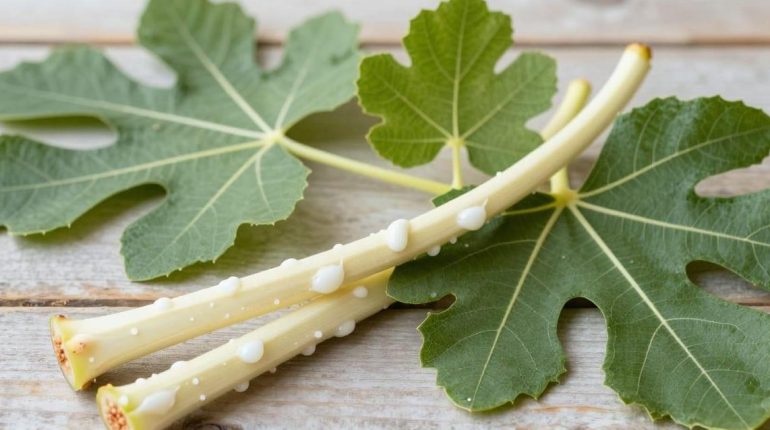
This milky and thick substance, secreted by the Ficus carica when its leaves, stems, or fruits are cut, contains a unique blend of active components: plant water, natural latex, specific enzymes, and bioactive compounds. It is precisely this natural alchemy that explains why different Mediterranean and Middle Eastern cultures have integrated it into their ancestral pharmacopoeias.
Also called fig latex or fig milk, this substance with pearly reflections has crossed eras as an empirical remedy, mainly for skin applications. Rural populations used it freshly harvested, aware of its potential but also its power.
Today, as scientific research begins to decrypt its biochemical composition, this millennial sap is attracting the attention of natural care enthusiasts. However, its use requires caution and discernment, as concentrated plant substances are never harmless. Understanding its nature and properties is the indispensable prerequisite before any experimentation.
Traditional Uses And Active Compounds
At the heart of this millennial sap is ficin, a proteolytic enzyme capable of breaking down proteins. This natural molecule, so powerful that it is now used industrially to tenderize meat, largely explains the empirical effectiveness observed in ancestral remedies.
Researchers have also identified antimicrobial and antioxidant compounds, scientifically validating what traditional practitioners have observed for generations: the sap’s ability to preserve skin integrity against environmental aggressions.
In traditional practices, the plant latex was applied sparingly to areas of thickened or rough skin. Users reported a gradual softening of calluses and a natural exfoliation thanks to the liquid’s enzymatic properties. Some preparations also aimed to even out the complexion, taking advantage of the gentle but continuous action of the enzymes on superficial dead cells.
The exfoliation induced by ficin differs radically from mechanical methods: it operates at the molecular level, delicately fragmenting the keratin proteins that hold dead skin to the surface of the epidermis. This biochemical action, combined with naturally present antioxidants, offered rural populations a rudimentary but remarkably sophisticated care tool.
Still, these ancestral uses, however ingenious they may be, do not dispense with a methodical approach for any contemporary application.
Homemade Preparations And Application Protocols
Harvesting is the first critical step. Equipped with protective gloves, delicately cut a leaf or a stem to collect the few drops of latex that immediately bead. The rapid oxidation of the liquid requires near-instantaneous use: any storage compromises the integrity of the active enzymes.
For areas of thickened skin, the traditional method advocates an ultra-targeted application. After cleaning with lukewarm water, place a single drop on the affected surface, strictly avoiding any overflow onto healthy tissue. A light bandage can maintain contact for a few hours.
The brightening mask combines three drops of sap with a tablespoon of honey and a teaspoon of lemon juice. Mix vigorously before applying with a brush or cotton pad to the cleansed face. Leave on for fifteen minutes maximum, twice a week at most, then rinse thoroughly with lukewarm water. The honey-lemon synergy amplifies the enzymatic action while buffering its irritant potential.
To regulate excess sebum, dilute two drops in a cup of rose water. This plant tonic is applied lightly with a cotton pad on clean skin, in circular movements. The natural astringent compounds temporarily tighten dilated pores.
These protocols require absolute rigor in dosages: any excess transforms an ancestral care into a source of skin irritation. The boundary between effectiveness and harmfulness remains particularly thin.
Potential Benefits And Essential Precautions
This protocol vigilance is explained by the dual nature of the sap: therapeutic promise on one side, dermatological risk on the other. Traditional observations document a gradual softening of calluses, an enzymatic exfoliation that reveals a refined skin texture, and a visible reduction in irregular pigmentations. The plant antioxidants captured in the latex offer theoretical protection against skin oxidative stress.
However, these ancestral benefits do not benefit from any robust scientific validation. Studies remain embryonic, focused on biochemical identification rather than clinical evaluation. This methodological gap requires redoubled caution: the ficin that tenderizes meat tissues can just as easily attack sensitive epidermis.
Skin reactions are the first pitfall. Redness, itching, and burning sensations frequently occur on reactive skin or during too generous applications. Contact with mucous membranes, especially the eyes, causes severe irritation requiring immediate and prolonged rinsing. Ingestion, even minimal, remains formally prohibited in the absence of reliable toxicological data.
Pregnant or breastfeeding women must categorically abstain: the absence of studies on fetal or milk transmission prohibits any experimentation. The preliminary skin test becomes mandatory: apply a micro-dose to the inner forearm and wait forty-eight hours before any extensive use.
Faced with these persistent unknowns, consulting a dermatologist or a practitioner trained in natural medicine is an indispensable safeguard. Enthusiasm for ancestral remedies should not obscure health safety imperatives.