Follow us
7 June 2026

Eggplant Parmigiana

Prep Time
30 minutes
Cook Time
40 minutes
Total Time
1h20
Servings
4 to 6 servings

Parmigiana is the dish you tell yourself you can’t make on a weekday because you imagine hours at the stove. Wrong. With 30 minutes of active prep and the oven doing the work, it’s totally doable on a tired Tuesday evening. And the result—melting layers of eggplant, tomato sauce and melted cheese—is well worth the effort.
Advertisement
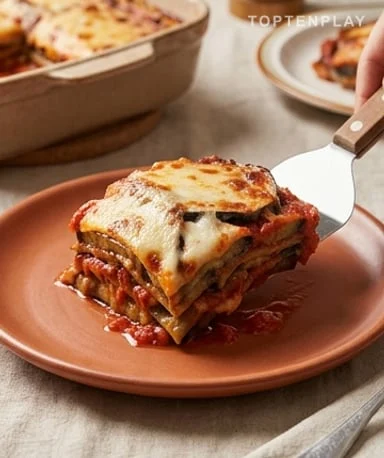
Final result
Parmigiana straight from the oven, well gratinated: generous layers of melting eggplant, tomato sauce and perfectly melted cheese.

What comes out of the oven has that golden, almost brown color on the edges where the cheese has caramelized against the dish. The smell rising is of concentrated tomatoes, warm basil, bubbling cheese. When you plunge the spatula to serve, the layers hold for a few seconds before gently collapsing—the eggplant is so tender it yields to the slightest touch. That’s exactly what you want.

Why you’ll love this recipe

Vegetarian but filling : Eggplants soak up the flavors of the sauce and cheese to saturation. No one looks for meat.
Just as good cold as hot : The next day, a cold slice on bread is a complete meal. The flavors have settled and it’s even better than the day before.
Few dishes, one pan : A baking dish, a saucepan, a frying pan. That’s all you need to take out of the cupboard.
Adaptable to what you have : No mozzarella? Scamorza or gruyère melt well. The structure stays the same, the result too.

Ingredient Notes

Ingredients

The basic ingredients: plump eggplants, good mozzarella, Parmesan, and a tomato purée perfumed with basil.

  • Eggplants : They form the structure of the dish—without them, nothing holds. To avoid bitterness and excess oil during cooking, salt them and let them sit for 20–30 minutes: the yellow, slightly bitter water that comes out proves the step is useful. Choose firm eggplants, no soft spots, medium-sized rather than very large—fewer seeds, less natural bitterness.
  • Mozzarella : It provides the stretchiness and moisture that binds the layers together. Buffalo mozzarella is creamier and melts with more character, but the classic version works fine. If you use industrial block mozzarella, drain and pat it dry before use: it contains a lot of water that can make the dish soggy during cooking.
  • Grated Parmesan : It plays two distinct roles. Between layers, it adds umami and depth. On top, it forms the golden crust: its proteins caramelize in the dry heat of the oven. Grate it fresh if possible—pre-grated Parmesan is often dehydrated and doesn’t melt as well.
  • Tomato purée : The binder between all layers. It should be slightly thickened and well seasoned before assembly—a too-runny sauce makes the dish watery and the layers slide apart. 15–20 minutes of simmering is enough to concentrate flavors. A good quality purée (with only tomatoes in the ingredients) is a great weeknight substitute for a long-cooked homemade sauce.
  • Fresh basil : It can’t handle prolonged heat. Its role is to bring a fresh, slightly aniseed note that contrasts with the intensity of the melted cheese—this is what prevents the dish from being heavy. Add it off the heat at the end of the sauce, and a few leaves only at serving time.
  • Olive oil : For cooking the eggplants and the sauce base. The temptation is to use a lot—eggplants absorb oil like sponges—but restrain. One tablespoon per batch in the pan is enough if the pan is hot at the start. Too much oil makes the dish heavy and prevents the slices from browning properly.

Eggplants aren’t cooked, they’re prepared

Most parmigiana failures come from poorly handled eggplants. First, cut them into slices about 5 mm thick lengthwise—not too thin (they disappear during cooking), not too thick (they remain hard in the center). Layer them in a colander, sprinkle generously with salt, and let rest 20–30 minutes. Droplets of yellow, slightly bitter water form on the surface—that’s exactly what you want to remove. After a quick rinse and drying with paper towels, the slices are ready to cook without releasing water into the dish. In a hot pan with a drizzle of oil, they brown in 3–4 minutes per side and become tender, slightly translucent, with brown cooking marks that smell of grilled vegetables. Set them aside on paper towels while you prepare the rest.

Eggplants aren't cooked, they're prepared
Assembling the dish, layer by layer—the key to a parmigiana well balanced in both taste and texture.

A quick sauce, not a sauce that simmers all day

Parmigiana sauce doesn’t need to be complex to be good. The onion sautéed over medium heat in olive oil for 5 minutes becomes translucent and slightly sweet—it loses its sharpness and releases its natural sweetness. The crushed garlic (not chopped, to avoid burning) goes in for a minute, then the purée goes into the pot with salt, pepper, and a pinch of sugar if the tomatoes are too acidic. Fifteen to twenty minutes of simmering is enough to concentrate the flavors: the sauce should coat the spoon without being too thick, with a deep orange-red color and a smell that begins to caramelize slightly on the edges. Fresh basil, torn by hand rather than chopped, goes in at the last minute off the heat—added too early, it blackens and becomes bitter, ruining everything.

Assembly: the logic of layers

Assemble in a baking dish of the right size—too large and the layers will be too thin and dry, too small and the cheese will overflow during cooking. Start with a thin layer of sauce on the bottom, which prevents the eggplants from sticking and drying out. Then a layer of eggplants slightly overlapping, a few spoonfuls of sauce, pieces of mozzarella broken by hand so they melt unevenly, and a good handful of grated Parmesan. Repeat until the ingredients are used up—usually two to three layers depending on the depth of the dish. The top layer must always end with cheese on the surface, Parmesan first, to get that gratinated crust which is the visual signature of the dish.

The oven works, but you need to watch the end

At 180°C, the dish cooks for 30–40 minutes. During the first twenty minutes, nothing spectacular: the sauce bubbles gently on the edges, the mozzarella begins to melt and blend into the other layers. It’s in the last quarter of an hour that the surface takes color—the Parmesan browns, the whole thing firms up slightly, and a smell of caramelized cheese starts coming out of the oven. Cooking is done when the top is golden with darker spots on the edges, and a knife tip inserted in the center comes out hot. If the top browns too quickly, lay a sheet of parchment paper loosely on top. If, on the contrary, the surface remains pale at 35 minutes, switch to grill mode for 2–3 minutes, watching closely—it burns in one minute of inattention.

Resting, the most overlooked and most important part

Taking the parmigiana out of the oven and serving it immediately is the best way to end up with a shapeless mush on the plate. The liquids are still moving, the layers haven’t had time to firm up. Ten minutes of rest at room temperature changes everything: the sauce thickens slightly on contact with the air, the cheese solidifies, the layers hold when cut. You then get neat portions, with that beautiful cross-section where the dark layers of eggplant, the deep red of the sauce, and the creamy white of the melted cheese alternate. A few fresh basil leaves placed at serving time bring a note of freshness that contrasts with the hot melty gratin.

Resting, the most overlooked and most important part
40 minutes in the oven at 180°C to achieve this well-gratinated top, slightly caramelized on the edges.

Tips & Tricks
  • Dry the eggplants well after rinsing before pan-frying. A wet slice splashes water into the hot pan, drops the temperature instantly, and turns the cooking into steaming—result: soft, grey slices without any browning.
  • Don’t drown each layer in sauce. The idea is to mortar, not to flood: a thin layer that covers without forming a pool. Too much liquid sauce rises to the surface during cooking, makes the eggplants soggy, and gives a watery dish instead of a structured gratin.
  • Let rest at least 10 minutes before cutting. This isn’t patience for nothing—the layers only stabilize when the temperatures drop slightly. This holds for all gratins, and parmigiana in particular.
  • Reheat in the oven rather than the microwave. In the microwave, the mozzarella becomes rubbery and the whole thing loses its texture in a few seconds too many. 15 minutes at 160°C and the dish regains its first-day softness, with the crust becoming slightly crisp again.
Close-up
The melt of the cheese, the softness of the eggplant, the acidity of the tomato—all the richness of parmigiana in one forkful.
FAQs

Is it really necessary to salt and drain the eggplants before cooking?

Yes, and the step is worth the 20-minute wait. The salt extracts the bitter water from the flesh, giving slices that brown properly in the pan instead of releasing moisture into the dish. Without it, the final result is often watery and the flavors less concentrated.

Can parmigiana be made ahead?

Not only is it possible, it’s often better the next day. The layers have time to soak into each other, the sauce has settled well, the flavors are more melded. You can assemble it the day before, cover it and keep it in the fridge, then bake the same day.

Is it better to fry or grill the eggplants?

Both work, but the pan-fried version with a drizzle of oil is quicker and lighter than traditional deep-frying. The key is that the pan is very hot at the start to get a good color without the slices absorbing oil like a sponge. In the oven at 200°C, they cook in 20 minutes, flipped halfway—handy when you have lots of slices to deal with.

Which mozzarella to choose for parmigiana?

Fresh mozzarella (ball in whey) melts more creamily, but it contains a lot of water that must absolutely be removed—slice it and pat dry with paper towels before use. Industrial block mozzarella is drier and melts more evenly, which can be an advantage for a well-held gratin.

Can parmigiana be frozen?

Yes, it freezes well once cooked and cooled, in individual portions or whole. The texture of the eggplants will be slightly softer upon thawing, but the flavors remain intact. Reheat directly from the freezer in the oven at 160°C for 30–40 minutes, covered with parchment paper for the first 20 minutes.

How many layers should you do?

Two to three layers is the norm depending on the depth of the dish. The important thing is to finish with a generous layer of cheese on top—that’s what forms the gratinated crust. If the dish is too shallow for three full layers, two well-filled layers are better than three skinny layers.

Eggplant Parmigiana

Eggplant Parmigiana

Easy
Italian
Main course

Prep Time
30 minutes
Cook Time
40 minutes
Total Time
1h20
Servings
4 to 6 servings

The great classic of southern Italy: layers of melting eggplant, tomato sauce perfumed with basil, and melted cheese. A generous vegetarian dish, just as good the same night as reheated the next day.

Ingredients

  • 3 large eggplants (about 1 kg total)
  • 3 tbsp olive oil (+ a drizzle for the pan)
  • 500 ml tomato purée
  • 1 onion, finely chopped
  • 2 garlic cloves, crushed
  • 1 tsp sugar (optional, depending on acidity of purée)
  • 150 g mozzarella, drained and patted dry
  • 80 g grated Parmesan
  • 10 fresh basil leaves
  • Salt and black pepper

Instructions

  1. 1Cut the eggplants into 5 mm slices lengthwise. Layer them in a colander, sprinkle salt between each layer and let drain for 20–30 minutes. Rinse with cold water then dry thoroughly with paper towels.
  2. 2Heat a drizzle of oil in a large frying pan over high heat. Brown the eggplant slices in batches, 3–4 minutes per side, until golden. Set aside on paper towels.
  3. 3In a saucepan, sauté the chopped onion in 2 tablespoons of olive oil over medium heat for 5 minutes. Add the crushed garlic and cook for 1 minute. Pour in the tomato purée, season with salt, pepper, and sugar if needed. Simmer over low heat for 15–20 minutes. Add the torn basil off the heat.
  4. 4Preheat the oven to 180°C. Spread a thin layer of tomato sauce on the bottom of a baking dish. Arrange a layer of eggplants, slightly overlapping.
  5. 5Distribute a few spoonfuls of sauce, pieces of mozzarella broken by hand, and a handful of grated Parmesan. Repeat until ingredients are used up (2 to 3 layers depending on dish depth).
  6. 6Finish with a generous layer of grated Parmesan. Bake for 30–40 minutes until the top is golden brown and the sauce bubbles on the edges.
  7. 7Let rest 10 minutes out of the oven before cutting and serving. Sprinkle with a few fresh basil leaves.

Notes

• Eggplants must be well dried before going into the pan—a wet slice lowers the temperature and prevents browning.

• For an even creamier version, tuck a few spoonfuls of ricotta between two layers.

• The dish keeps for 2–3 days in the refrigerator. Reheat in the oven at 160°C for 15 minutes rather than in the microwave to preserve texture.

• Parmigiana freezes perfectly. Thaw in the refrigerator overnight then reheat covered in the oven for 30 minutes at 160°C.

Nutrition Facts (per serving, estimated)

370 kcalCalories 17gProtein 22gCarbs 24gFat
Advertisement
Share on Facebook