Follow us
7 June 2026

Egg, Turkey Ham and Béchamel Gratin

Prep Time
20 minutes
Cook Time
30 minutes
Total Time
50 minutes
Servings
4 portions

The smell of béchamel starting to brown — butter, hot milk, cheese slowly taking on color — is the kind of signal that gets people off the couch. This egg and turkey ham gratin is one of those recipes you make without hesitation, because it’s honestly good and pleases everyone at the table. Comforting, simple, honest.
Advertisement
Final result
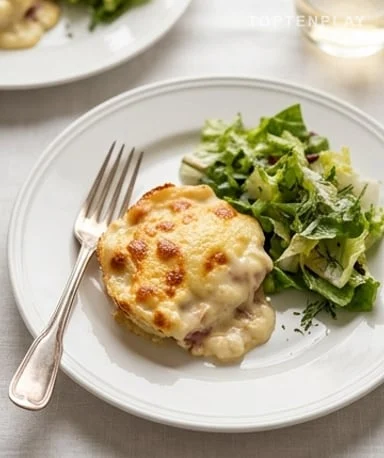
The gratin comes out of the oven with its golden cheese crust and bubbling béchamel — hard to resist.

The pearly béchamel coats the hard-boiled eggs like a velvety cloak, the strips of turkey ham add their softness, and the cheese gratinates on top, forming that irregular crust that cracks slightly under the spoon. It all smells like a hot oven, melted cheese — the kind of cooking that doesn’t try to impress but still succeeds. When it comes out of the oven, the dish still crackles, the béchamel bubbles here and there at the edges — it’s the right moment to wait two minutes before digging in, if you can restrain yourself.
Why you’ll love this recipe

Effortless preparation : Assembly takes less than 20 minutes. There’s no tricky technique to master — if you know how to boil water and whisk a sauce, you’ve got this.
One-dish meal : Eggs provide protein, béchamel acts as sauce and binder, cheese gratinates everything into a complete dish. A green salad on the side and you’re set.
Leftovers are almost better : Reheated in the oven the next day with a little extra cheese on top, the gratin is even more flavorful — the béchamel has had time to soak into the eggs and ham.
Adaptable to your fridge : Sautéed mushrooms, spinach, a handful of melted leeks — this gratin happily accepts anything you slip between its layers, as long as it doesn’t release too much water.

Ingredient Notes

Ingredients

Everyday ingredients: eggs, turkey ham, Emmental, and homemade béchamel. Simple and effective.

  • Eggs : The heart of the dish. You want them hard-boiled but not rubbery — 9 minutes in boiling water, no more. Beyond that, the yolk turns gray-green and the texture becomes dry, ruining everything once coated in béchamel. Run them under cold water immediately after cooking to stop the process dead.
  • Turkey ham : It replaces classic white ham with the same tender texture and mildly salty edge. Choose thick slices rather than shaved: cut into cubes or strips, it holds up better during cooking and you actually get it in every bite instead of disappearing into the sauce.
  • Grated Emmental : It melts, gratinates, and browns. Emmental is the classic choice because it melts well without releasing water and colors nicely under the grill. If you like a stronger taste, mix half with aged Comté. Avoid soft cheeses — they melt poorly in this context and can make the surface greasy and unappetizing.
  • Butter and flour (the roux) : The base of any béchamel. In equal parts, these two ingredients form the roux that thickens the milk: the butter coats the flour grains to prevent lumps. The golden rule: never pour the milk all at once, and whisk continuously as soon as it enters the pot.
  • Whole milk : Whole milk gives a creamier and more stable béchamel than skimmed or semi-skimmed. If you don’t have any on hand, semi-skimmed works, but the sauce will be slightly less velvety. Preferably add it warm — this avoids the thermal shock with the hot roux, the main cause of lumps.
  • Nutmeg : Optional on the list, essential in practice. A pinch of freshly grated nutmeg transforms a flat béchamel into something aromatic and deep. It’s a natural enhancer that lifts all the other ingredients without you pinpointing exactly where the difference comes from — you just know it’s better.

Eggs that stay tender

It all starts with the eggs, and that’s where many gratins fail from the start. Plunge them into a pot of already boiling water — not cold — and count exactly 9 minutes. This precision is not a whim: less, the white isn’t firm enough and falls apart when cut; more, the yolk turns gray-green and dries out, losing all its interest under the béchamel. At 9 minutes, the yolk is just set, still slightly soft in the center, and the white is perfectly firm. Transfer them directly to a bowl of cold water — this stops the cooking instantly and makes peeling easier. Then cut them in half lengthwise: the longitudinal cut is more visually appealing and the egg halves hold better in layers in the dish.

Eggs that stay tender
The key to the gratin: a smooth, coating béchamel, patiently whisked to the right consistency.

Béchamel: all about rhythm

Béchamel has a reputation as a complicated sauce that it doesn’t really deserve, as long as you respect its rhythm. In a heavy-bottomed pot, melt the butter over medium heat — it should foam slightly without browning. Add the flour all at once and whisk immediately: you get a pale blond roux that smells slightly of cooked dough. Let it cook for 1 to 2 minutes while stirring — this step is crucial to eliminate the raw flour taste that many people criticize in their béchamel. Then pour in the milk in a steady stream while whisking non-stop. The sauce thickens gradually, gains body, becomes smooth and coating. Seasoning comes last: salt, freshly ground black pepper, and that pinch of nutmeg that changes everything. The target texture is a sauce that coats the back of a spoon but still flows — too thick, it will smother the gratin; too thin, it will make a soggy bottom.

Assembly: layers and generosity

Butter the gratin dish — not for flavor, but so the bottom béchamel doesn’t stick and serving is cleaner. Start with a thin layer of béchamel directly on the bottom: this protects the eggs from the direct heat of the dish and keeps them tender during cooking. Then arrange the egg halves yolk-side up — they look prettier when cut and absorb the sauce better this way. Interlace the turkey ham strips or cubes on and around the eggs, then generously coat with béchamel. If your dish is deep, make two layers by repeating the process. Always finish with béchamel, then a generous covering of grated cheese over the entire surface. The cheese thickness is not cosmetic: it forms the crust, protects the sauce underneath from the intense grill heat, and creates that texture contrast — crispy on top, melting below — that makes the dish truly addictive.

Oven and grill: two distinct stages

First the oven, at 200°C (fan-assisted), for 20 to 25 minutes. This initial phase heats the gratin through, brings the béchamel to a gentle simmer, and starts melting the cheese without burning it. You hear the dish crackling softly, see the béchamel bubbling at the edges — that’s the good sign that the heat has penetrated well. Then comes the grill, 3 to 5 minutes maximum, watching closely. The cheese goes from melted to golden in a few minutes and can turn black very quickly if you turn your back. The goal: a brown and irregular crust with some areas darker than others, not a uniformly reddish surface. Remove the dish as soon as you see the first well-browned spots and the cheese is slightly blistering. Let it rest for 2 minutes before serving — the béchamel is at its peak heat and stabilizes a bit, making cutting cleaner and the flavor more balanced.

Oven and grill: two distinct stages
In the oven at 200°C until bubbling, then under the grill for the golden crust that cracks under the spoon.

Tips & Tricks
  • Warm the milk before adding it to the roux: the thermal shock between a hot roux and cold milk is the main cause of lumps. Two minutes in the microwave is enough, and the sauce smooth out much more easily.
  • Do not salt the water for boiling the eggs. Unlike pasta, salt adds nothing here — and in high concentration, it can slightly harden the white and make the texture less even.
  • Add a teaspoon of whole-grain mustard to the béchamel if you like slightly spicy flavors: it disappears into the sauce but brings a slight acidity that balances the cheese’s fat and wakes up everything.
  • If you prepare the gratin in advance, assemble it without baking and cover with plastic wrap in the refrigerator. Add 5 to 8 minutes of oven time if you bake it directly from cold — a cold béchamel takes much longer to heat through and the gratinated cheese may burn before the inside is hot.
Close-up
Crispy top, melting heart: that’s exactly what you want in a good homemade gratin.
FAQs

Can I prepare this gratin in advance?

Yes, and it’s even convenient. Assemble the complete gratin without baking, cover with plastic wrap and refrigerate for up to 24 hours. When baking, add 5 to 8 extra minutes of cooking so the heat penetrates well before switching to the grill.

How do I avoid lumps in the béchamel?

Two things make the difference: pour the milk gradually in a stream rather than all at once, and warm the milk beforehand to avoid thermal shock with the hot roux. If lumps still appear, a vigorous whisk off the heat or a quick immersion blender blitz solves the problem.

What cheese can I use if I don’t have Emmental?

Aged Comté is an excellent alternative — it gratinates well and brings a more intense flavor. You can also mix Gruyère with a handful of Parmesan for a more golden and slightly drier crust. Avoid soft cheeses like Camembert or Brie, which release too much fat during cooking.

Can I freeze this gratin?

It’s possible but not ideal. The béchamel tends to separate slightly upon thawing, and hard-boiled eggs become a bit rubbery after freezing. If you want to prepare it for later, it’s better to assemble it raw and freeze before baking rather than after.

How do I reheat leftovers without drying out the gratin?

In the oven at 160°C for 10 to 15 minutes, with a little extra grated cheese on top and a splash of water or milk poured into the dish before baking — this restores the creaminess of the béchamel. The microwave works in a pinch, but the crust softens and the eggs lose their texture.

Egg, Turkey Ham and Béchamel Gratin

Egg, Turkey Ham and Béchamel Gratin

Easy
French
Main course

Prep Time
20 minutes
Cook Time
30 minutes
Total Time
50 minutes
Servings
4 portions

A simple and comforting family gratin: tender hard-boiled eggs, turkey ham, all topped with a creamy homemade béchamel and gratinated under a golden Emmental crust. Ready in under an hour with everyday ingredients.

Ingredients

  • 6 eggs
  • 4 slices turkey ham (about 120 g)
  • 150 g grated Emmental (or Comté)
  • 40 g butter (for the béchamel)
  • 1 knob butter (for the dish)
  • 40 g all-purpose flour
  • 500 ml whole milk
  • 1 pinch freshly grated nutmeg
  • ½ tsp salt
  • ¼ tsp freshly ground black pepper

Instructions

  1. 1Plunge the eggs into a pot of boiling water and cook for exactly 9 minutes. Transfer immediately to a bowl of cold water, peel, and cut in half lengthwise. Set aside.
  2. 2Preheat the oven to 200°C (fan-assisted). Lightly butter a gratin dish.
  3. 3Melt 40 g butter in a saucepan over medium heat. Add the flour all at once and whisk to form a roux. Cook for 1 to 2 minutes, stirring, without browning.
  4. 4Pour in the milk in a steady stream while whisking continuously until the sauce is smooth and coats the back of a spoon. Season with salt, pepper, and nutmeg. Remove from heat.
  5. 5Spread a thin layer of béchamel on the bottom of the dish. Arrange the egg halves yolk-side up. Cut the turkey ham into strips or cubes and distribute over the eggs.
  6. 6Generously coat with béchamel and sprinkle the grated Emmental over the entire surface.
  7. 7Bake for 20 to 25 minutes, until the béchamel is gently bubbling at the edges. Then switch to grill mode for 3 to 5 minutes, watching closely, until a golden and irregular crust forms. Let rest 2 minutes before serving.

Notes

• Warm the milk in the microwave before adding it to the roux — this prevents lumps and speeds up thickening.

• For a spicier flavor, add a teaspoon of whole-grain mustard to the béchamel.

• Complete variation: slide cooked potato slices between the layers for an even heartier dish.

• The gratin keeps for 2 days in the refrigerator. To reheat, add a little cheese on top and bake at 160°C for 12 to 15 minutes.

Nutrition Facts (per serving, estimated)

478 kcalCalories 30 gProtein 14 gCarbs 33 gFat
Advertisement
Share on Facebook