Follow us
10 June 2026

Dollywood-Style Cinnamon Pull-Apart Bread

Prep Time
20 minutes
Cook Time
30 minutes
Total Time
50 minutes
Servings
6 portions

There are autumn mornings when you want something warm, sweet, that fills the house with fragrance even before the coffee is ready. This cinnamon pull-apart bread comes straight from the legendary stands of Dollywood, the Tennessee theme park where the lines to buy it can last an hour. The good news: at home, it takes less time than finding a parking spot.
Advertisement
Final result
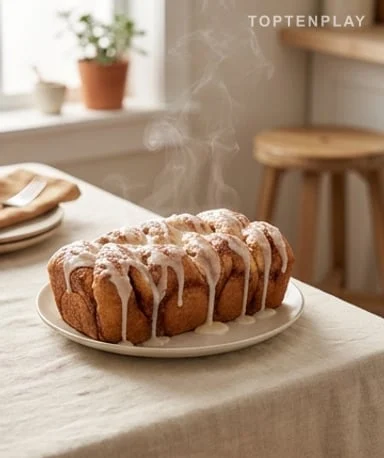
Dollywood-style cinnamon pull-apart bread: golden, soft, with vanilla glaze dripping between each piece.

What strikes you first is the color — a golden amber hue where the sugar has slightly caramelized against the sides of the pan, with that pearly white glaze trickling into every crevice. When you pull off a piece, you hear a slight tearing sound: the soft crumb giving way, coated in a thin, sweet crust. The smell of warm cinnamon mingles with the vanilla of the glaze and spreads throughout the room. It’s the kind of dish that disappears from the table before you’ve finished setting it down.
Why you’ll love this recipe

Ready in under an hour : No kneading, no rising time to watch over. The frozen dough does the basic work, you just handle the flavor and presentation.
Sharing is built into the format : Pull-apart is meant for picking directly from the dish with others. No need for a knife or individual plates — it’s the perfect argument for a family brunch or a lazy Sunday.
The technique is hard to mess up : No caramel to watch over, no dough to knead. If you know how to hold a knife and mix sugar in a bowl, you can do it without stress.
Customizable to your liking : More cinnamon for thrill-seekers, thicker glaze for sweet tooths, a touch of cardamom to step out of the classic. The base lends itself to many variations without losing its identity.

Ingredient Notes

Ingredients

Frozen bread dough, butter, cinnamon, sugar, and a simple glaze from powdered sugar — no more needed.

  • Frozen bread dough (Rhodes-style) : This is the base and the smart shortcut of the dish. Store-bought frozen dough is already balanced in gluten and salt — it cuts cleanly when still cold, which is exactly what we want. Thaw it in the refrigerator overnight rather than at room temperature: dough that’s too warm becomes sticky, collapses, and is hard to incise cleanly.
  • Melted butter : Its role is twofold: it penetrates between the cut sections to add fat and richness, and it acts as glue so the cinnamon-sugar mixture adheres everywhere, even in the crevices. Unsalted butter works better here than salted, which can unbalance the sweetness. Melt it gently — not on high power in the microwave — so it remains homogeneous and easy to work with.
  • Granulated sugar : Classic white sugar creates a slight caramelization during baking when in contact with the pan and dry heat. It gives that subtle crunch to the outside of each piece. Avoid brown sugar here: it contains more moisture and can make the crust soft instead of slightly crispy.
  • Ground cinnamon : This is the star ingredient, so quality really matters. Cinnamon that was opened two years ago has lost much of its essential oil — it smells little, tastes little. Get a fresh one, ideally Ceylon rather than Cassia, which is sweeter and less harsh on the palate. Two tablespoons in a cup of sugar is the Dollywood ratio: generous but not aggressive.
  • Powdered sugar : It forms the base of the glaze. Its ultra-fine texture dissolves instantly in liquid, giving that smooth, opaque consistency characteristic. Lightly pack it before measuring to avoid air pockets, or sift it directly into the bowl for a lump-free result.
  • Whole milk or heavy cream + vanilla extract : The liquid of the glaze determines its fluidity. Start with two tablespoons and add a third if you want a runnier glaze that seeps well between pieces. Heavy cream gives a thicker, richer result that stays more on the surface. Vanilla extract is not optional — it’s what takes the glaze from ‘white sugar’ to ‘real pastry’.

The cut that makes all the difference

The pull-apart technique relies entirely on how you incise the dough, and it’s less complicated than it sounds. Take it out of the refrigerator just before starting — cold, it’s firm and cuts cleanly without sticking to the knife. Place it in a lightly greased loaf pan and, with a sharp blade, make lengthwise cuts every 2 cm or so, without going all the way down. You want the sections to remain attached at the base, like the pages of a book not yet separated. Then cut crosswise to create a grid. This lattice is what allows butter and cinnamon to penetrate everywhere — not just on the surface. If the cuts are too shallow, the center of the bread will be bland; too deep, the pieces will separate before baking and the bread loses its characteristic structure.

The cut that makes all the difference
The grid cut without going all the way through is the key to pull-apart: each piece soaks up butter and cinnamon while remaining attached.

Coat without holding back

Pour the melted butter slowly over the top, trying to let it flow into each slit — a small spoon can help direct the liquid into the narrower gaps. The dough absorbs quickly, and any excess accumulates at the bottom of the pan, which is exactly what you want: it will create that slightly caramelized bottom you find when unmolding. For the cinnamon-sugar mixture, don’t just sprinkle it on top. Gently spread each section with your fingers and coax the cinnamon sugar into the spaces — the smell that wafts up at this moment already gives an idea of what’s coming. The goal is a dense, uniform coating throughout the volume of the dough, not a thin decorative layer on top.

Baking: monitor without stressing

The oven must be well preheated to 175°C before the pan goes in. A cold oven at the start gives dough that rises too quickly on the surface before the inside is cooked — you get a nice appearance and a doughy center. Expect about 25 to 30 minutes depending on your oven. At the halfway point, a smell of warm cinnamon begins to spread through the kitchen and the surface takes on a deep golden brown color. Don’t rely solely on color: press lightly in the center with your finger — if it springs back, it’s done. If it sinks softly, leave it for five more minutes. Let it rest in the pan for two minutes before glazing, so the structure stabilizes slightly before receiving the liquid.

Glaze while it’s still hot

This is the moment when everything visually transforms. Mix the powdered sugar, milk, and vanilla until you get a fluid but not watery consistency — it should flow in a continuous ribbon from the whisk, without breaking. Pour it directly over the hot bread in a zigzag, without trying to cover evenly: the drips into nooks and crannies are part of the charm. The heat of the bread slightly melts the glaze, which seeps into the slits and coats each piece with a sweet, vanilla film. If you wait until the bread is cold to glaze, it stays on the surface and dries into a hard, compact layer — you lose all that melting quality you’re aiming for.

Glaze while it's still hot
In the oven at 175°C, the dough rises and the cinnamon sugar gently caramelizes to form a slightly crispy crust.

Tips & Tricks
  • Thaw the dough in the refrigerator the night before, not on the countertop. Dough thawed at room temperature becomes sticky and hard to incise cleanly — the sections stick together and the grid loses its neatness even before going into the oven.
  • Grease the pan generously, including the sides all the way up. Caramelized sugar sticks easily to an insufficiently prepared surface, and unmolding the hot bread without damaging it can become complicated. A little butter or cooking spray on all interior surfaces avoids this problem effortlessly.
  • Don’t double the cinnamon out of reflex. Too much cinnamon can make the dough slightly bitter during baking and completely cover the vanilla in the glaze. Stick with the two tablespoons — it’s the right balance between fragrant and indulgent, the one that exactly recalls the original.
  • Serve within 15 minutes after glazing. Pull-apart bread loses a good part of its texture as it cools: the crumb compacts, the sugar hardens, the glaze crystallizes. If you need to prepare it ahead, heat it for 8 minutes at 160°C before serving and add the glaze only at the last moment.
Close-up
The soft inside, the layers of melted cinnamon sugar, and the drizzle of vanilla glaze — that’s exactly what we’re after.
FAQs

Can I use homemade dough instead of frozen dough?

Yes, a classic white bread dough works very well, provided it has already gone through a first rise. The advantage of frozen dough is that it is firm and cold at the time of cutting, which makes clean incisions easier. If you use homemade dough, place it in the refrigerator for 30 minutes before incising to regain that same firmness.

Can I assemble the bread the day before?

You can do all the preparation — incising, butter, cinnamon-sugar — the night before, cover the pan with plastic wrap, and leave it in the refrigerator until the next day. Just bake it straight from the fridge, adding 5 minutes to the baking time. The glaze is always done last, just before serving.

How to store and reheat leftovers?

The bread can be stored at room temperature under plastic wrap or in an airtight container for 1 to 2 days. To reheat, place portions in the oven at 160°C for 8 to 10 minutes — it regains much of its softness. For a quick single serving, 20 seconds in the microwave is enough.

Is the glaze mandatory?

No, the bread is very good without glaze, simply dusted with powdered sugar when serving. The glaze nevertheless brings the melting texture and vanilla touch that brings the result closer to the original Dollywood. If you want something less sweet, a pat of butter placed on top of the hot pieces is an effective alternative.

How do I know if the bread is fully baked in the center?

The golden surface is not enough to confirm center doneness, especially with a thick dough ball. Press lightly on top with a finger: if the dough springs back immediately, it’s done. If it stays indented, cover the pan with aluminum foil and leave for another 5 minutes to avoid over-browning the top.

Can I freeze this bread?

Yes, but always without the glaze. Let it cool completely, wrap in plastic wrap then in a freezer bag, and store for up to a month. To serve, thaw for 2 hours at room temperature, reheat for 10 minutes at 160°C, then add fresh glaze just before serving.

Dollywood-Style Cinnamon Pull-Apart Bread

Dollywood-Style Cinnamon Pull-Apart Bread

Easy
American
Bakery & Pastries

Prep Time
20 minutes
Cook Time
30 minutes
Total Time
50 minutes
Servings
6 servings

Cinnamon sugar pull-apart bread inspired by the iconic stands of Dollywood — soft crumb coated in caramelized cinnamon, drizzled with a runny vanilla glaze. Ready in under an hour thanks to frozen dough, with no kneading or rising time to manage.

Ingredients

  • 450g frozen bread dough (Rhodes-style), thawed in the refrigerator overnight
  • 60g unsalted butter, melted (about 4 tbsp)
  • 200g granulated sugar (about 1 cup)
  • 16g ground cinnamon (2 tbsp)
  • 120g powdered sugar (about 1 cup)
  • 3 tbsp whole milk or heavy cream
  • ½ tsp vanilla extract

Instructions

  1. 1Preheat the oven to 175°C. Generously grease a loaf pan on all sides, including the walls.
  2. 2Take the thawed dough out of the refrigerator — it should still be cold and firm. Place the dough ball in the pan and make lengthwise cuts every 2 cm or so, without cutting all the way through, then cut crosswise to create a pull-apart grid. The sections should remain attached at the base.
  3. 3Slowly pour the melted butter over the bread, directing the liquid into each slit with a small spoon.
  4. 4Mix the granulated sugar and cinnamon in a bowl. Generously sprinkle over the bread, spreading each section with your fingers to let the mixture penetrate into the crevices, not just on the surface.
  5. 5Bake for 25 to 30 minutes, until the surface is nicely golden and the center springs back immediately when pressed with a finger.
  6. 6Let rest in the pan for 2 minutes. Meanwhile, whisk the powdered sugar, milk, and vanilla extract until smooth and runny.
  7. 7Drizzle the glaze in a zigzag over the still-hot bread so it seeps into the slits, then serve immediately.

Notes

• The dough must be cold at the time of cutting for clean incisions. If it has softened too much, put it back in the refrigerator for 15 minutes before proceeding.

• For a thicker glaze that stays on the surface, replace the milk with heavy cream and reduce to 2 tablespoons.

• To reheat leftovers, bake at 160°C for 8 to 10 minutes and add the glaze after reheating — never before.

Nutrition Facts (per serving, estimated)

455 kcalCalories 5gProtein 83gCarbs 11gFat
Advertisement
Share on Facebook