📌 Deviled eggs: the little-known trick to peel them easily (and 6 variations to surprise your guests)
Posted 8 March 2026 by: Admin
Deviled Eggs: The Timeless Appetizer That Spans Generations
Deviled eggs embody that rare alliance between culinary tradition and modern practicality. Present on Easter tables for decades, they are now invited to Sunday brunches, improvised appetizers, and sophisticated buffets alike. Their secret? A disconcerting simplicity that requires only three essential ingredients: eggs, mayonnaise, and Dijon mustard.
This classic recipe perfectly meets contemporary nutritional requirements. Low in carbs and high in protein, it adapts to multiple diets without compromising on flavor. Two tablespoons of light mayonnaise are enough to obtain that characteristic creamy texture, while a teaspoon of mustard provides the touch of subtle spice that makes all the difference.
The true strength of deviled eggs lies in their adaptability. The base remains unchanged, but the variations are infinite: substituting mayonnaise with Greek yogurt for a lighter version, adding pickles for a tangy note, incorporating bacon for foodies, or even jalapeño peppers for those who like it hot. Each version retains the essence of this great classic while reflecting personal tastes.
This versatility transforms a simple appetizer into a culinary blank canvas, ready to welcome creativity and boldness without ever losing its soul.
The Foolproof Technique For Perfectly Prepared Eggs
Peeling hard-boiled eggs is the real challenge of this recipe. A mastered technique transforms this dreaded step into a formality. The fundamental rule: use eggs that are at least ten days old. Eggs that are too fresh stubbornly adhere to their membrane, making peeling laborious and the result disappointing.
Cooking offers several options depending on the equipment available. The Instant Pot revolutionizes the process: the pressure allows the eggs to “literally pop out of their shells” as the saying goes. The air fryer and the traditional stovetop method also work, provided the precise timing is respected. Whatever technique is chosen, an immediate ice bath after cooking remains imperative to stop the process and avoid that unpleasant greenish ring around the yolk.
The timing of peeling matters as much as the cooking. Contrary to popular belief, you should intervene as soon as the eggs can be handled, while still warm. Completely cooled eggs are more resistant, as their membrane tightens and complicates the operation. This optimal temperature window, between hot and warm, guarantees an impeccable result with smooth and intact whites.
These technical details eliminate guesswork and ensure a perfect base for the creamy filling that will bring these sophisticated little bites to life.
The Secret To A Creamy Filling And A Caterer-Worthy Presentation
Texture determines the success of the filling. A frequent mistake is incorporating mayonnaise into yolks that are still grainy. Meticulously mashing the yolks until a fine powder is obtained before any addition guarantees the desired smoothness. For four eggs, two tablespoons of light mayonnaise and one teaspoon of Dijon mustard are enough. Salt and pepper are adjusted according to preference, but parsimony is required: the power of the mustard can be surprising.
The resulting mixture must have a homogeneous consistency, without lumps. This pale yellow cream constitutes the blank canvas that will host subsequent variations. The quality of this blend determines the final taste experience.
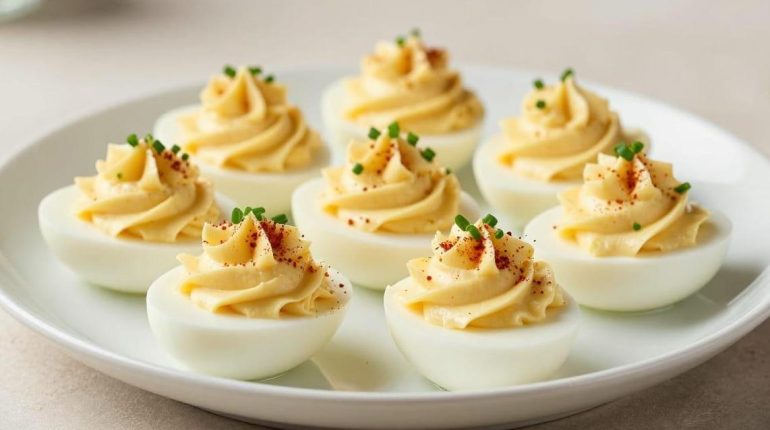
Presentation distinguishes the amateur from the professional. A piping bag equipped with a star tip instantly transforms these eggs into a creation worthy of a caterer. The circular movement, from the outside towards the center, builds an elegant rosette that catches the light. The alternative of a cut-off zip-top bag works perfectly, although it is less visually spectacular.
Finalization brings color and freshness. Chopped chives sprinkle the rosettes with delicate green touches, while dusted paprika offers that characteristic red contrast. These visual details announce the sophistication of the taste and invite immediate tasting.
Customization And Storage: Adapting The Recipe To Your Desires
The classic formula tolerates countless variations. Replacing mayonnaise with Greek yogurt considerably lightens the appetizer while preserving the creaminess. Chopped pickles, whether sweet or dill, introduce a tangy acidity that wakes up the taste buds. A few drops of red vinegar intensify this liveliness. Fans of strong sensations will incorporate grated horseradish, a few dashes of hot sauce, or finely chopped jalapeños.
Crumbled bacon crowns these eggs with an irresistible crunchy texture. Fresh dill, parsley, or shallots advantageously replace traditional chives. Each modification transforms the taste experience without complicating the preparation.
Logistics favor anticipation. Eggs can be cooked two days before the event: whites wrapped airtight in plastic wrap, filling stored in a resealable bag. This organization divides the work and eliminates last-minute stress. Final assembly requires fifteen minutes maximum.
Storage requires vigilance. In the refrigerator, these eggs last two to three days in an airtight container. During receptions, the two-hour limit at room temperature is mandatory: beyond that, bacteria proliferate dangerously. A watery filling usually signals overcooking or an excess of acidic liquid. This modular recipe adjusts to dietary constraints and personal preferences without sacrificing elegance or flavor.