Have you ever watched a Japanese chef roll an omelet with that quiet precision that makes it look like it’s second nature? Dashimaki tamago is exactly that: a technique that looks intimidating from the outside, but only requires patience and two or three tries — like all good things. The Kansai version, from Osaka, with its high dashi ratio, is by far the most flavorful.
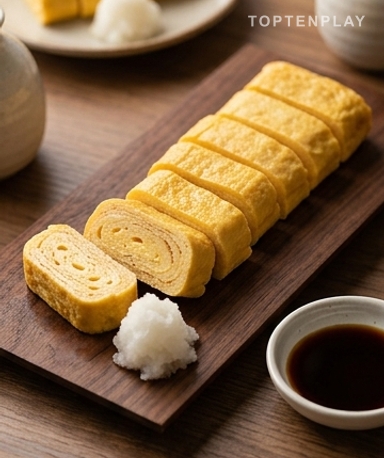
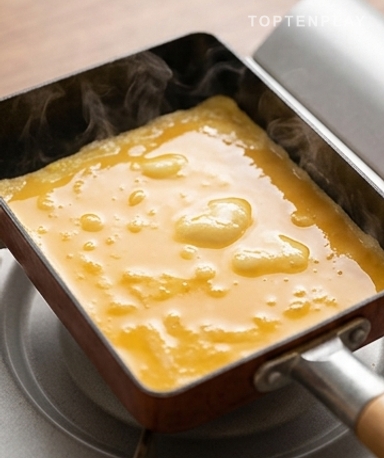
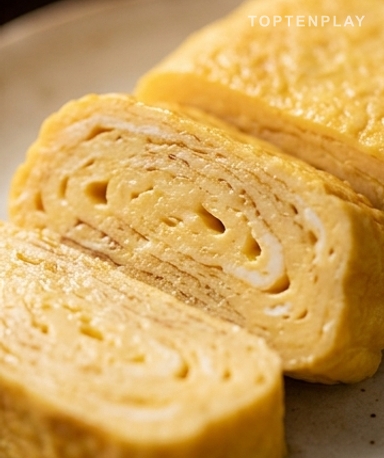
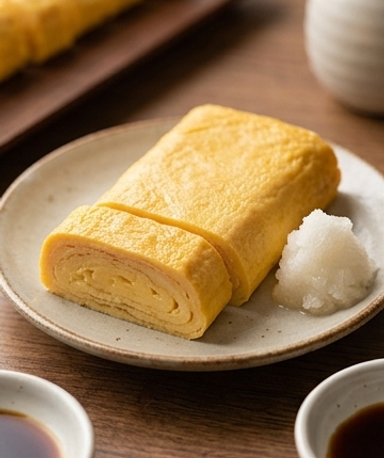
What you see before you is an omelet with layers as thin as a book page, a golden yellow like very light caramel, which trembles slightly when the plate is set down. Slice it and it barely resists the knife. Inside, the texture is almost custard-like — moist, silky, with that discrete dashi aroma reminiscent of the sea and dried seaweed. The grated daikon on the side isn’t just decoration: its fresh and slightly peppery side cuts through the sweetness of the egg exactly where it’s needed.
Why you’ll love this recipe
Ingredient Notes
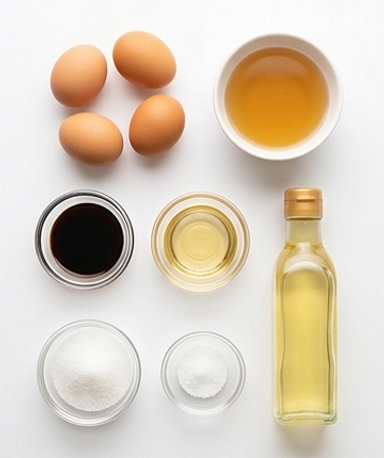
Everything you need for the omelet: eggs, dashi, and a few essential Japanese condiments.
- Eggs : Three large eggs, at room temperature if possible — it makes mixing with the cold dashi easier. No need for a special variety, but free-range eggs make a real difference in the yolk color: more orange, more beautiful on the plate.
- Dashi : This is the soul of the dish, don’t neglect it. The best is homemade kombu-katsuobushi dashi, but an instant dashi packet (Kayanoya or Ajinomoto, found in Asian grocery stores) works very well for everyday use. Avoid the jarred powder — it lacks depth and is too salty. Liquid dashi stock in a carton is also fine if you find nothing else.
- Mirin : A slightly syrupy sweet condiment that shouldn’t be replaced just by sugar, at the risk of losing the roundness. It gives the omelet that characteristic shine and a less sharp sweetness. One bottle lasts for months — it’s a useful investment.
- Soy sauce : Just a few drops, only for depth and slight coloration. A light Japanese soy sauce (usukuchi) is ideal for not darkening the omelet, but classic Kikkoman works perfectly.
- Neutral oil : To grease the pan between each layer. Sunflower, canola, grapeseed — the key is that it has no taste. Absolutely no olive oil.
Don’t whisk your eggs — cut them with chopsticks
The difference between a silky dashimaki and one full of bubbles is right here. Crack the eggs into a bowl, place the chopsticks perpendicular to the bottom and make back-and-forth movements — not circular. The goal is to break the white without aerating it. Then, pour in the dashi, soy sauce, mirin, sugar, and salt, and mix until everything is homogeneous. The color should be uniform, slightly translucent. If you see foam on the surface, remove it with a spoon — it will create holes in the omelet during cooking.
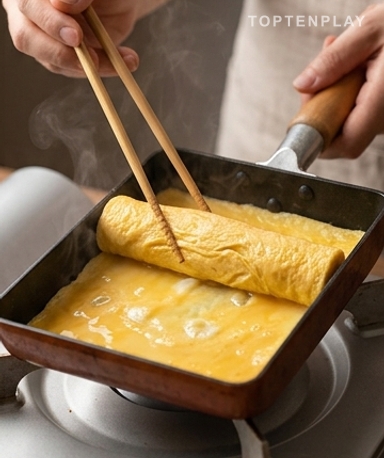
The pan should sizzle gently, not crackle
Heat your rectangular pan over medium heat. Dip a paper towel in oil and wipe it over the entire surface — lightly, not a thick layer. To test the temperature, drop a bit of the egg mixture: it should whisper in the pan, that quiet hiss that says it’s ready. If it crackles loudly, lower the heat. If nothing happens, wait another thirty seconds. Pour a thin layer of eggs and tilt the pan to cover the entire bottom in one single motion.
Roll when the top is still trembling
This is the most counter-intuitive moment of the recipe, and the most important. The top should still be slightly moist and shiny when you start rolling — not cooked dry. Use your chopsticks or a thin spatula to lift the far edge and roll towards you. The movement should be decisive but not abrupt. The first layer will always be the hardest. Then push the roll back to the far end of the pan, oil the empty bottom, pour a new layer and repeat. The roll grows with each pass — you can feel its weight changing in the pan, which is reassuring.
Tighten in the makisu while it’s still hot
As soon as the last layer is rolled, remove the omelet and place it on a makisu — the bamboo mat used for sushi — or simply on plastic wrap. Roll tightly and let rest for 5 minutes. It’s during this time that the omelet bonds, stabilizes, and takes on that neat rectangular shape we recognize. If you skip this step, it still tastes good, but it opens up when sliced. Slice into 2 to 3 cm pieces with a very sharp knife, serve with grated daikon and soy sauce.
Tips & Tricks
- If your mixture is too liquid because you added a lot of dashi, make even thinner layers — a thick layer of wet mixture will tear at the slightest hesitation.
- Keep the heat on medium-low throughout the cooking. Japanese omelets don’t get along with high heat: you want soft coagulation, not a brown crust.
- Eat the dashimaki within five minutes of slicing. This isn’t poetry — the dashi gradually seeps out and the texture changes. It’s truly meant to be eaten now.
- For the grated daikon, squeeze the excess water between your palms before serving. Too watery daikon wets the bottom of the plate and dilutes the soy sauce.
Can I use a round pan if I don’t have a rectangular pan?
Yes, a small 20 cm non-stick pan works. The roll will be rounded rather than rectangular, but the taste and texture are identical. The rectangular pan (tamagoyaki-ki) mainly facilitates rolling and maintaining the shape — it’s a plus, not a requirement.
My omelet tears every time I roll it. What am I doing wrong?
There are two main causes: either the layer is too thick, or the top is too cooked before rolling. Pour less mixture each time and roll as soon as the top is still slightly shiny and moist. Too high heat is often the culprit — stay on medium-low throughout the cooking.
How long does dashimaki tamago keep?
Dashimaki is really made to be eaten within minutes of slicing — the dashi seeps out and the texture changes quickly. If you must prepare it in advance, keep it rolled in the makisu or plastic wrap in the refrigerator for up to 24h, and slice just before serving.
What dashi should I use if I don’t have any at home?
An instant dashi packet (Kayanoya or Ajinomoto, from an Asian grocery) is the most practical solution and very high quality. Failing that, a light vegetable broth can help, but the umami profile will be different. Avoid chicken broth — it covers the delicate taste of the egg too much.
Can I make a version without matsu (bamboo) for shaping?
Yes. Place the still-hot omelet on sturdy plastic wrap, roll it tight, and twist the ends like a candy wrapper. Let rest for 5 minutes. You’ll get a cylindrical shape that’s a bit less perfect than with the makisu, but perfectly presentable.
Can you double the recipe for more servings?
It’s better to make two batches rather than doubling in the same pan. With too much mixture, the layers become thick and difficult to roll neatly. Each dashimaki takes 5 minutes to prepare — you might as well do it twice well than failing one big one.
Dashimaki Tamago
Japanese
Side Dish
Kansai-style Japanese rolled omelet, with a high dashi ratio for a silky and almost custard-like texture. Ready in 10 minutes, eat immediately.
Ingredients
- 3 large eggs (at room temperature)
- 80 ml dashi (instant packet or homemade)
- 1 tsp mirin
- 1/2 tsp Japanese soy sauce (Kikkoman type)
- 1/2 tsp sugar
- 1 small pinch salt
- 1 tbsp neutral oil (sunflower or canola)
- 100 g daikon (Japanese white radish), for serving — optional
- 1 tbsp soy sauce, for serving
Instructions
- 1Mix eggs with chopsticks using back-and-forth movements (not circular) to avoid aerating them. Add dashi, mirin, soy sauce, sugar, and salt. Mix until completely homogeneous. Remove foam on the surface if necessary.
- 2Heat the rectangular pan over medium heat. Lightly oil the entire surface with a paper towel soaked in oil. Test the heat with a drop of egg mixture: it should sizzle gently.
- 3Pour about 1/3 of the mixture. Tilt the pan to cover the entire bottom in a thin, uniform layer. Puncture any bubbles with chopsticks.
- 4When the top is still slightly moist and shiny, roll the omelet from the far side of the pan toward the handle using chopsticks. Push the roll back to the far end.
- 5Oil the empty bottom again. Pour half of the remaining mixture. Lift the roll to let the mixture flow underneath. Roll again as soon as the top is still moist.
- 6Repeat the operation with the rest of the mixture. The roll should be well-formed and thick.
- 7Place the omelet on a makisu or plastic wrap. Roll tightly and let rest for 5 minutes off the heat.
- 8Slice into 2-3 cm thick pieces with a very sharp knife. Serve immediately with grated daikon (squeezed dry) and a drizzle of soy sauce.
Notes
• Eat within 5 minutes of slicing: the dashi seeps out gradually and the texture changes. This dish is not made to wait.
• Storage: rolled in plastic wrap, the dashimaki keeps up to 24h in the refrigerator. Slice just before serving to limit dripping.
• Sweeter variant: reduce dashi to 60 ml and add an extra 1/2 tsp of sugar for a result halfway between Osaka and Tokyo styles.
Nutrition Facts (per serving, estimated)
| 145 kcalCalories | 9gProtein | 4gCarbs | 10gFat |