📌 Corn Casserole: 6 ingredients for a side dish ready in less than an hour
Posted 22 March 2026 by: Admin
The Miracle Recipe Taking the World by Storm: 6 Ingredients for Guaranteed Success
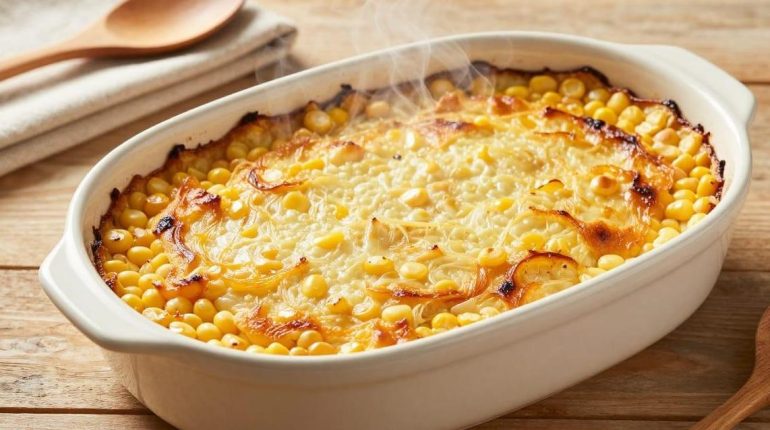
A golden casserole that disappears even before the other dishes are served. This is the enduring reputation of this Jiffy mix corn casserole, a recipe that defies all logic: six basic ingredients, fifty-five minutes flat, and a result worthy of the most elaborate holiday tables.
The secret lies in a bafflingly simple formula. A Jiffy corn muffin mix forms the foundation, while eight tablespoons of melted salted butter, two eggs, two cups of whole kernel corn, one can of cream-style corn, and one cup of sour cream make up the complete arsenal. No exotic ingredients, no complex techniques, just a balanced combination that invariably produces that much-sought-after creamy and comforting texture.
The magic happens in the meeting between the undrained creamed corn, which provides the necessary moisture, and the full-fat sour cream, which guarantees the final creaminess. The salted butter envelops the whole in a subtle richness, while the corn kernels punctuate each bite with sweet and crunchy bursts.
Preheat the oven to 350°F, mix the ingredients in a medium bowl, spread in a greased two-quart dish, bake for forty-five to fifty-five minutes until a golden top is obtained. This formidable efficiency explains why savvy hosts adopt this recipe as a sure bet for family meals, Thanksgiving dinners, or improvised buffets.
Secrets to a Perfect Texture: What the Experts Don’t Tell You
Behind this apparent simplicity lie technical nuances that separate an ordinary casserole from a systematic success. The drainage of canned corn determines the final firmness: meticulous draining produces a more compact texture, while insufficiently dried corn generates a softer consistency. For frozen corn, complete thawing followed by patting with paper towels eliminates excess moisture that would compromise the structure.
Melted butter requires special attention. If incorporated while scalding hot, it risks prematurely cooking the eggs and creating unwanted lumps. Two minutes of cooling is enough to avoid this culinary disaster. Similarly, mixing must remain minimal: a few turns of the spatula until homogeneous, no more. Excessive kneading develops gluten and transforms the desired tender texture into a dense and rubbery mass.
Baking at 350°F for forty-five to fifty-five minutes aims for a golden top and a toothpick coming out with moist crumbs, never dry. If browning accelerates prematurely, a loosely placed sheet of aluminum foil during the last ten to fifteen minutes preserves the ideal color without interrupting the internal cooking.
The ultimate tip: post-cooking rest. Ten minutes out of the oven allows the structure to firm up, guaranteeing clean portions that hold on the spoon instead of collapsing into a shapeless mush. This final patience transforms a good casserole into a presentable masterpiece.
Infinite Customizations: From the Classic Version to Bold Variations
Once this technical mastery is acquired, the recipe becomes a blank canvas for creative expression. Optional additions radically transform the flavor profile without compromising the proven structure. Finely chopped green onion, diced jalapeño, or crumbled bacon bring herbal freshness, vibrant spice, or smoky depth, respectively. These aromatics and proteins are incorporated directly into the preparation before cooking, each addition subtly modifying the flavor-texture balance.
The cheese axis offers three major variations: sharp cheddar for pronounced richness, parmesan for sophisticated salty notes, pepper jack for a spicy character. Incorporated into the batter, the cheese melts uniformly into the creamy mass. Sprinkled on the surface, it forms a golden and crispy crust that contrasts with the soft heart, a technique prized during holiday meals for visual impact.
For cooks without an available oven, the Crock Pot adaptation works perfectly: two to three hours on high or four to five hours on low until set. Greek yogurt advantageously replaces sour cream for a firmer and tangier version, appealing to palates seeking a less rich profile.
This exceptional versatility explains why the recipe spans generations: each cook takes ownership of the basic formula according to their preferences, creating an infinity of variations while retaining the reassuring DNA of the original dish.
Strategic Planning: The Ally of Organized Cooks
This creative flexibility is accompanied by a decisive temporal freedom for savvy hosts. The casserole can be prepared up to two days before the event: once cooked and completely cooled, it keeps in the refrigerator under airtight plastic wrap. This anticipation eliminates the pressure of the big day, allowing precious time to be spent with guests rather than at the stove.
The reheating protocol guarantees intact quality. Take the dish out one hour before serving to reach room temperature, then bake covered at 350°F for fifteen to twenty minutes until the heat penetrates uniformly. This method preserves the creamy texture without drying out the edges, restoring the original creaminess.
For extended storage, freezing works admirably: tight plastic wrap, storage for up to three months, overnight thawing in the refrigerator. Daily leftovers remain delicious for four days refrigerated, with individual portions reheat-able in the microwave in minutes for quick weekday meals.
This mastered time management transforms a simple side dish into a strategic solution. Preparing several dishes in advance, freezing them, and then orchestrating their staggered thawing according to the holiday meal schedule becomes possible. Organization replaces stressful improvisation, allowing cooks to enjoy their own receptions with the same serenity as their guests.