📌 Cleaning a dirty oven without toxic products: three effective methods from baking soda to professional degreaser
Posted 4 March 2026 by: Admin
The Natural Baking Soda Method: Overnight Cleaning Without Chemicals
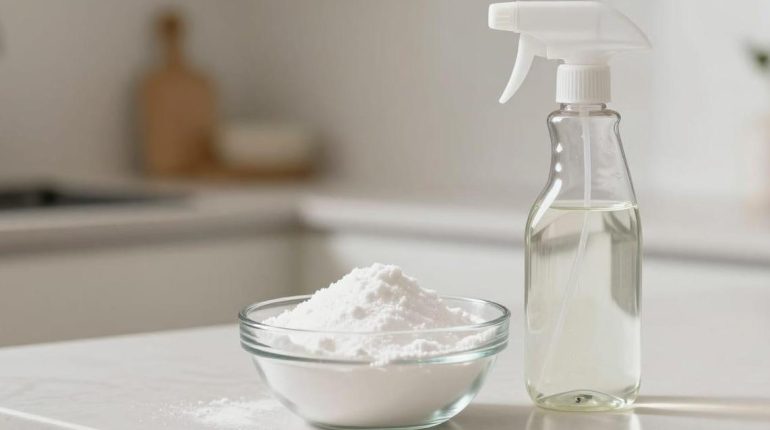
Household chemistry holds unsuspected treasures of efficiency. The combination of baking soda and white vinegar creates a spectacular reaction capable of dissolving years of grease buildup without any toxicity. The secret lies in the timing: a resting time of 8 to 12 hours transforms this homemade paste into a formidable stripper.
The preparation is disarmingly simple: half a cup of baking soda mixed with 2-3 tablespoons of water generates a thick paste, similar to toothpaste. After removing the racks, this mixture is spread generously over all interior surfaces — walls, bottom, door — scrupulously avoiding the heating elements and fans of convection models.
It is upon waking that the magic happens. Spraying white vinegar on the dried crust causes a characteristic fizz: the effervescent bubbles literally lift the carbonized residues. A soft brush is then enough to dislodge the most stubborn clusters, concentrated in the corners and under the rack supports. A damp microfiber cloth eliminates the last traces.
For the racks themselves, a prolonged soak in soapy water with added baking soda completes this natural protocol. This ecological approach is particularly suitable for regular maintenance and for cooks concerned about avoiding chemical exposure in their food preparation space.
Diversey Break-Up: The Heavy Artillery of Professionals
When gentle methods reach their limits, industrial cleaning professionals bring out a formidable weapon: Diversey Break-Up. This degreaser with an industrial formula dissolves carbonized fats that years of cooking have literally welded to the metal walls. Its promise is held in three words: “no scrubbing required.”
The usage protocol contrasts radically with the overnight baking soda approach. On a cooled oven, a uniform spray covers the soiled surfaces — except for the heating elements. Thirty minutes are enough for the chemical agents to penetrate and liquefy the most resistant carbon deposits. A simple wipe with a damp cloth then reveals a sparkling enamel, without physical effort.
This lightning efficiency is accompanied by non-negotiable safety imperatives. Intensive ventilation is required throughout the operation, while thick gloves protect the skin from contact with this aggressive solution. Its scope of action goes far beyond the domestic oven: restaurant hoods, professional grill plates, drip pans blackened by decades of intensive use.
Diversey Break-Up is intended for desperate situations — those ovens inherited from a previous rental or neglected for years. Where baking soda would require several cycles, this chemical concentrate settles the problem in half an hour. The balance between destructive power and practicality explains why commercial kitchens and maintenance services make it their reference solution for extreme stripping.
The Pink Stuff: The Viral Phenomenon from the UK
Between the patience of baking soda and the chemical aggressiveness of Diversey, a third way has established itself through digital word-of-mouth: The Pink Stuff. This candy-pink paste from Great Britain conquered social networks before invading cupboards worldwide, carried by thousands of videos showing its near-miraculous capabilities.
Its decisive technical advantage lies in its thick texture that refuses to run. Where liquid sprays slide lamentably down vertical walls, this creamy formula clings to the inclined surfaces of the oven and maintains its cleaning action exactly where you apply it. The simple physics of a well-thought-out consistency thus surpasses chemically more complex formulas.
The spectrum of action goes far beyond carbonized grease. Rust on metal racks, encrusted limescale traces, brownish discolorations on enamel — The Pink Stuff dissolves these heterogeneous soils with disconcerting versatility. A single pot replaces three specialized products in the classic household arsenal.
Its viral success is not a marketing fluke. Users spontaneously share spectacular transformations: unrecognizable ovens after a simple application, without the toxic fumes of chemicals or the interminable wait of the natural method. This visible efficiency combined with relative safety explains why professionals and individuals alike are massively adopting this British product, now distributed in forty countries.
The global popularity nevertheless poses a practical question: how to choose the right method according to the real state of your oven and guarantee optimal results in complete safety?
Safety Protocol and Optimization of Results
Choosing between these three methods is not a matter of chance but of an honest diagnosis of the oven’s condition. For preventive quarterly maintenance, baking soda is more than enough and preserves the integrity of the surfaces. Faced with three years of neglected accumulation with carbonized grease, Diversey Break-Up becomes essential despite its chemical composition. The Pink Stuff occupies the intermediate territory: moderate to severe fouling without reaching the extremes requiring heavy artillery.
Whatever solution is chosen, three safety rules remain non-negotiable. First, absolutely avoid any contact with the heating elements — resistors, convection fans, gas zones — otherwise toxic fumes will be released during the next preheating. Second, ventilate generously during and after application, with windows open and the hood activated, particularly with professional formulas. Third, wear protective gloves even with baking soda, which dries out the skin during prolonged contact.
The final rinsing determines the complete success of the operation. Several wipes with a damp cloth eliminate all chemical or mineral residue, followed by meticulous drying with a clean towel. An oven rinsed halfway releases unpleasant vapors during the next cooking session — an avoidable frustration with fifteen extra minutes of careful finishing.
Adapting the resting time transforms an average method into a high-performance solution. Baking soda: four hours for light maintenance, twelve hours for deep cleaning. Diversey: thirty minutes standard, forty-five in case of extreme resistance. The Pink Stuff: fifteen to twenty minutes depending on the thickness of the deposits. This temporal flexibility adjusts the chemical efficiency to the physical reality of the observed fouling.