Floating island is probably the French dessert we rediscover every time with surprise — we expected something old-fashioned, and we end up scraping the plate in silence. Three distinct preparations, a handful of common ingredients, a result that far exceeds the effort. It’s no coincidence it stands the test of time.
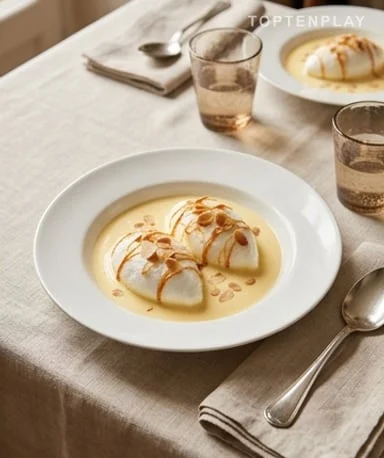
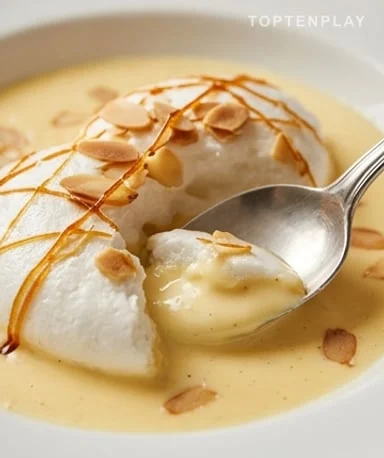
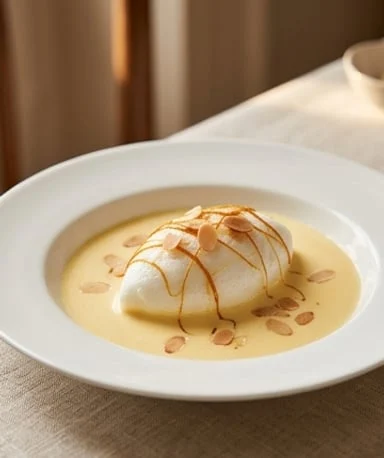
The first thing that strikes you is the contrast on the plate: the very pale yellow of the custard, almost ivory, on which sits a snowy white crossed with amber threads. You dip the spoon and feel a slight, airy resistance before the white gives way effortlessly. The smell of vanilla is discreet, not overpowering — just present like a good-smelling kitchen background. In the mouth, everything goes quickly: the silky cold of the custard, the softness of the poached meringue, then the short crunch of the toasted almonds that arrive last.
Why you’ll love this recipe
Ingredient Notes
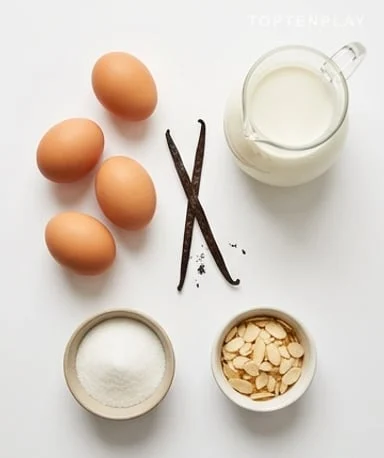
The secret lies in few things: a real split vanilla bean, fresh eggs, and whole milk. No shortcuts possible.
- Whole milk (50 cl) : Whole milk gives the custard its velvety texture and slightly golden color. Semi-skimmed milk will work, but the custard will be thinner and less coating. If you want to go further, replace 10 cl of milk with heavy cream — the difference is noticeable.
- Vanilla bean : This is the central ingredient, not a secondary flavor. The bean provides seeds that dot the custard with characteristic black specks and a scent that liquid extract doesn’t exactly replicate. Choose a supple, fleshy bean, not dry. If you don’t have one, a teaspoon of vanilla paste is the best alternative — extract is less suitable here.
- Egg yolks (4) : Yolks are the natural thickening agent of custard — their proteins gently coagulate with heat and transform milk into cream. Take them out of the refrigerator 20 minutes before starting: a room-temperature mixture incorporates hot milk better without thermal shock, and the custard thickens more evenly.
- Egg whites (4) : They form the islands, and their stability depends on two things: the bowl and whisk must be perfectly clean and dry (any trace of fat prevents whipping), and do not overwhip. Whites that are too firm and dry crack during cooking. Aim for a shiny, supple texture that forms a stable but not rigid bird’s beak.
- Sugar for caramel (80 g) : Prefer a dry caramel — without water — for a more concentrated result that’s easier to control. Dry cooking colors quickly and evenly without risk of crystallization. The only rule: tilt the pan slightly if necessary, without stirring with a spoon until the sugar has completely melted.
- Sliced almonds (30 g) : Their role is purely textural — they bring the only crunchy element in an otherwise entirely soft dessert. Toast them dry in a pan until golden and they start to smell like hazelnut. This takes two minutes, and the difference between raw and toasted almonds is considerable.
Start with the custard, it sets the tone
Custard has a bad reputation for being finicky, but it forgives if you follow one rule: never let it boil. Put the milk in a saucepan with the split and scraped vanilla bean. Heat over low heat until the first shimmers — small bubbles on the edges, but no real boiling. Meanwhile, whisk the yolks with sugar until the mixture slightly lightens and thickens: this is the sign that the sugar has dissolved. Remove the bean, then pour the hot milk over the yolks in a stream, whisking constantly — this gradual action prevents cooking the yolks all at once. Pour everything back into the saucepan and cook over very low heat, stirring constantly with a spatula in figure eights. The custard is ready when it coats the spatula and a line drawn with your finger remains clean. At this point, it gives off a sweet, warm, slightly milky scent with vanilla in the background. Pour it immediately into a cold bowl to stop the cooking, then refrigerate for at least one hour.
Whip the whites stiff, then cook them gently
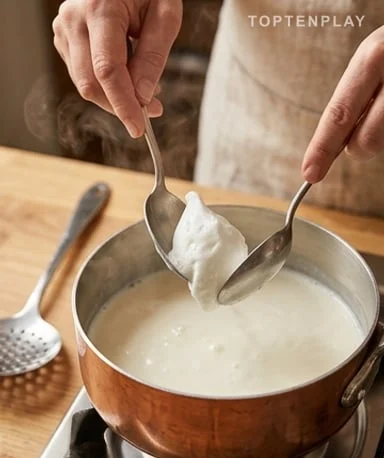
A well-whipped egg white has a shiny, smooth, almost satiny texture — this is the sign that the proteins are well incorporated and the sugar has had time to dissolve. Start whipping the whites alone at medium speed, and add the sugar in a gradual rain once they start to foam. If you add sugar too early, the whites will whip less high. To cook the islands, gently simmer water in a large saucepan — no violent boiling that would deform the whites. Form quenelles using two wet tablespoons, sliding the mass from one spoon to the other to get a regular oval shape. Gently place them in the simmering water: they swell slightly with heat and take on a matte, slightly translucent white color. Thirty seconds per side is enough — they should remain light and wobbly, not dense. Remove them with a slotted spoon, place on paper towels, and let cool before refrigerating.
Succeed at caramel without panicking
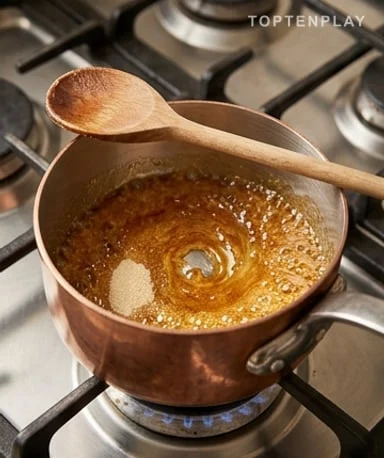
Caramel scares people because it colors quickly and doesn’t warn. In reality, dry caramel is simpler than it seems if you don’t take your eyes off it. Pour the sugar into a small heavy-bottomed saucepan and place over medium heat. Don’t touch anything until the edges start to melt and color — from there, gently tilt the pan so that the melted sugar reaches the still-solid crystals. The smell changes: first neutral, then slightly caramelized, then nutty. This last phase indicates the caramel is ready — a deep amber color, not too light, not too dark. Remove from heat immediately. Wait about thirty seconds before pouring: the caramel will thicken slightly and the threads will hold better on the dessert.
Assemble at serving time, everything stays cold except the caramel
Assembling floating island is the fastest and most rewarding step. Pour the well-chilled custard into a shallow bowl or coupe — it should be a uniform pale yellow, slightly translucent at the edges. Place one or two quenelles of white on top, lifting them gently so as not to deform them. Then pour the caramel in a stream from the tip of the spoon, drawing irregular lines — the hot caramel contrasts with the cold custard and solidifies almost immediately on the surface, creating a slight crackly film. Finish with toasted almonds: a few pinches are enough, distributed naturally. The final image at the table — golden brown caramel on snowy white on ivory cream — is exactly what it should be.
Tips & Tricks
- Remove the custard from heat as soon as it coats the spatula, without waiting for it to thicken further — it continues to cook from thermal inertia in the hot pan, and an overcooked custard turns into scrambled eggs.
- Moisten the spoons before forming the quenelles of white: the mass slides better and the oval shape is obtained effortlessly without tearing.
- Prepare all elements the day before and store them separately in the refrigerator — custard in a bowl with plastic wrap touching the surface, poached whites in an airtight container. Caramel is made at the last moment, and the dessert gains in flavor when everything is well chilled.
- Do not let the poached whites sit in the cooking water while waiting: they absorb liquid and soften. Remove them as soon as cooking is done and drain immediately on paper towels.
How to know if the custard is cooked without a thermometer?
The spoon technique is reliable: dip the back of a spoon into the custard, then draw a horizontal line with your finger. If the line stays clean and the custard does not run, it’s ready. If it runs, continue cooking over low heat for another one to two minutes, stirring constantly.
Why do my whites deflate during cooking?
This is often a problem of too high heat: the poaching water should never boil vigorously, a gentle simmer is enough. Too violent heat makes the whites swell quickly, then deflate as soon as they come out of the water. Also ensure the whites are firm but still supple — overly stiff whites crack.
Can you prepare floating island the day before?
Yes, it’s even recommended. The custard keeps for 48 hours in the refrigerator in a bowl with plastic wrap touching the surface, and the poached whites hold for 24 hours in an airtight container. Prepare the caramel and toast the almonds at the last moment, just before assembling — cold caramel loses its fluidity.
My custard curdled — is it salvageable?
If it has slightly curdled, pour it immediately into a blender and blend for 30 seconds on high speed: blending breaks up the small lumps of coagulated egg and often restores a correct texture. If it truly boiled and formed thick egg flakes, it’s better to start over — the texture will never be completely smooth.
Can I replace the sliced almonds?
Absolutely. Crushed toasted hazelnuts bring a stronger taste and similar texture. Powdered praline, toasted sesame seeds, or crushed pink pralines (Lyonnaise version) also work very well. The key is to keep a crunchy element to balance the sweetness of the whites and custard.
Classic Floating Island with Vanilla Custard
French
Dessert
The great classic of French pastry: poached meringue floating on a smooth vanilla custard, topped with a drizzle of golden caramel and toasted sliced almonds. Light, elegant, and much simpler than it looks.
Ingredients
- 50 cl whole milk
- 1 vanilla bean
- 4 egg yolks
- 80 g granulated sugar (for custard)
- 4 egg whites
- 40 g granulated sugar (for whites)
- 80 g granulated sugar (for caramel)
- 30 g sliced almonds
Instructions
- 1Split the vanilla bean in half and scrape out the seeds. Pour the milk into a saucepan with the bean and seeds. Heat over low heat until the first shimmers without boiling.
- 2Whisk the egg yolks with 80 g of sugar until the mixture slightly lightens. Remove the vanilla bean from the hot milk, then gradually pour the milk over the yolks while whisking constantly.
- 3Pour everything back into the saucepan. Cook over very low heat, stirring constantly with a spatula, until the custard coats the back of a spoon and a line drawn with your finger remains clean. Immediately pour into a cold bowl and refrigerate for at least 1 hour.
- 4Whip the egg whites at medium speed. As soon as they start to foam, gradually add 40 g of sugar while continuing to whip until you achieve a shiny, supple texture that forms a stable bird’s beak.
- 5Gently simmer water in a large saucepan. Form quenelles of whipped whites using two wet tablespoons and gently place them in the water. Cook for 30 seconds per side, remove with a slotted spoon, and drain on paper towels. Let cool.
- 6Toast the sliced almonds in a dry pan over medium heat, stirring regularly, until golden brown and smelling of hazelnut. Set aside.
- 7Pour 80 g of sugar into a small heavy-bottomed saucepan. Melt dry over medium heat without stirring. When the edges start to brown, gently tilt the pan to even out. Remove from heat as soon as the caramel reaches a deep amber color. Let cool for 30 seconds.
- 8Divide the cold custard among four bowls or shallow plates. Gently place the poached whites on top. Drizzle with caramel and sprinkle with toasted almonds. Serve immediately.
Notes
• The custard must never boil; it would curdle. If it becomes slightly grainy, blend it for 30 seconds before serving.
• All elements can be prepared the day before — custard covered with plastic wrap touching the surface, poached whites in an airtight container in the refrigerator. Only the caramel is made at the last moment.
• For an even richer custard, replace 10 cl of milk with heavy cream.
• Simple variations: dark chocolate sauce instead of caramel, or raspberry coulis for a fresher version.
Nutrition Facts (per serving, estimated)
| 390 kcalCalories | 12 gProtein | 58 gCarbs | 13 gFat |