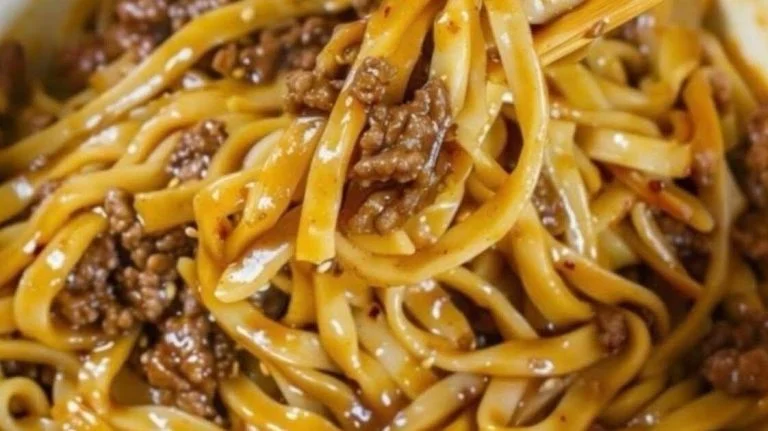
That violent sizzle when cold meat hits a scorching hot wok — that’s the signal that something good is happening. Chinese restaurants nail stir-fried beef every single time. You can do the same at home, and your guests will have no idea you only spent ten minutes behind the stove.
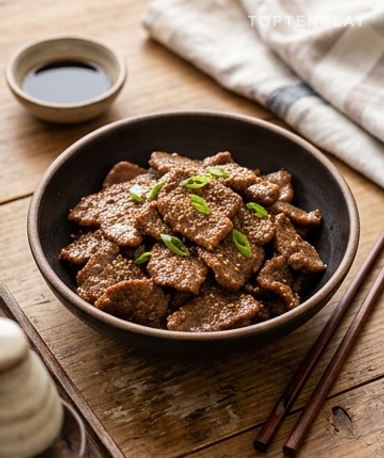
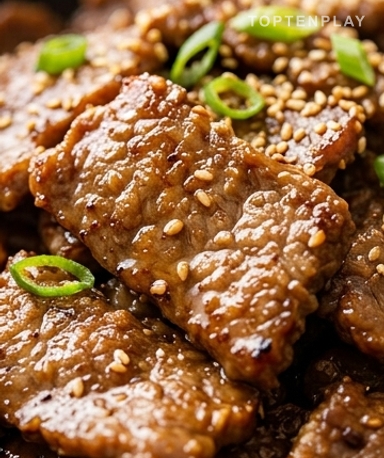
Look at these strips. A light caramel brown, slightly glazed on the edges, with a thin crust that contrasts with the still-tender interior. You prick them with a fork and they give way without resistance, as if the meat had simmered for two hours. The smell rising from the bowl is the soy sauce that caramelized on contact with the hot metal — a smoky, almost sweet note. That’s what we’re going to cook.
Why you’ll love this recipe
Ingredient Notes

A few ingredients that make all the difference: baking soda, soy sauce, starch, and sugar for a marinade that tenderizes the meat deep down.
- The Beef : Flank, chuck, hanger steak, any cut labeled for ‘braising’. The tougher the cut, the more useful the technique. Ribeye here would be a waste.
- Baking Soda : The true secret. It modifies the pH of the meat’s surface and breaks down proteins deep inside. One teaspoon for 450g — no more, otherwise you’ll notice an unpleasant metallic aftertaste.
- Soy Sauce : Regular or low-sodium, both work. Avoid flavored or sweetened versions — they go haywire over high heat and burn before the meat is done.
- Cornstarch : This is what gives that silky coating. It wraps each strip in a thin layer that retains moisture during cooking and gives that slightly glazed look visible in the pan.
- Chicken Broth + Rice Vinegar : As a substitute for rice wine: one tablespoon of chicken broth with one teaspoon of rice vinegar, or diluted white vinegar. It provides the necessary acidity to the marinade and works very well.
The trick restaurants keep to themselves
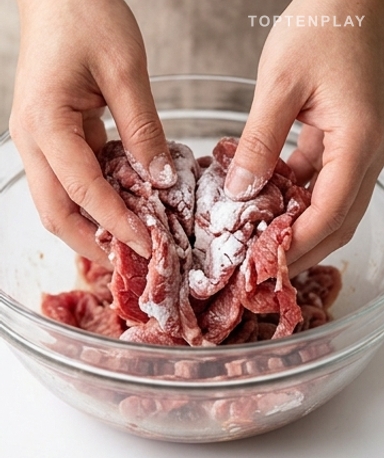
Have you ever eaten stir-fried beef at a restaurant and wondered why yours feels like shoe leather at home? It’s the baking soda. Slice the meat into thin strips against the grain — when you look at the piece, you see parallel lines; you cut perpendicular to them. Then coat each strip in baking soda and let it rest for 15 to 20 minutes. During this time, the meat will slightly change color on the surface, becoming darker, almost gray. This is normal; it’s exactly what we want. Next, a thorough rinse under cold water — no residual baking soda, or the taste will be weird. Dry well with paper towels before moving on.
The two-minute marinade
Soy sauce, chicken broth, rice vinegar, cornstarch, sugar, water — everything in a bowl, stir until the starch disappears. The texture of the mixture is cloudy and slightly viscous, a bit like cloudy water with body. Add the rinsed and dried beef, mix well so every piece is coated. Thirty minutes minimum. Two hours in the refrigerator is better — the meat takes on a darker hue and the starch really sticks to the surface. If your guests are arriving in an hour, thirty minutes is plenty.
Maximum heat, no compromises
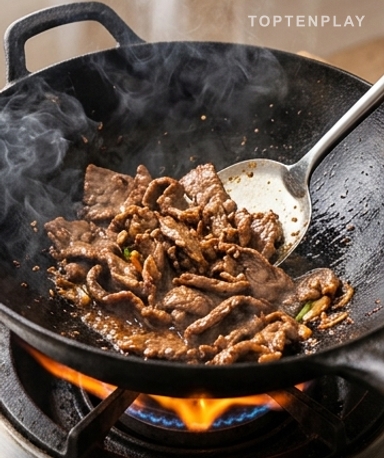
Heat your wok or large skillet over very high heat until it starts to smoke slightly. Oil in, and immediately the meat — in a single layer, nothing stacked. The metal-to-meat contact should produce a loud, almost aggressive sizzle. If it makes a timid ‘pffft’, the pan isn’t hot enough and you’re missing out. The meat goes from pinkish-beige to light caramel brown in two to three minutes — turn it only once, no more. If you have a large quantity, work in two batches rather than one. Crowding the meat turns the whole thing into a stew, which is the exact opposite of what we’re looking for.
Tips & Tricks
- Really rinse the baking soda well — a sloppy rinse leaves a metallic aftertaste that ruins all your marinade work.
- Put the beef in the freezer for 20 minutes before slicing: the semi-firm meat cuts into even strips without sliding around under the knife.
- The pan must be almost smoking before adding anything — it’s counter-intuitive when you’re afraid of burning, but it’s exactly what this recipe requires for that caramelized crust.
Will the baking soda leave a weird taste in the meat?
No, provided you rinse it well. This is the critical step: after 15-20 minutes of resting, run the strips under cold water until there is no trace of powder left. A sloppy rinse does indeed leave an unpleasant metallic aftertaste, but a careful rinse — 30 seconds under the tap while stirring — completely solves the problem.
Which cut of beef should I choose for this dish?
Flank, chuck, flap, hanger, or shank — any piece labeled for ‘braising’ or sold cheaply works great here. The more naturally tough the cut, the more effective the technique. Ribeye or tenderloin don’t need this treatment: no need to use them for this recipe.
I don’t have rice vinegar, what can I substitute it with?
Regular white vinegar diluted half-and-half with water works very well. A little dash of lemon juice can also help in the marinade, but with a more pronounced acidity — use half as much. The main point is to have a small acidic note to balance the soy sauce.
Does this technique work with chicken or lamb?
Yes, and very well. For chicken, reduce the baking soda resting time to 10 minutes maximum — the meat is more fragile and can become mushy if left too long. For lamb, the technique is identical to beef and gives excellent results on shoulder or leg pieces cut into strips.
How do I know if my pan is hot enough before adding the meat?
Hold your hand about 5 cm above the surface — you should feel intense heat in less than a second. You can also drop a bead of water: if it evaporates instantly with a sharp sizzle, you’re good. If it beads up and rolls around (Leidenfrost effect), it’s even better, but a standard domestic pan rarely reaches that temperature.
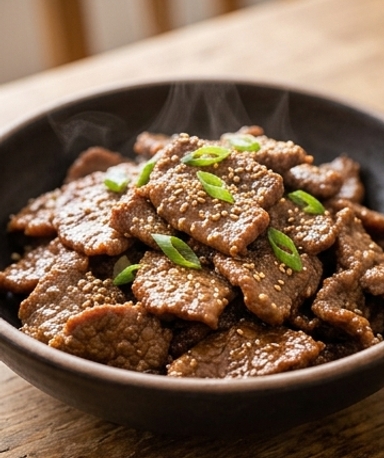
Chinese-Style Melting Beef
Asian
Main Course
The baking soda ‘velveting’ technique from Chinese restaurants, adapted for the home. Tough strips transformed into melt-in-your-mouth meat in less than an hour.
Ingredients
- 450g beef (flank, chuck, or flap meat)
- 1 tsp baking soda
- 1 tbsp (15ml) soy sauce
- 1 tbsp (15ml) chicken broth
- 1 tsp (5ml) rice vinegar (or diluted white vinegar)
- 1 tbsp (10g) cornstarch
- 1 tsp (4g) sugar
- 2 tbsp (30ml) water
- 1 tbsp (15ml) vegetable oil
Instructions
- 1Slice the beef into thin strips (3-4mm) against the grain.
- 2Coat the strips with baking soda in a bowl and let rest for 15 to 20 minutes.
- 3Rinse thoroughly under cold water until all baking soda is removed. Pat dry with paper towels.
- 4In a bowl, mix the soy sauce, chicken broth, rice vinegar, cornstarch, sugar, and water. Whisk until the starch is completely dissolved.
- 5Add the dried beef to the marinade and mix well. Let marinate for 30 minutes at room temperature, or 2 hours covered in the refrigerator.
- 6Heat the oil in a wok or large skillet over very high heat until slightly smoking.
- 7Place the marinated strips in a single layer without overlapping. Stir-fry for 2 to 3 minutes without touching, then flip once. Work in two batches if necessary. Serve immediately.
Notes
• Storage: keeps for 2 days in the refrigerator in an airtight container. Reheat quickly over high heat — do not use the microwave as it toughens the meat.
• Make ahead: the meat can marinate for up to 24 hours in the refrigerator after the baking soda step. Practical for a dinner with guests.
• Variations: serve with jasmine rice, stir-fried noodles, or crunchy vegetables sautéed in the same wok after the meat.
Nutrition Facts (per serving, estimated)
| 245 kcalCalories | 26gProtein | 5gCarbs | 13gFat |