Chicken fried rice is one of those dishes that is constantly underestimated, and that’s a mistake. Not because it’s difficult — on the contrary, it’s remarkably simple — but because it relies on a few specific rules that most people ignore. Ignore them, and you get a clump of sticky rice; respect them, and you have a complete dish that disappears in minutes.
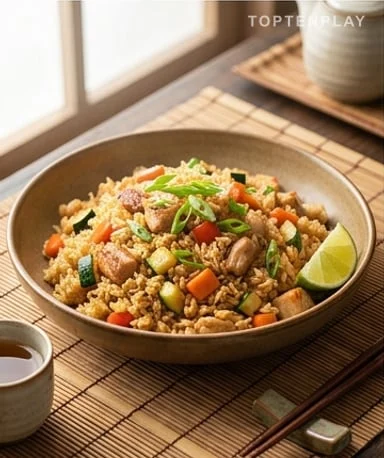
Chicken fried rice is first and foremost a smell that fills the kitchen: garlic sizzling in hot oil, soy sauce lightly caramelizing on the hot pan bottom, and that vegetal steam rising when vegetables hit the metal. The basmati grains take on an amber tint, slightly shiny, each grain distinct and separate from the others. The chicken stays tender inside, with that fine golden crust that just catches under the teeth. Visually, the dish is vibrant — orange from the carrot, green from the zucchini, red from the bell pepper — and it already tells you everything about what it contains.
Why you’ll love this recipe
Ingredient Notes

All the ingredients together: basmati rice, chicken breast, carrot, zucchini, bell pepper, garlic, ginger, and soy sauce.
- Basmati rice (300 g, ideally day-old) : Basmati is the best choice here for its long grains that stay separate after cooking. Round or overly moist rice will stick and form a compact mass in the pan. Ideally: cook the rice the day before, fluff it with a fork, and let it rest uncovered in the refrigerator overnight so it’s perfectly dry.
- Chicken breast (500 g) : Chicken breast cooks quickly and stays tender as long as you don’t overcook it. Cut it into cubes of 2 cm maximum — pieces that are too large take too long to brown and dry out before cooking through. Boneless thighs also work very well and give an even more flavorful result.
- Soy sauce (3 tablespoons) : This is the main seasoning of the dish, not just a finishing condiment. Soy sauce provides salt, umami, and that slight caramelization that occurs when it hits the hot pan bottom. Use regular soy sauce, not the sweet version (ketjap manis) which would make the dish confusing. Add gradually — it salts quickly and you can’t go back.
- Carrot, zucchini, bell pepper : These three vegetables are complementary in texture and cooking time. Carrot provides lasting crunch and slight sweetness, bell pepper a vegetal note and lots of color, zucchini softness. Cut them into small, uniform pieces: irregular sizes cook at different rates, some will be soft while others are still raw.
- Garlic and ginger : Garlic builds the aromatic base of the dish — it must cook just enough to lose its raw sharpness, not enough to brown, which would give it a bitter taste. Ginger, even in small amounts, changes the flavor profile: it brings a slight warmth at the end of the mouth that prevents the dish from being too neutral. If you don’t have fresh ginger, half a teaspoon of powder is enough.
- Vegetable oil (2 tablespoons) : Choose an oil with a high smoke point: sunflower, peanut, or grapeseed. Olive oil does not withstand the high heat needed for stir-frying and turns bitter beyond a certain point. Two tablespoons are sufficient if the pan is already hot before adding the oil.
Cold rice is not optional, it’s rule number one
The first thing to understand about fried rice is that day-old rice is not a luxury — it’s a condition for success. Freshly cooked rice is still moist inside, and that moisture turns into steam in the hot pan: the grains stick together, form compact clumps, and you end up with something between porridge and mash. Rice that has spent a night in the refrigerator has lost that surface moisture. The grains are dry, slightly firm, and they will bounce in the pan rather than stick. If you didn’t plan ahead, cook the rice two to three hours beforehand and spread it on a tray to cool quickly — it’s not perfect, but it’s much better than hot rice. Cook it in salted boiling water, drain well, and fluff with a fork before chilling.

The chicken is seared first, and there’s no compromise
The pan — ideally a wok or a large heavy-bottomed skillet — must be hot before anything goes in. Add the oil when the pan is already hot, wait until it’s shimmering and slightly smoking, then add the chicken cubes in a single layer without overlapping. The contact with the hot metal produces an immediate, sharp sizzle — that’s a good sign. Don’t stir right away: let the chicken sit undisturbed for two to three minutes to develop color before turning. That golden crust that forms on the surface is not just aesthetic; it concentrates flavors and gives the dish its character. Once browned on all sides, remove the chicken and set aside in a bowl. It will finish cooking during the final assembly, so there’s no need to insist if the center is still slightly pink at this stage.
Vegetables keep their bite, or they’re useless
In the same pan without washing, sauté the sliced onion and minced garlic for two minutes. The onion should become translucent and slightly soft; the garlic must lose its raw taste without browning — it’s a narrow window that requires attention and regular stirring. The smell changes at this point: from sharp and raw, it becomes sweet and slightly caramelized. Then add the vegetables in order of density: carrot first because it’s the hardest, then bell pepper, then zucchini. Five to eight minutes of cooking over high heat is enough. The goal is not to soften the vegetables but to tenderize while keeping their bite — a carrot that still slightly crunches, a firm bell pepper. If the vegetables release water during cooking, increase the heat instead of covering: excess moisture will make the rice soggy during assembly.
Final assembly: leave the rice alone for perfection
Return the chicken to the pan with the vegetables, then add the cold rice, breaking it up well — grain by grain if possible — to separate any clumps before it hits the hot surface. Quickly mix with a spatula to distribute rice, chicken, and vegetables evenly in the pan. Then leave the rice undisturbed for about thirty seconds without stirring: it touches the hot bottom directly and begins to develop a light golden crust that gives the dish its characteristic flavor. Flip, leave again, flip again. Finally, drizzle soy sauce over the entire dish, never all at once in the center. You’ll hear a hiss as it hits the hot pan, and a slight caramelized smoke will rise. Two to three minutes more and each grain is coated, slightly amber, ready to serve.

Tips & Tricks
- Never overcrowd the pan: if you double the quantities, cook in two batches. An overloaded pan causes the temperature to drop, ingredients steam instead of searing, and you lose all color and caramelized flavor.
- Heat the pan empty before adding oil: a cold pan absorbs oil and makes ingredients stick. A very hot pan sears the chicken and stir-fries the vegetables from the first contact.
- Add soy sauce gradually and taste before adding more: it salts instantly and excess is impossible to correct. Two tablespoons are often enough depending on the brand and your salt tolerance.
- For a richer version, crack one or two eggs directly into the pan at the end, just before the soy sauce. Stir quickly to incorporate them into small shreds in the rice — the texture becomes much more indulgent and the dish holds together better on the plate.

Can I use rice cooked the same day?
Technically yes, but the result will be significantly less good. Freshly cooked rice is still moist, and that moisture turns into steam in the hot pan: the grains stick, form clumps, and the rice ends up steaming instead of frying. If you have no choice, cook the rice two to three hours ahead and spread it on a tray to cool and dry as much as possible before stir-frying.
What pan to use if I don’t have a wok?
A large heavy-bottomed skillet or a stainless steel pan works fine. The important thing is that the surface is wide and the bottom maintains high, stable heat when ingredients are added. Avoid small, lightweight non-stick pans that lose temperature too quickly and cause steaming instead of searing.
How to prevent the rice from being too salty?
Soy sauce is the only salt in the dish, and it salts very quickly. Always start with two tablespoons, mix well, and taste before adding a third. Some brands are much saltier than others, so the amount indicated in the recipe is a starting point, not an absolute rule.
Can I replace the chicken with something else?
Yes, this dish is very adaptable. Peeled shrimp work perfectly — they cook even faster, about two minutes per side. Firm tofu cut into cubes is a good vegetarian option, provided it is well browned before adding the vegetables. You can also use very thinly sliced beef for a heartier version.
Can this dish be prepared in advance?
Fried rice keeps for two to three days in the refrigerator in an airtight container. To reheat, return it to the pan over medium heat with a splash of water — it will regain its texture without drying out. The microwave also works with a few drops of water, but the pan gives a better result.
Why does restaurant fried rice taste different?
Restaurants use industrial woks on extremely powerful gas burners that create what is called ‘wok hei’ — a slightly smoky and caramelized flavor that is impossible to replicate exactly at home. To get closer, use the highest flame on your stove, heat the pan empty for a long time before adding oil, and never cook more than two portions at a time to maintain the temperature.
Chicken Fried Rice with Vegetables
Asian
Main course
A classic of everyday Asian cooking: basmati rice stir-fried over high heat with golden chicken pieces and crunchy vegetables, all bound together by soy sauce. Complete, economical, and ready in 40 minutes.
Ingredients
- 300 g basmati rice (ideally day-old)
- 500 g chicken breast
- 1 carrot
- 1 red bell pepper
- 1 zucchini
- 1 onion
- 2 garlic cloves
- 1 knob fresh ginger (or ½ tsp powder)
- 3 tbsp soy sauce
- 2 tbsp vegetable oil (sunflower or peanut)
- 3 green onions for serving
- salt and pepper
Instructions
- 1Cook the rice in salted boiling water, drain, and let cool completely — ideally overnight in the refrigerator, uncovered.
- 2Cut the chicken into 2 cm cubes. Peel and cut the vegetables: carrot into thin rounds, zucchini into small dice, bell pepper into strips, onion sliced, garlic minced finely.
- 3Heat a large pan or wok over high heat. Add the oil, wait until it shimmers and is slightly smoking, then brown the chicken in a single layer without stirring for 2 to 3 minutes. Turn and continue for 2 minutes. Remove and set aside in a bowl.
- 4In the same pan, sauté the onion and garlic for 2 minutes over medium heat until soft. Add the carrot first, then the bell pepper and zucchini. Stir-fry over high heat for 6 to 8 minutes, stirring regularly — the vegetables should remain slightly crunchy.
- 5Return the chicken to the pan. Add the cold rice, breaking it up well to separate the grains. Mix, then let it sit undisturbed for 30 seconds on the hot bottom so the rice starts to brown. Flip and repeat once.
- 6Drizzle soy sauce over the entire dish, mix well, and stir-fry for another 2 to 3 minutes. Taste, adjust seasoning if necessary, and serve immediately garnished with sliced green onions.
Notes
• Cold rice is essential: freshly cooked rice sticks and forms lumps. If short on time, cook it 2 hours ahead and spread on a tray to dry.
• Don’t overcrowd the pan: if doubling the quantities, cook in two batches to maintain heat and achieve browning.
• Protein variation: replace chicken with peeled shrimp (cook 2 min per side) or firm tofu, well browned.
• Egg variation: beat one or two eggs and add directly to the pan just before the soy sauce, stirring quickly to incorporate into shreds in the rice.
Nutrition Facts (per serving, estimated)
| 440 kcalCalories | 36 gProtein | 54 gCarbs | 8 gFat |