📌 Chestnut-stuffed madeleines: the brown butter and overnight rest technique for a perfect texture
Posted 28 February 2026 by: Admin
The Recipe Revealed: Haute Pâtisserie Style Madeleines
The secret of exceptional madeleines lies in a gesture that 90% of cooks neglect: overnight rest in the refrigerator. This strategic wait, far from being anecdotal, radically transforms the structure of the batter and guarantees that honeycomb texture characteristic of professional creations.
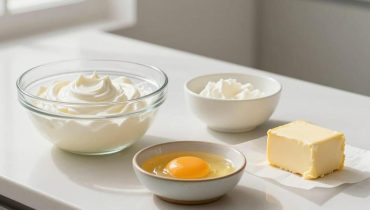
The technique begins with the preparation of brown butter (beurre noisette), a fundamental step to intensify the aromas. The 100g of butter must reach that precise golden hue where the milk proteins caramelize without burning. Meanwhile, fresh orange zest mixes with the sugar to release its essential oils, creating that chestnut-orange association that boldly revisits the classic plain madeleine.
The batter takes shape with the progressive addition of 2 beaten eggs, then the delicate incorporation of 130g of sifted T45 flour with 4g of baking powder. The lukewarm butter is integrated last, just before the batter goes into its piping bag for its mandatory rest. This prolonged immobilization allows the ingredients to fuse completely, the gluten to relax, and the flavors to harmonize.
During these hours of waiting, the preparation of the homemade chestnut cream begins: 500g of finely blended cooked chestnuts, transformed by a precise syrup of 300g of sugar and 20g of water. Slow cooking over low heat requires 15 minutes of constant monitoring to obtain that dense and smooth texture that will characterize the final filling.
The Art of Homemade Chestnut Cream: 15 Minutes That Change Everything
While the batter rests, the making of homemade chestnut cream reveals its disconcerting simplicity. The 500g of cooked chestnuts, once finely blended, produce a puree that only awaits a precise chemical transformation to rival high-end commercial versions.
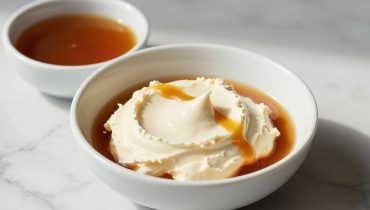
The syrup is the determining element of this metamorphosis. 300g of sugar dissolved in barely 20g of water creates an ultra-dense concentrate which, poured over the puree heated over medium heat, radically modifies its molecular structure. The complete dissolution of the sugar before incorporation guarantees a texture without the slightest crystallized grain, a fatal flaw in amateur preparations.
Cooking for 15 minutes over low heat requires sustained attention. Every minute counts: too short, the cream remains liquid and will slide out of the madeleines; too long, it hardens and loses its characteristic smoothness. The regular movement of the spatula prevents caramelization at the bottom of the pan while progressively homogenizing the preparation. The low temperature preserves the subtle chestnut aromas that high flames would irremediably destroy.
Complete cooling before filling allows the cream to reach its final consistency. This step determines the final hold: a lukewarm cream will sag, a cold cream will maintain its volume in the split madeleine, creating that visual contrast between the soft golden envelope and the dense caramel-colored heart.
The Technical Steps That Make The Difference
Even before the batter rests, the preparation of the mixture determines the aromatic success. Freshly grated orange zest, mixed directly with the sugar, releases its essential oils under the effect of the abrasion of the crystals. This mechanical friction extracts the volatile compounds that would otherwise remain trapped in the peel. The incorporation of the eggs then stabilizes this fragrant emulsion by creating a homogeneous base where each aromatic molecule is dispersed uniformly.
Sifting the flour with the baking powder is the most underestimated technical step. The 130g of T45 flour and the 4g of baking powder must pass through the sieve together to guarantee perfect microscopic distribution. A single lump of baking powder causes a zone of over-leavening that deforms the madeleine and creates unsightly bubbles. The delicate incorporation that follows preserves the air bubbles trapped during the sugar-egg mixing, an invisible but crucial structure for the final lightness.
Baking at 190°C for exactly 10 minutes relies on a precise thermal balance. This high temperature causes the thermal shock necessary for the formation of the characteristic hump while allowing for complete core cooking. Professional piping of the batter into the molds, performed with a piping bag, ensures an equitable distribution that compensates for oven heat variations.
Immediate unmolding followed by hot filling exploits the residual heat of the madeleine. The cream, in contact with the still-warm surface, adheres perfectly without sliding, creating that fusion between envelope and filling that characterizes professional pastries.
Final Result: 15 Madeleines Between Tradition And Innovation
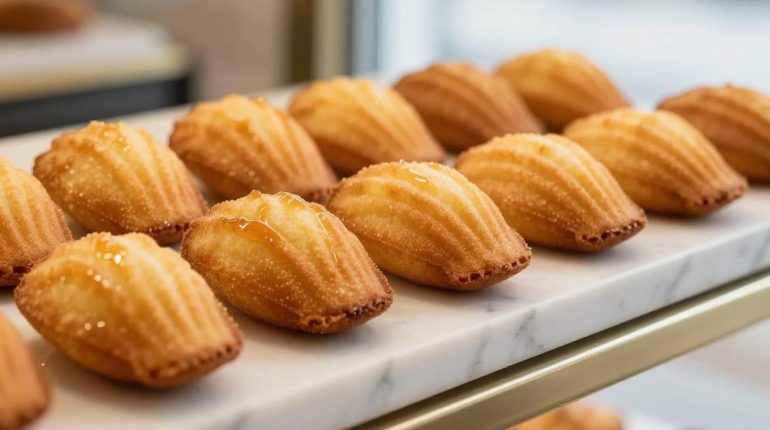
This recipe reveals its true potential in the sensory contrast it establishes. The 15 pieces obtained show professional regularity, each bearing the characteristic golden hump and its dense cream heart. The precise yield allows for mastery of portions and presentation, transforming a domestic preparation into a pastry worthy of a shop window.
The time investment defies appearances: 20 minutes of active handling, 10 minutes of monitored baking, but above all that incompressible day of waiting. The prolonged rest restructures the batter in depth, developing that softness that resists filling without sagging. Patience here becomes a technical ingredient, as crucial as the brown butter or the orange zest.
Complete cooling after filling reveals the final transformation. The chestnut cream, applied to the lukewarm madeleine, progressively fuses with the crumb during the return to room temperature. This union creates a hybrid pastry where the boundaries between biscuit and filling blur. Each bite then delivers three distinct textures: the fine outer crust, the airy heart of the madeleine, and the velvety density of the chestnut.
The chestnut-orange association transcends its status as a classic pairing to become an aromatic signature. The citrus essential oils pierce the richness of the chestnut syrup, balancing sweetness and freshness in a contrast that maintains taste interest until the last crumb.