📌 Broken wooden clothespins: 10 ingenious ways to give them a second life
Posted 18 February 2026 by: Admin
Wooden Clothespins: A Hidden Treasure at the Back of Your Drawer
Every spring, spring cleaning pushes millions of people to sort, purge, and eliminate. In this relentless logic of renewal, one object invariably ends up in the trash: the wooden clothespin whose spring has snapped. An automatic gesture, a final decision — and yet, deeply regrettable.
Because behind this apparent uselessness lies unsuspected potential. The wooden clothespin is not simply a tool for hanging laundry; it is a versatile object, infinitely shapeable, capable of reinventing itself in almost every room of the house. Its simple structure — two wooden arms articulated by a spring — is precisely what makes it so adaptable to uses one would never have considered.
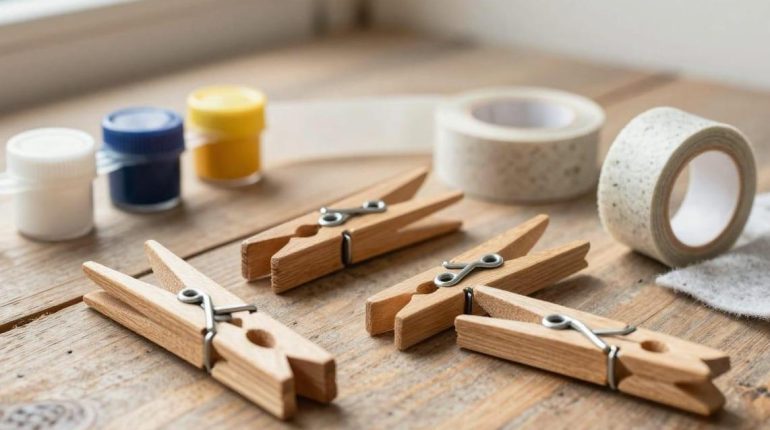
Most households throw these pins away at the first sign of failure, unaware that with a few basic supplies — acrylic paint, washi tape, felt, or simple double-sided tape — they transform into functional gadgets and authentic decorative elements. All for a cost close to zero.
At a time when responsible consumption is redefining our daily habits, rehabilitating these condemned objects takes on a new dimension. Here are ten concrete ways to give them a second life — in the kitchen, in the office, and well beyond.
In the Kitchen: When the Clothespin Becomes Your Best Ally
Let’s start with the room where these reinvented objects reveal their most immediate utility: the kitchen. An open bag of chips, a half-eaten bag of cereal — the clothespin, thanks to its spring mechanism, seals these packages with surprising efficiency. The result: preserved food, without purchasing specialized clips.
To strengthen the grip, one trick is enough: glue a thin strip of rubber or felt inside the jaws. This small addition transforms the pin into a high-performance clip, capable of holding even the heaviest bags without slipping. On the aesthetic side, a few brushstrokes or washi tape allow it to harmonize with the rest of the decoration.
But the kitchen holds a second, equally clever use. By fixing several pins spaced a few centimeters apart on a wooden board or a corkboard, you create a wall-mounted memo and recipe holder system. Grocery notes, recipe cards, daily reminders — everything is organized with a simple clip, accessible at a glance.
Functional, customizable, almost free: the object you were going to throw away now stands as a discreet but formidable ally. And this is just the beginning — other spaces in the house are waiting to be reimagined with the same creative logic.
In the Office and Living Room: Organizing and Decorating with Style
This creative logic naturally extends beyond the kitchen, moving into two other spaces where clutter often reigns supreme: the office and the living room.
On the workspace, cables are the number one enemy of concentration. Immediate solution: fix a clothespin to the edge of the desk with double-sided tape, then slide the wire of a charger or headphones into it. The cable remains accessible, out of the way, without ever disappearing into the chaos of the desk. To go further, a color code per pin allows you to categorize each cable according to the device it belongs to — smartphone, tablet, computer. A glance is now enough to find your way.
In the living room, the clothespin abandons its utilitarian vocation to adopt a decorative dimension. Stretch a simple piece of twine between two wall hooks, and display your favorite photos, postcards, or illustrations using a few pins. This wall of memories, both modular and customizable, reinvents itself at will: a recent trip, a new season, an evolving collection.
Painted, decorated with washi tape, or left raw for a natural effect, these pins adapt to all interiors. What was thought to be destined for the trash finally becomes a decorative element in its own right — proof that creativity often begins where waste ends.
The Art of Reuse: Giving a Second Life to Condemned Objects
What these examples reveal goes beyond a simple practical tip: the wooden clothespin has become the symbol of more thoughtful consumption, where the condemned object finds an unsuspected utility.
The common point of all these transformations? Their accessibility. A few basic supplies are enough — a roll of double-sided tape, acrylic paint, twine, a square of felt — for an object destined for the trash to come back to life in an entirely new form. No particular technical skills are required, no significant investment. Just a different look at what we are about to throw away.
The strength of these reuses also lies in their double value: each creation remains both functional and decorative, capable of integrating as well into a kitchen as into a living room or an office. One same object, dozens of possible expressions depending on the space, style, and needs.
This DIY movement, anchored in a universal daily reality, recalls an often-forgotten truth: the most ordinary objects hold a creative potential that we almost never exploit. The ten uses presented here are only the surface — every drawer, every cupboard probably hides its own untapped resources, ready to be reinvented.