Making viennoiserie at home is often a project we keep putting off. Brian Boclet’s Mediterranean Square is worth stopping the procrastination. A laminated yeasted dough, a filling with southern flavors, and a result that has nothing to do with what you find in bakeries.
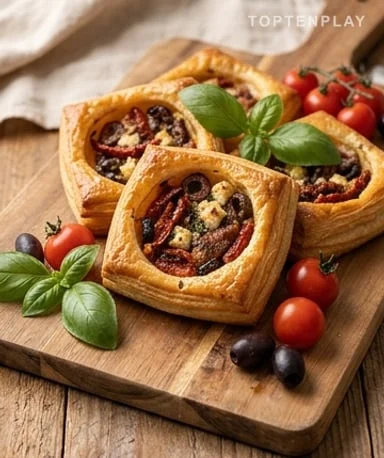
When it comes out of the oven, the Mediterranean Square is a deep golden, almost amber in places, with layers slightly separating at the edges. The smell that spreads—warm butter, grilled thyme, concentrated tomato—is that of a bakery in the South of France on a summer morning. The crust crackles under your fingers before you even bite into it. Inside, the stretchy, airy crumb contrasts with pockets of melting, dark, fragrant filling.
Why you’ll love this recipe
Ingredient Notes
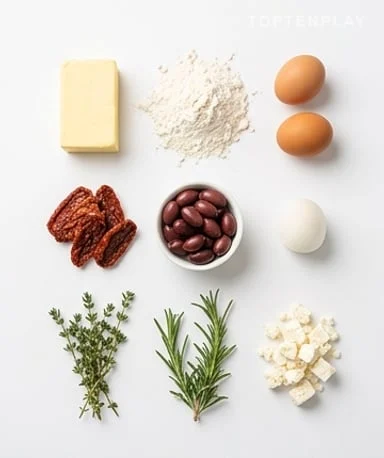
Simple but precise ingredients: quality butter for lamination, sun-dried tomatoes, olives, and fresh herbs for the Mediterranean filling.
- T45 Flour : T45, finer and lower in gluten than T55, gives a tighter crumb and more delicate lamination. A strong bread flour (like Gruau d’or) further strengthens the gluten network during folding without making the dough elastic and hard to roll. Avoid regular supermarket flour: it absorbs butter poorly and the lamination flattens during baking.
- Butter for laminating : This is the butter that creates the layers, not the one in the dough. It must have a high fat content (84% minimum) and remain firm without breaking—a dry butter, called ‘tourage butter’, is ideal. Alternatively, a well-chilled AOP butter works. The rule: if the butter crumbles when tapped, it’s too cold; if it sticks to your fingers, it’s too warm. The right texture is like plasticine.
- Oil-packed sun-dried tomatoes : They provide an umami concentration that fresh tomatoes cannot achieve. Drain them thoroughly on paper towels before using: excess oil soaks the dough and prevents proper lamination. Cut into small irregular pieces to create flavor pockets rather than a uniform layer.
- Pitted black olives : Preferably Kalamata, for their fleshy texture and balanced bitterness. Canned olives work, but rinse them in cold water to reduce metallic taste. Dry them well before adding to the filling—same logic as tomatoes: moisture is the enemy of lamination.
- Fresh herbs (thyme, rosemary) : Fresh thyme holds up better during baking than rosemary, whose needles can harden and prick. A mixture works, but if you only have one: thyme. Dried herbs can be used in a pinch, but at half the amount—they are two to three times more concentrated and can overpower the filling.
- Fresh baker’s yeast : Laminated yeasted dough is a hybrid between croissant dough and puff pastry: it must both rise and laminate. Fresh yeast provides a gentler fermentation and more complex aroma than instant dry yeast. If using dry yeast, divide by three and rehydrate in a little warm water before adding.
The Détrempe: The Foundation of Everything
It all starts with the détrempe—the base dough before incorporating the laminating butter. Mix the flour, salt, sugar, crumbled fresh yeast, and cold liquids until a homogeneous, slightly sticky dough that pulls away from the bowl sides without effort. The classic pitfall: over-kneading. An over-kneaded détrempe develops too much gluten, and the dough resists lamination—it shrinks, tears, and becomes frustrating. Three to four minutes with the dough hook is enough. The dough should be supple, not silky like brioche. Cover with plastic wrap and let rest for one hour in the refrigerator, not at room temperature: an initial chill slows fermentation and makes the dough easier to work during the first lamination.
Lamination: Patience and Cold
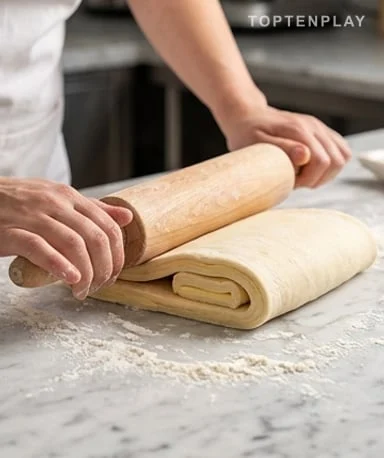
Lamination is the process that traps butter layers between dough layers. Flatten the cold butter into a regular rectangle—the technique of enclosing a square in dough—then perform a series of folds, usually two double turns or three single turns, with at least thirty minutes of chilling between each. This rest is not procrastination: it allows the butter to firm up and the dough to relax so it accepts the next fold without tearing. With each rolling, the layers multiply. The butter must remain cold but not brittle—butter that shatters creates holes in the lamination rather than clean strata. Flour on the work surface is there to prevent sticking, not to incorporate extra flour into the dough: use little, brush off excess between folds.
The Mediterranean Filling
During the chilling rests, prepare the filling. Drained and coarsely chopped sun-dried tomatoes, pitted black olives sliced into rounds, stripped thyme leaves, a touch of finely chopped rosemary. The mixture must be dry—repeating: no trace of residual oil. Some add shavings of Parmesan or Pecorino to bind and provide fat that melts during baking, creating creamy pockets inside. The finished mixture smells of the garrigue: warm dried herbs, slightly bitter olive, tangy-sweet tomato. It’s dense, concentrated, and exactly what’s needed against the buttery neutrality of the dough.
Shaping and Proofing
After the final lamination, roll the dough into a regular rectangle about 4 mm thick. Spread the filling evenly over the entire surface, leaving a 1 cm border on the edges for sealing. Roll tightly, seal, then cut into equal sections—ten pieces for the given quantity—and place them in buttered rings or directly on a baking sheet. Proof for two to three hours at room temperature, around 24-26°C: the squares double in volume, become light and jiggly to the touch. This long proof (including 16 hours that include slow cold fermentation the previous night) is what gives the crumb its airy alveolation and developed flavor, far from industrial bread.
Baking and Removing from the Oven
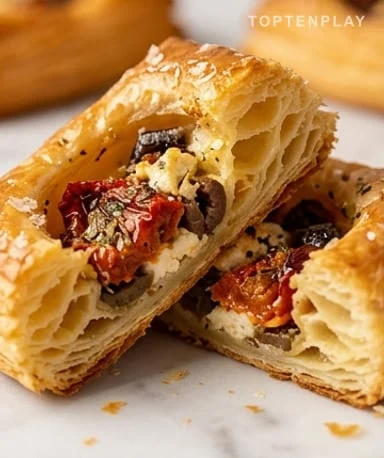
Bake in a very hot oven, 200°C fan-forced, on the middle rack. Fifteen minutes on the clock. The thermal shock makes the layers rise at once: in a few minutes, the squares visibly swell, layers separate, the surface starts to brown. Around ten minutes, the smell changes—the butter begins to lightly caramelize, the heated filling releases aromas of thyme and concentrated tomato. Upon removal, the squares are a deep golden brown, firm to the touch but light to lift. Resist the urge to cut them immediately: five minutes of rest allows the layers to stabilize. Cut while hot, they flatten. After five minutes, they hold their shape and reveal their inner alveolation.

Tips & Tricks
- Prepare the détrempe the day before and let it rise slowly in the refrigerator overnight: a long cold fermentation develops aromas that two hours at room temperature never achieve, and the cold dough is infinitely easier to laminate the next morning.
- If the dough shrinks under the rolling pin during lamination, don’t force it—place it flat in the freezer for ten minutes. The gluten has tensed up under effort and resists; cold relaxes it without breaking the butter.
- Drain the filling on two layers of paper towels and let it rest for twenty minutes: residual moisture from tomatoes and olives is the number one cause of lamination not developing during baking—steam escapes between layers instead of lifting them.
- To check proper proofing maturity, lightly press a finger on a shaped square: if the imprint slowly rebounds in two to three seconds, it’s ready. If it rebounds immediately, the dough hasn’t risen enough; if it stays indented, it’s over-proofed and the lamination will be disappointing.
Can the Mediterranean Squares be prepared the day before?
Yes, it’s even recommended. The détrempe and lamination turns can be done the day before, with a long fermentation in the refrigerator overnight—that’s what gives deep flavor. The next day, just shape, proof at room temperature, and bake.
What is the difference between classic puff pastry and laminated yeasted dough?
Classic puff pastry contains no yeast: it laminates but does not rise, resulting in a crispy, dry product. Laminated yeasted dough combines yeast and lamination: it both rises and laminates, producing an airy, stretchy crumb inside with crispy layers outside. This is the base for croissants and savory viennoiseries like this Mediterranean Square.
Can Mediterranean Squares be frozen?
Yes, in two ways. Either freeze the shaped squares before final proofing: take them out the day before, let them thaw and proof in the refrigerator overnight, then bake the next morning. Or freeze fully baked and cooled squares, reheating them for ten minutes at 160°C—the lamination firms up very well.
How to know if proofing is complete?
Lightly press a finger on a shaped square. If the imprint slowly rebounds in two to three seconds, the dough is ready. If it rebounds immediately, wait longer. If it stays indented without rebounding, the dough is over-proofed and the lamination will be disappointing when baked—in that case, bake immediately.
Can the black olives or sun-dried tomatoes be substituted?
Black olives can be replaced with pitted green olives, but their flavor is sharper and less mellow—reduce the amount slightly. For sun-dried tomatoes, grilled red peppers in oil (drained and dried the same way) work very well and offer a different sweetness. In all cases, dry the substitutes thoroughly: moisture remains the main enemy of lamination.
Why doesn’t my lamination develop during baking?
The most common causes are three: laminating butter that melted during folding (temperature too high), a filling too moist that soaked the dough between layers, or an oven not hot enough at the start. The thermal shock upon baking is what makes the layers rise at once—preheat to 200°C fan-forced without fail and do not reduce the temperature during baking.
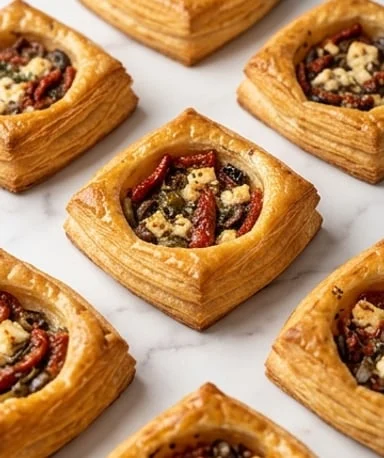
Brian Boclet’s Mediterranean Square
French
Savory viennoiserie
A savory viennoiserie made with laminated yeasted dough, filled with sun-dried tomatoes, black olives, and fresh herbs. Baker’s technique, chef’s result.
Ingredients
- 500g T45 flour (strong bread flour preferred)
- 10g fine salt
- 60g granulated sugar
- 20g fresh baker’s yeast
- 30cl cold whole milk
- 50g softened unsalted butter (for the détrempe)
- 250g butter for laminating (84% fat minimum)
- 150g oil-packed sun-dried tomatoes, drained
- 100g pitted black olives (Kalamata type)
- 80g grated Pecorino or Parmesan
- 3 sprigs of fresh thyme
- 1 sprig of rosemary
- 1 whole egg + 1 yolk (for egg wash)
Instructions
- 1Mix the flour, salt, and sugar in the mixer bowl. Crumble the fresh yeast without letting it touch the salt directly. Add the cold milk and softened butter, then knead with the dough hook for 3 to 4 minutes—the dough should be homogeneous and slightly sticky. Cover with plastic wrap and refrigerate for 1 hour.
- 2Place the laminating butter between two sheets of parchment paper and beat it with a rolling pin to form a regular 20×20 cm square. The butter should be pliable without being soft—it bends without breaking. Refrigerate if necessary.
- 3Remove the détrempe and roll it into an elongated rectangle, twice the size of the butter square. Place the butter in the center, fold the dough edges over to enclose it completely, and seal the seams by pressing.
- 4Gently roll out into a long rectangle, then perform a first double turn (book fold). Cover and refrigerate for 30 minutes. Repeat with a second double turn. Cover and refrigerate for another 30 minutes.
- 5After the final turn, cover the dough and let it ferment in the refrigerator overnight (minimum 12 hours, ideally 16 hours). This slow fermentation develops flavor and makes shaping easier.
- 6Prepare the filling: thoroughly drain the sun-dried tomatoes, coarsely chop them. Slice the olives into rounds. Strip the thyme leaves, finely chop the rosemary. Mix with the grated Pecorino and spread on two layers of paper towels for 20 minutes to dry.
- 7Remove the dough from the refrigerator and roll it into a 30×50 cm rectangle, 4 mm thick. Spread the filling evenly over the entire surface, leaving a 1 cm border on the long edges.
- 8Roll the filled dough tightly into a log along the length. Pinch the seam to seal, then cut into 10 equal sections about 5 cm wide.
- 9Place the sections cut-side up in buttered rings or on a baking sheet lined with parchment paper. Let proof at room temperature (24-26°C) for 2 to 3 hours, until doubled in volume.
- 10Preheat the oven to 200°C fan-forced. Brush the squares with the egg beaten with the yolk and a pinch of salt. Bake for 15 minutes until deep golden brown.
- 11Let rest on a wire rack for 5 minutes before serving. The lamination stabilizes and the filling holds better when cutting.
Notes
• The laminating butter must remain cold but never brittle: test by bending it—if it breaks, let it sit at room temperature for a few minutes; if it sticks, return to cold for 10 minutes.
• Do not skip the long refrigeration fermentation: it’s what distinguishes a complex, flavorful viennoiserie from a simple, characterless pastry.
• If the butter breaks through the dough during lamination, lightly dust the work surface and continue—it’s not irreparable. However, if the dough becomes warm and shiny, stop everything and put it in the freezer for 15 minutes.
• The squares keep well in an airtight container at room temperature for 24 hours, or up to 3 months in the freezer (baked or shaped before proofing).
Nutrition Facts (per serving, estimated)
| 355 kcalCalories | 8gProtein | 33gCarbs | 21gFat |