📌 Bread molding too fast: temperature and humidity explain why (and how to fix it)
Posted 12 January 2026 by: Admin
The Real Reasons Behind Premature Mold
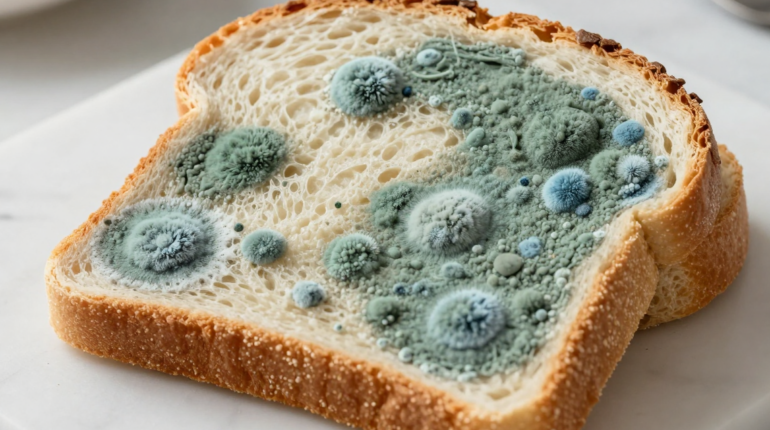
Those fluffy spots that turn your bread into food waste are not inevitable. Before changing your storage habits, identify the problem precisely: mold manifests as fungal colonies in green, blue, or black shades, quite distinct from stale bread which hardens and dries without particular coloration.
This distinction is not trivial. The microscopic fungi that colonize your bread actively feed on its structure, creating these characteristic cottony formations. Unlike simply dried-out bread, moldy bread presents real health risks and must be discarded immediately.
If there is any doubt about the nature of the observed alterations, always prioritize safety. Toxins produced by certain molds can cause serious digestive issues, even if the contaminated areas seem limited. The mycelium extends far beyond the visible zones, infiltrating the crumb through its invisible filaments.
This visual recognition is the essential first step. Identifying the problem correctly allows for adapting preservation solutions and understanding why certain domestic environments dramatically accelerate this fungal degradation phenomenon.
Kitchen Temperature: The Invisible Factor That Accelerates Everything
Beyond the visual identification of mold, an often-overlooked parameter determines their proliferation speed: your kitchen’s ambient temperature. Fungal colonies thrive in heat, transforming a standard domestic environment into a real accelerator of degradation.
The critical threshold is 24°C (75°F). Once exceeded, this thermal ceiling creates optimal conditions for spore multiplication. Kitchens constantly kept above this temperature see their bread covered in fluffy spots in just a few days, drastically reducing its natural shelf life.
This thermal reality explains why the same bread degrades differently depending on the season. Summer, with its heat peaks, mechanically accelerates the fungal colonization process. A simple ambient thermometer allows you to quickly diagnose if your kitchen regularly exceeds this problematic threshold.
The solution does not lie in a radical modification of your air conditioning system, but in a strategic repositioning of the storage location. A cooler pantry, a cupboard away from heat sources, or an adjacent room that is less exposed is often enough to significantly slow down degradation.
However, this thermal variable does not operate alone. It interacts with a second, equally decisive atmospheric factor, capable of transforming your kitchen into a fungal incubator even at moderate temperatures.
Humidity: The Silent Enemy of Your Bread
This invisible atmospheric variable acts in synergy with heat to create a devastating environment. A humidity level exceeding 60% transforms your kitchen into an ideal breeding ground for fungal colonies, even if the temperature remains moderate.
Moisture-saturated air penetrates the porous crumb of the bread, creating the hydration necessary for spore germination. This phenomenon explains why some households notice accelerated degradation despite apparently adequate storage. The invisible culprit operates in silence, gradually condensing atmospheric moisture on the crust and then into the internal fibers.
Maximum risk zones are concentrated near the sink and cooktops. Water vapor released during cooking or dishwashing creates localized humidity peaks, particularly harmful if the bread is nearby. These humid micro-environments drastically accelerate the colonization process.
Installing a dehumidifier in the pantry or kitchen is the most effective solution. This equipment actively regulates ambient humidity, keeping the atmosphere below the critical threshold. A more accessible alternative: systematically move bread away from steam sources and prioritize naturally dry spaces, far from water points.
This understanding of atmospheric factors must be accompanied by vigilance regarding certain domestic locations that are apparently practical but catastrophic for bread preservation.
Forbidden Locations That Ruin Your Bread
The controlled atmosphere is not enough if the positioning of the bread itself condemns it. Two omnipresent household appliances transform their perimeter into critical zones: the refrigerator and the dishwasher. Their apparent harmlessness hides a deadly combination of residual heat and cyclic humidity.
The top of the refrigerator, a location favored by many households for its practicality, concentrates the heat released by the continuously running motor. This surface accumulates several degrees more than the ambient temperature, creating a micro-climate conducive to fungal acceleration. The bread undergoes constant thermal exposure there, invisible but devastating.
The dishwasher presents a different but equally concerning risk profile. Each wash cycle releases massive amounts of water vapor into the immediate environment. This saturated moisture invades adjacent storage spaces, soaking packaging and surfaces. Dormant spores thus find the hydration necessary for their activation, even in correctly packaged bread.
The solution lies in strategic repositioning. A dedicated bread box, installed in a dry cupboard away from any heat or steam source, provides the necessary stable environment. This space should benefit from moderate air circulation without direct exposure to the thermal variations of household appliances. This physical separation is the last barrier against premature proliferation, but other factors also deserve special attention.