Can a vegetarian dish really win over guests who “need meat”? This bok choy and tofu stir-fry is concrete proof. The ginger-garlic sauce is addictive, the golden tofu holds its own, and the whole thing comes together in exactly twenty minutes.
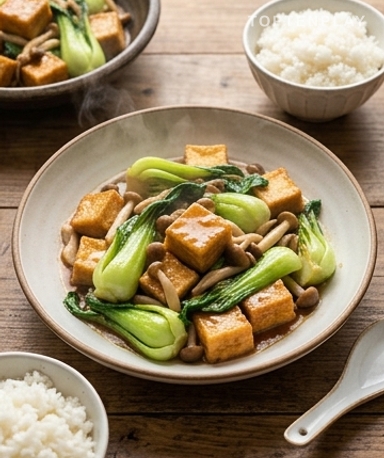
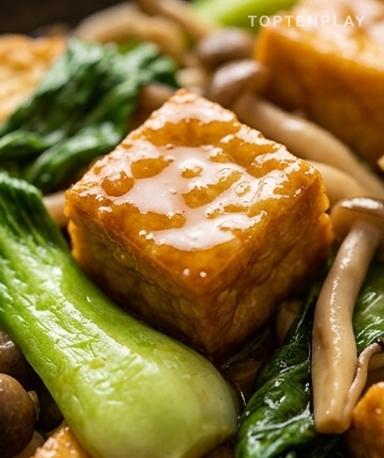
In the bowl, the tofu displays that precise golden hue—like a light caramel that hasn’t yet turned brown. The bok choy has kept its bright emerald green, and the cream-colored shimeji mushrooms slip between the leaves as if they had always belonged there. The sauce glazes everything with a thin, glossy finish that smells of toasted ginger in sesame oil. One poke with a chopstick and you hear that slight sound of the sauce resisting for half a second before flowing.
Why you’ll love this recipe
Ingredient Notes
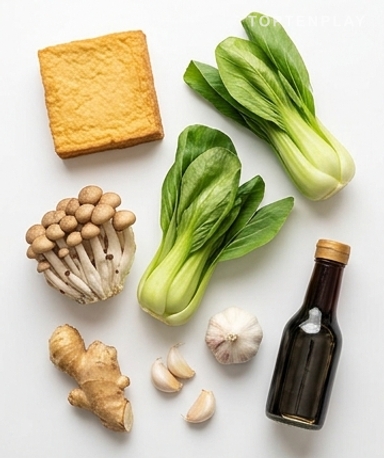
All the stir-fry ingredients: fried tofu, fresh bok choy, shimeji mushrooms, ginger, and garlic.
- Atsuage (deep-fried tofu) : This is a block of firm tofu that has already been deep-fried once—giving it its golden skin and slightly springy feel. You can find it in Asian grocery stores, often in the refrigerated vacuum-packed section. If you can’t find it, take extra-firm tofu, press it well in a towel for fifteen minutes, cut it into cubes and brown them in oil before continuing. The result is a bit more fragile, but it works perfectly.
- Shanghai Bok Choy (baby bok choy) : Sweeter and more tender than large bok choy. The white stems are crunchy, while the leaves cook in less than two minutes. The key detail: separate stems and leaves when cutting; they have very different cooking times, and if you treat them the same, you’ll end up with overcooked leaves and hard stems.
- Brown Shimeji Mushrooms : These small clustered mushrooms have a slightly earthy, nutty flavor, very different from button mushrooms. If you can’t find them, thinly sliced fresh shiitake make an excellent replacement. Enoki work too, but they are more fragile—add them at the very last minute.
- Fresh Ginger : Grate it finely—you want it to disappear into the sauce, not bite into a fibrous piece while eating. Pro tip: keep a knob of ginger in the freezer. You don’t even need to peel it before grating it directly with a fine grater.
- Potato Starch (or cornstarch) : It thickens the sauce in seconds and gives it that glossy restaurant glaze. Cornstarch works too, but potato starch gives a slightly smoother, less sticky texture. Critical point: stir the mixture well just before pouring it into the wok; the starch settles at the bottom of the bowl very quickly.
Why I never make this dish with regular tofu anymore
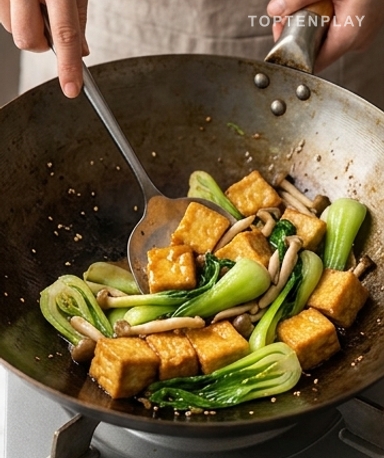
Atsuage is tofu that has already done half the work for you. Its outer surface is pre-fried and slightly spongy to the touch—it grips the sauce instead of letting it slide off. Cut it into fairly thick cubes, about three centimeters, so it holds up during cooking without falling apart. In a hot wok, it quickly takes on a toasted gold color, offering a firm resistance when you flip it with a spatula. If you make a trip to the Asian grocery store for this recipe, it’s truly worth the effort.
The part everyone gets wrong: the order in the wok
Many people throw everything into the pan at once and end up with a soggy, bland result. Order matters more than technique. Garlic and ginger go in first for thirty seconds over medium heat—until the whole kitchen smells warm and slightly spicy. Then the bok choy stems and tofu go in together, because both need time. The leaves and mushrooms arrive last: the leaves wilt in a minute and a half, and shimeji even faster. Keep the heat on medium throughout—cranking it to the max would burn the ginger before the tofu even gets hot.
Thirty seconds for a sauce that looks restaurant-quality
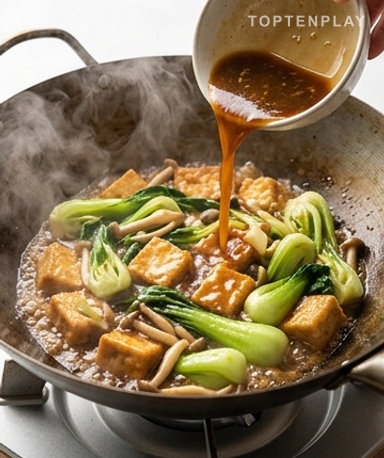
Prepare your sauce in a bowl before even turning on the heat. Concentrated vegetable broth diluted in water, soy sauce, starch—whisk it quickly and set it next to the stove. When the vegetables are ready, give the bowl a final stir (the starch will have settled), and pour it all at once into the wok. The sauce thickens in thirty to sixty seconds of constant stirring, becoming glossy and coating everything with a thick bubbling sound. Remove the pan from the heat as soon as it’s shiny: one second too long and the texture turns gummy.
Tips & Tricks
- Prep everything before turning on the heat—once you start, it moves fast and you won’t have time to look for starch in the cupboard while the garlic starts to burn.
- Stir your starch in the bowl right before pouring, not five minutes before. It sinks to the bottom in moments, and if you pour clear liquid thinking it’s mixed, your sauce will never set.
- Serve immediately after adding the sauce. This dish doesn’t wait—the sauce continues to thicken off the heat and the vegetables soften. It’s a last-minute dish, not one for reheating.
Can I replace atsuage with regular tofu?
Yes, with extra-firm tofu. You must first press it in a towel for 15 minutes to remove excess water, then cut it into cubes and brown them in a little oil before adding them to the wok. The texture will be more delicate than atsuage, but it holds up if you don’t handle it too much.
How to store and reheat leftovers?
Leftovers keep for up to 3 days in the refrigerator in an airtight container. To reheat, a pan over medium heat with a splash of water or broth is better than the microwave, which softens the tofu and makes the vegetables soggy. Note: the bok choy will be slightly less crunchy the next day; it’s unavoidable.
Can I prepare the sauce in advance?
You can mix the broth and soy sauce in advance, but only add the starch when you are ready to cook. If it sits in the liquid too long, it begins to absorb moisture and the sauce won’t thicken properly in the wok.
I don’t have a wok—does a regular pan work?
Yes, a large heavy-bottomed pan or a sauté pan works great. The important thing is to have enough surface area so the ingredients stay in a single layer and sauté rather than steam. Avoid small pans where everything overlaps.
Can I add different mushrooms if I can’t find shimeji?
Absolutely. Thinly sliced fresh shiitake are the best substitute, with a slightly stronger flavor. Brown button mushrooms (cremini) also work. Enoki are more delicate—add them at the very last minute, just 30 seconds before the sauce.
Can I prepare this dish for 4 people?
Yes, simply double the quantities. The only adjustment: if your pan isn’t large enough, cook the tofu and bok choy stems in two batches to sear them properly. Putting everything at once into an overcrowded pan results in boiling rather than stir-frying.
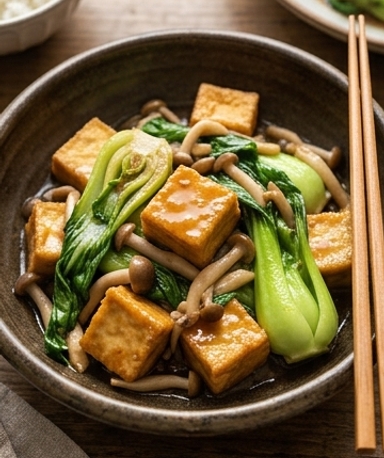
Bok Choy and Tofu Stir-Fry with Ginger-Garlic Sauce
Asian
Main Course
An express vegetarian wok featuring golden fried tofu, crunchy bok choy, and shimeji mushrooms, coated in a glossy ginger-garlic sauce. Ready in 20 minutes.
Ingredients
- 200g atsuage (fried tofu), cut into 3 cm cubes
- 250g Shanghai bok choy (about 3 small heads), stems and leaves separated
- 100g brown shimeji mushrooms, separated into small clusters
- 1 tsp grated fresh ginger (about 5g)
- 2 garlic cloves, finely minced
- 1 tbsp toasted sesame oil (15ml)
- 1 pinch salt and black pepper
- 120ml water
- 1 tsp vegetable broth concentrate (like Better Than Bouillon or equivalent)
- 2 tbsp soy sauce (30ml)
- 1 tbsp potato starch or cornstarch (10g)
Instructions
- 1Prepare the vegetables: cut the bok choy stems into 5 cm pieces, keep the leaves whole. Separate the shimeji into small clusters. In a bowl, mix the water, broth concentrate, soy sauce, and starch—set aside.
- 2Heat the sesame oil in a wok or large pan over medium heat. Add the ginger and garlic, sauté for 30 seconds until fragrant.
- 3Add the atsuage cubes and bok choy stems. Stir-fry for 3-4 minutes, stirring regularly, until the tofu is lightly golden and the stems begin to soften. Season with salt and pepper.
- 4Add the bok choy leaves and shimeji mushrooms. Stir-fry for 1 to 2 minutes until the leaves are wilted and the mushrooms are tender.
- 5Stir the sauce bowl well (the starch has settled), pour all at once into the wok. Stir constantly for 30 to 60 seconds until the sauce is glossy and coats everything. Remove from heat immediately and serve with rice or noodles.
Notes
• Storage: keeps for 3 days in the refrigerator. Reheat in a pan with a splash of water, not in the microwave.
• Without atsuage: use pressed extra-firm tofu, cubed and previously browned in oil. The texture will be more fragile.
• To spice it up: add a pinch of shichimi togarashi or a drizzle of chili oil when serving.
Nutrition Facts (per serving, estimated)
| 220 kcalCalories | 13gProtein | 11gCarbs | 14gFat |