📌 Banana peel and hair straightening: why this viral method doesn’t work as promised
Posted 13 February 2026 by: Admin
The Controversial Origin Of A Viral Method
On TikTok and Instagram, an “ancient Japanese method” promises the impossible: transforming curly hair into a smooth and shiny mane using simple banana peels. The videos accumulate millions of views, showcasing spectacular transformations accompanied by enthusiastic testimonials. However, no historical trace links this practice to Japan, nor to traditional Japanese hair care techniques.
The term “Japanese straightening” actually refers to thermal reconditioning, a permanent chemical treatment developed in the 1990s that restructures keratin. This professional process has strictly nothing to do with natural fruit-based remedies. Confusion sets in when viral content appropriates this terminology to give credibility to a grandmother’s recipe without cultural or scientific foundation.
The before/after photos flooding social media mostly reveal freshly hydrated and styled hair, not a structural metamorphosis. Dermatologists and trichologists interviewed confirm the obvious: no natural ingredient can permanently change the shape of the hair follicle. Banana peel, rich in potassium and antioxidants, does indeed offer temporary softening and smoothing properties – but promising permanent straightening is pure misinformation.
This trend illustrates how the algorithm amplifies cosmetic myths, dressing up practices whose effectiveness remains anecdotal with pseudo-science and cultural exoticism. It remains to be understood what the banana actually brings to the hair fiber.
What Bananas Can Actually Provide To Hair
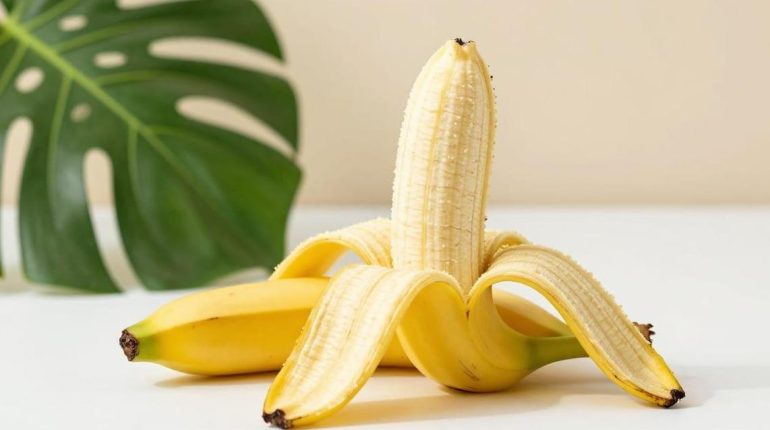
Beyond the viral hype, the nutritional composition of bananas justifies its traditional cosmetic use in several cultures – just not for straightening. The flesh and peel contain potassium, vitamins B6 and C, silica, and natural antioxidants. These compounds act as moisturizing agents thanks to sugars and vegetable oils that superficially penetrate the hair cuticle.
Dermatological studies confirm that intensive hydration temporarily reduces frizz by sealing the hair scales. The result: a more supple texture, increased luminous reflection, and a visually “smoothed” appearance – without modification of the helical structure of the follicle. Antioxidants protect against environmental aggressions (UV, pollution), while silica strengthens the fiber on the surface.
The gap between “softening” and “permanent transformation” remains abyssal. An application of blended banana peel provides a feeling of softness comparable to a nourishing conditioner, ideal for managing rebellious curls between washes. User testimonials indeed mention more disciplined hair for 24 to 48 hours – the classic duration for any hydrating mask.
These benefits, although modest, explain the persistence of homemade banana-based recipes in Latin America and Southeast Asia. The crucial nuance: no one there ever claimed to achieve lasting straightening. To exploit these properties without disillusionment, precise application protocols must be respected.
Recipes And Safe Application Protocols
Preparation determines the effectiveness of the treatment. Choose very ripe banana peels – their concentration of sugars and enzymes reaches its maximum – then blend carefully to avoid residual fibers that get tangled in the lengths. Full grinding is non-negotiable: fibrous fragments turn rinsing into an ordeal.
The basic mask is limited to scraping the white inner part of the peel with a spoon, then kneading this pulp until a homogeneous paste is obtained. Apply to damp hair, from the scalp to the ends, focusing on dehydrated areas. Leave on for 30 minutes under a shower cap before rinsing thoroughly with lukewarm water.
The enriched variant combines a whole mashed banana with the blended peel, plus a tablespoon of honey (sealing agent) or coconut oil (enhanced penetration). Some traditions recommend a final rinse with cooled peel cooking water – the infusion retains soluble minerals and antioxidants – as a daily detangling spray version.
Optimal frequency: one to two applications per week maximum. Beyond that, nutrient saturation brings nothing and unnecessarily weighs down the fiber. Prior skin testing is systematically required: apply a little of the mixture behind the ear 24 hours before full use to detect any rare but documented allergic reaction to banana enzymes.
This routine provides hydration and temporary frizz management – visible but fleeting results that require a realistic understanding of the physiological limits of any natural method.
Scientific Verdict And Professional Alternatives
No natural topical application can permanently change the molecular structure of the hair. The disulfide bonds that determine the curly or straight shape are located at the heart of the keratin – their permanent reorganization requires powerful alkaline chemical agents or strictly controlled high-temperature thermal processes. Banana peel hydrates the surface, it does not penetrate the cuticle to the disulfide bridges.
The viral images showing spectacular transformations actually capture freshly hydrated and blow-dried hair. The visible smoothing effect results from the weight of residual water and the styling technique, not from a structural reconfiguration. From the next shampoo, the natural texture reappears entirely – formal proof of the absence of permanent modification.
For authentic and lasting straightening, professional treatments remain essential: Japanese straightening by thermal reconditioning (breaking and reforming bonds with heat), Brazilian keratin treatment, or chemical relaxing. These protocols cost between 150 and 600 euros depending on the length and require rigorous maintenance.
Banana nevertheless offers a legitimate solution to temporarily soften curls, reduce frizz between shampoos, and provide natural shine without synthetic silicones. Its interest lies in this comfortable daily management, not in a promise of radical transformation. For those looking for a punctual relaxation respectful of the fiber, this natural ritual remains fully relevant – provided they abandon the illusion of permanent change and embrace natural texture as a starting point.