📌 Apple Tatin Galette des Rois: the two-stage baking recipe for perfect puff pastry
Posted 2 January 2026 by: Admin
The Innovative Recipe Reinventing Tradition
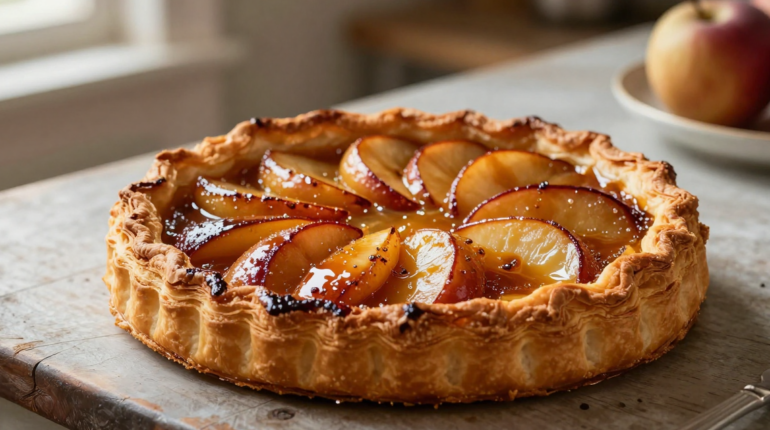
Epiphany takes an unexpected gastronomic turn with this Apple Tatin Galette des Rois, a bold fusion of two monuments of French pastry. Forget plain classic frangipane: here, apples caramelized in butter and sugar invite themselves between two layers of puff pastry, transforming the January ritual into a renewed taste experience.
The technical prowess relies on a layered assembly: a first pastry base pricked with a fork hosts the artisanal frangipane – a homogeneous mixture of butter, sugar, egg, and almond powder, optionally enhanced with amaretto or rum. The previously simmered apple cubes then crown this creamy base, before a second pastry seals the whole. The secret to perfect puff pastry? Baking in two precise stages: ten minutes at 200°C to set the structure, then twenty minutes at 170°C to develop the aromas without burning the egg yolk wash.
This reinterpretation combines the crispy elegance of traditional puff pastry with the caramelized indulgence of Tarte Tatin. The central chimney made of parchment paper releases moisture during baking, guaranteeing an airy texture. Served hot, warm, or cold according to preference, it adapts to the organizational constraints of family celebrations while keeping its festive character intact.
The Secret Of The Caramelized Apple Filling
The transformation of the apples constitutes the beating heart of this hybrid galette. After meticulous washing and drying, the fruits are cut into regular cubes – a cut that favors uniform caramelization. In a heated sauté pan, the butter melts before adding the sugar, triggering a chemical reaction where the grains dissolve and begin to color. It is at this precise stage, when the mixture takes on an amber hue, that the apples join the dance.
The operation requires constant attention: the cubes must be uniformly coated in the nascent caramel, guaranteeing a homogeneous coloration that already heralds the flavors to come. With the lid on, the temperature naturally drops, allowing for gentle simmering for fifteen minutes. Intermittent stirring prevents sticking to the bottom while redistributing the natural juice of the apples which mixes with the caramel.
This progressive cooking develops a melting texture while preserving a slight bite – the apples must confit without reducing to compote. The result? Soft pieces imbued with deep caramelized notes, ready to diffuse their fragrance in every bite of the galette. This Tatin-style preparation tolerates no shortcuts: the fifteen minutes of simmering transform simple fresh apples into a gastronomic filling, creating the textural contrast with the creamy frangipane that will host them.
Homemade Frangipane And Its Customization Options
While the apples cool slightly, preparing the frangipane stands out as the step that balances the caramelized sweetness. In a bowl, the sugar meets the softened butter – manual mixing is enough, no need to take out the electric mixer. The incorporated egg binds the whole before the almond powder brings its characteristic grainy texture and distinct taste.
The fork becomes the preferred tool: a few energetic circular movements transform these basic ingredients into a homogeneous cream. Some pastry chefs add a dash of amaretto here to accentuate the almond notes, others prefer rum which brings a subtle aromatic depth. These optional choices allow for personalizing the recipe according to the palate, without ever betraying the essence of the traditional galette.
Refrigeration slightly firms the preparation, facilitating its subsequent application. During assembly, this generous filling must entirely cover the first puff pastry, right to the very edges – no area can remain bare. This total coverage is not just aesthetic: it forms a protective barrier preventing the frangipane from escaping through the sides during high-temperature baking. The marriage between this creamy almond base and the caramelized apples on top reconstructs the expected taste architecture, while introducing the signature fruity dimension of Tarte Tatin.
Assembly And Baking Tips For Guaranteed Success
Once the frangipane is spread to the edges and the caramelized apples are evenly distributed, the assembly reveals its technical subtleties. On the first puff pastry previously pricked with a fork – an essential gesture to avoid blistering – the second pastry comes to top the whole. The fingers then firmly pinch the perimeter, sealing the two layers into a watertight border that traps the creamy filling.
In the center, a small chimney fashioned with a roll of parchment paper goes right through the galette. This seemingly trivial opening allows steam to escape during baking, regulating internal pressure and preserving the structural integrity of the puff pastry. Without it, the steam seeks other exits and risks tearing the pastry at weakened spots.
The brush loaded with egg yolk glides over the top surface, depositing a thin golden film that will shine under the effect of the heat. The two-stage baking – ten minutes at 200°C to sear the pastry, then twenty minutes at 170°C to continue without burning – guarantees a crispy puff pastry enveloping a soft filling. Out of the oven, the galette offers rare versatility: served hot, it releases its most intense caramelized aromas; warm, it balances melting textures and structure; cold, it facilitates clean slicing for planned receptions where every detail counts.