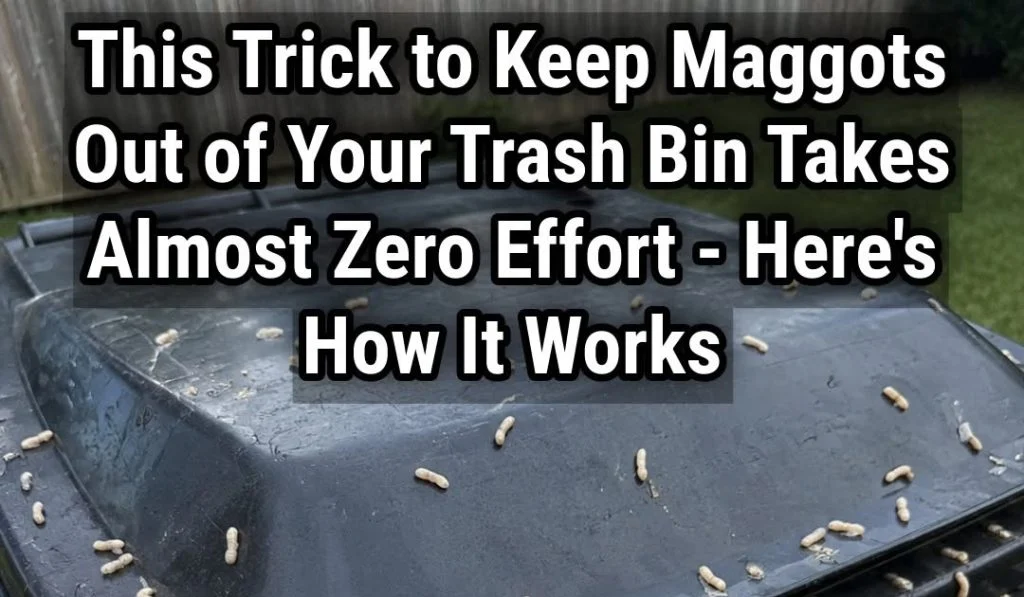
Opening the trash can to find maggots is an unpleasant but common household problem. The cause is biological and straightforward: flies lay eggs on decaying food, and in the right conditions those eggs hatch in less than a day. Understanding the cycle is the first step to breaking it.
In brief
- —Fly eggs hatch into maggots in as little as 8 to 24 hours
- —One female fly can lay hundreds of eggs at a time
- —Removing food, moisture and access breaks the cycle
Fly larvae, not a hygiene failure: the biology behind the problem
Maggots are not a sign of a dirty home. They are simply the larval stage of the common housefly or fruit fly, two species that are ubiquitous in domestic environments.

What draws flies to a trash bin is scent: decaying organic matter such as meat scraps, dairy residue, or overripe fruit releases compounds that attract flies from a distance. Once a fly locates that food source, it deposits eggs directly on it.
A single female fly is capable of laying hundreds of microscopic eggs in one visit. Because the eggs are tiny and nearly invisible, most people do not notice them until the larvae have already hatched and become visible.
The common housefly life cycle
The housefly (Musca domestica) and the fruit fly are among the most widespread insects in domestic settings worldwide. Females are capable of laying hundreds of eggs at a time, and the full life cycle from egg to adult can be completed in as little as a week under warm conditions. Trash bins concentrate the decaying organic matter that both species use as a breeding site.
8 to 24 hours: the narrow window before eggs become maggots
The speed of the hatch is what catches most people off guard. In a warm, moist environment — exactly the conditions inside a closed trash bin on a summer day — fly eggs can develop into maggots in as little as 8 to 24 hours.

Heat and humidity accelerate every stage of the fly life cycle. A bin left in a warm kitchen or a sun-exposed outdoor area provides near-ideal incubation conditions, which is why infestations can appear to emerge overnight.
This tight timeline means that prevention must happen before the bin is closed, not after the problem is visible. Once larvae are present, the infestation is already hours old.
Suggested Posts

Climate adaptation: from insurance retreat to $9 trillion opportunity
As climate change pushes entire regions toward uninsurability, a growing body of financial research is reframing adaptation not as a cost but as a…