📌 Yellow thawed salmon: why this color doesn’t always mean the fish is bad
Posted 17 February 2026 by: Admin
The Mystery of Yellow Salmon: The Phenomenon Alarming Thousands of Cooks
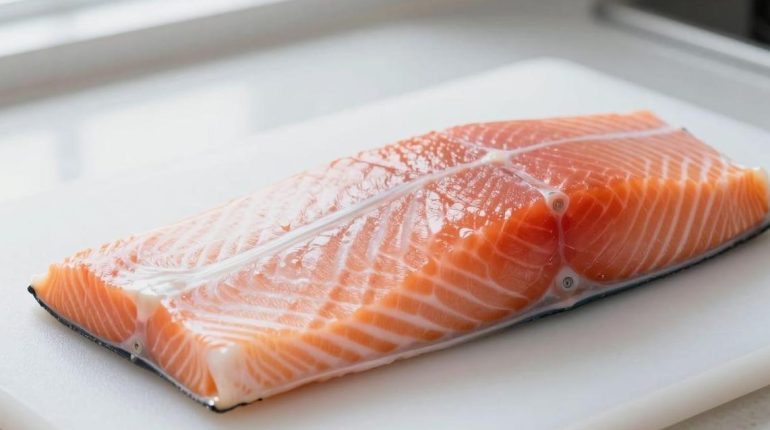
Salmon is one of the most popular fish in our kitchens. Its pink, meaty, and flavorful flesh makes it a reliable choice for both quick and elaborate meals. Yet, it only takes one thing to turn this certainty into immediate doubt: opening a thawed fillet and discovering an unexpected yellowish tint on the flesh.
The reaction is instinctive. You step back, observe, hesitate. Has the fish been in the freezer too long? Was the packaging faulty? Did the salmon simply go bad without anyone noticing? These questions arise in seconds, and the natural reflex is often to throw the fillet away without looking further.
Thousands of cooks experience this scenario every week. And yet, this yellow color does not automatically signal the end of the meal. A yellowish tint on thawed salmon can have several distinct origins — some harmless, others requiring more vigilance — and confusing them means unnecessarily wasting a perfectly edible food item.
Understanding this phenomenon means taking back control in your kitchen. Because between actual degradation and a simple visual variation, there is a difference; it is identifiable, and it relies on precise biological and physical mechanisms that every cook should know.
Fat Oxidation: The Science Behind Discoloration
Among the biological mechanisms that explain this color variation, fat oxidation is the first to understand. Salmon is a fish naturally rich in lipids — this is precisely what gives it that melting texture and characteristic flavor. But these fats, when exposed to imperfect storage conditions, become vulnerable.
During prolonged freezing or insufficient packaging, the fish’s fatty acids react upon contact with residual oxygen. The result: a progressive modification of the flesh color, which turns from pink to a more or less pronounced yellow. The phenomenon is chemically identical to the browning of an apple slice left in the open air — a visible oxidation, but not necessarily synonymous with danger.
This point is essential: oxidation affects quality and appearance, not automatically food safety. Salmon slightly yellowed for this reason often remains consumable, provided no other signs of deterioration are present.
This is where complementary vigilance comes in. An acidic or overly strong smell, a slimy texture to the touch, or an unpleasant taste when cooked are all reliable indicators that the fish has passed the stage of simple oxidation. In the absence of these signals, color alone is not enough to condemn a fillet.
Fat oxidation is, however, only one explanation among others — and some are even more surprising.
Freezer Burn and Natural Variations: The Two Other Culprits
Fat oxidation is not always the only cause. A second phenomenon, just as frequent, deserves to be identified precisely: freezer burn.
When salmon is poorly packaged — insufficient plastic wrap, non-airtight bag — air circulates in direct contact with the flesh. The fish then gradually loses its natural moisture, developing characteristic yellow or white spots. The affected area can be cut away without hesitation before cooking: the rest of the fillet remains perfectly consumable and retains all its nutritional qualities.
But yellowish discoloration can also have a much more unexpected — and totally natural — origin. Some species of wild salmon have a slightly yellowish belly, directly linked to their diet. Crustaceans, algae, and marine microorganisms contain specific pigments that integrate into the fish’s flesh as it grows. This has no link to deterioration: it is simply the trace of its natural environment.
Farmed salmon, whose diet is strictly controlled, generally displays a more homogeneous color. But even it can show occasional chromatic variations, without this compromising its quality in any way.
Understanding the exact origin of the yellow tint is therefore decisive. Once this distinction is established, one last essential criterion remains to be validated before definitively deciding on the fish’s edibility.
The 3-Step Freshness Test to Never Doubt Again
Once the origin of the yellow tint is identified, a central question remains: is the fish still edible? Three simple checks are enough to decide definitively.
First reflex: the smell test. Healthy salmon gives off a neutral and slightly briny smell, close to a sea breeze. If the smell turns too strong, acidic, or rancid, the fish should be discarded without hesitation. Smell remains the most reliable warning signal for detecting advanced deterioration.
Second step: the tactile test. Lightly press a finger on the flesh — it should return to its initial shape in a few seconds. Flesh that remains indented or displays a slimy texture signals a degradation of proteins, a sign that the fish has lost its structural freshness.
Third precaution: preventive cutting. Even when the first two tests are conclusive, removing the yellow area before cooking remains a common-sense measure. This simple precaution eliminates any residual uncertainty and guarantees an optimal taste experience.
These three checks — smell, texture, cutting — constitute a quick and accessible protocol, applicable directly in the kitchen. Applied methodically, they transform a source of concern into a simple routine step, allowing you to cook your salmon with complete peace of mind, regardless of its initial appearance.