📌 White tongue: 4 health signals your body is sending you and how to remedy them naturally
Posted 12 January 2026 by: Admin
Visual Manifestations Of White Tongue: Identifying The Signs
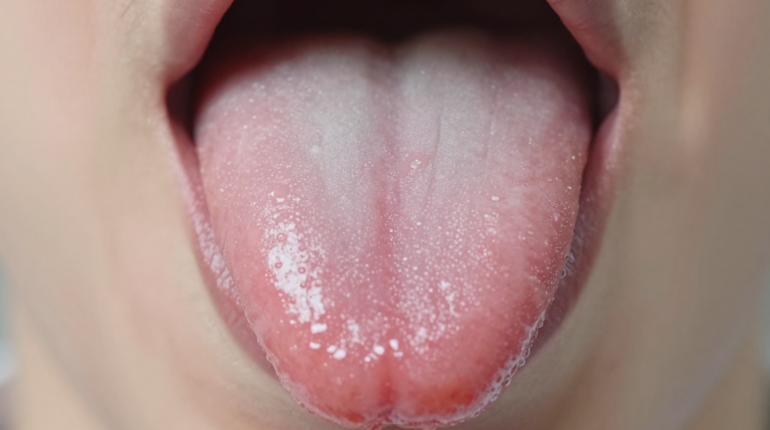
The appearance of a whitish film on the tongue can take several distinct forms. This deposit sometimes covers the entire lingual surface, is limited to certain areas, or manifests as scattered spots. In addition to this unusual coloring, there is frequently an unpleasant odor and an altered taste in the mouth, accompanied by a feeling of persistent dryness.
Careful examination of the tongue reveals what looks like tiny white hairs on its surface. This deceptive appearance actually hides a very different phenomenon: these “hairs” are the taste buds covered with organic particles, bacteria, and accumulated dead cells. This layer forms gradually when these residues are not naturally eliminated by tongue movements and saliva.
This accumulation creates an unusual texture to the touch and changes the perception of flavors. The odor emanating from it comes directly from the bacterial decomposition of organic particles trapped between the papillae. The dry mouth that often accompanies it worsens the phenomenon by reducing the natural cleaning action of saliva.
This visible manifestation is the first indicator of an oral imbalance requiring attention, although its origin can vary considerably from one individual to another.
Understanding The Origin Of The Whitish Deposit: Causes And Mechanisms
This observable oral imbalance has its roots in a precise biological process. The taste buds, normally clear, find themselves trapped by a progressive accumulation of organic debris, bacterial colonies, and dead epithelial cells. This cocktail of substances forms the characteristic whitish layer that alters the usual appearance of the tongue.
Two main categories of factors trigger this phenomenon: mechanical or chemical irritation on one hand, and bacterial or fungal infections on the other. Irritation can come from acidic foods, tobacco, or poor hydration. Infections, for their part, promote microbial proliferation which accelerates the formation of the deposit.
The good news lies in the natural resolution capacity of the problem. In the majority of cases, this coating disappears spontaneously after a few days, when normal cell renewal resumes its course and saliva regains its self-cleaning action. Simple regular tooth brushing, including the surface of the tongue, is generally sufficient to accelerate this elimination.
However, when this situation persists beyond several weeks or is accompanied by pain during chewing or speaking, it ceases to be harmless and requires a thorough medical examination.
When To Worry: Warning Signals Not To Ignore
This spontaneous resolution in a few days constitutes the normal evolution of the phenomenon. The body triggers its regeneration mechanisms, and the situation normalizes without particular intervention. Regular brushing of the teeth and tongue generally accelerates this return to normal, mechanically eliminating accumulated deposits.
Certain situations, however, require increased vigilance. When the whitish deposit persists beyond two to three weeks despite rigorous oral hygiene, it ceases to be a simple temporary inconvenience. This abnormally long duration suggests a deeper imbalance requiring a precise medical diagnosis.
The second major warning signal concerns the appearance of functional pain. If chewing becomes uncomfortable, if pronouncing certain words causes discomfort, if the tongue presents unusual sensitivity, consultation becomes imperative. These painful manifestations potentially indicate an underlying infection, oral thrush, or another pathology requiring specific treatment.
The ineffectiveness of standard tooth brushing also represents a relevant indicator. When hygiene efforts remain without visible effect, the problem probably goes beyond a simple superficial deposit and deserves a thorough professional evaluation. Other lingual colorations also reveal distinct metabolic imbalances deserving attention.
Beyond White: Decoding Other Tongue Colorations
This vigilance regarding lingual anomalies naturally extends to the observation of other revealing colorations. A pink tongue is the normal reference, a sign of a healthy mouth where papillae and mucous membranes maintain their natural balance. Any chromatic deviation deserves interpretation, as each shade betrays a specific imbalance.
A brown tongue generally signals excessive consumption of coffee or tea. The tannins contained in these drinks gradually pigment the lingual surface, creating this characteristic coloring. This phenomenon, although unsightly, remains benign and usually disappears with a reduction in consumption and meticulous brushing.
A yellow tongue reveals a potential liver dysfunction. This particular shade indicates that the liver is struggling to correctly eliminate certain toxins, which then manifest through this unusual coloring. A medical check-up is necessary to precisely identify the origin of this disorder and adapt the management.
A bright red tongue frequently reflects a vitamin B deficiency, an essential element for the cellular renewal of oral mucous membranes. This nutritional deficiency changes the normal appearance of the tongue, which loses its pinkish tint to adopt this characteristic red. Targeted supplementation generally corrects this anomaly quickly.
These chromatic variations thus transform the tongue into a true indicator of overall health, where each nuance reveals a particular metabolic imbalance requiring an adapted therapeutic approach.