📌 White laundry and soft towels: why pouring vinegar at the wrong time ruins its effectiveness
Posted 27 December 2025 by: Admin
The Unsuspected Properties Of Vinegar In Laundry
Distilled white vinegar hides behind its modest appearance a formidable chemical weapon against the invisible enemy of your laundry: acetic acid. This molecule acts as a natural solvent, capable of methodically breaking down the buildup of detergents, softeners, and lime minerals that become embedded in textile fibers over many washes. Unlike commercial products that add an extra layer, acetic acid directly attacks the residues responsible for the progressive dulling of fabrics.
Hard water is the main adversary of brilliant whites. Loaded with calcium and magnesium, it leaves microscopic deposits that trap dirt and create that grayish patina characteristic of aged white clothing. Vinegar neutralizes these minerals, freeing the fibers from their invisible shell. This stripping action not only restores the original whiteness but also restores the fabrics’ natural absorption capacity, which is particularly crucial for towels and clothing in direct contact with the skin.
Beyond effectiveness, this solution offers a double economic and ecological advantage that is rarely matched. At just a few cents per liter, vinegar outperforms specialized stain removers while eliminating harsh chemical agents that irritate sensitive skin and pollute wastewater. This natural alternative transforms a common condiment into an indispensable ally for impeccable laundry, provided you avoid certain common mistakes that compromise its effectiveness.
The Three Fatal Mistakes That Ruin Your Results
The first mistake is believing that more vinegar equals better results. This intuitive logic backfires: overdosing causes persistent acidic odors that permeate the fibers and weakens delicate textiles like silk or wool. Acetic acid, in excessive concentration, attacks the very structure of the fabrics instead of simply dissolving residues. Half a cup is more than enough for a full cycle; any additional amount becomes counterproductive.
Pouring vinegar directly onto clothes represents the second critical fault. This concentrated application creates zones of prolonged contact where the acidity literally strips dyes and locally weakens fibers. The whitish or discolored spots that mysteriously appear on your clothes often result from this hazardous handling. Systematic dilution in the drum water guarantees a homogeneous and harmless distribution.
But the most dangerous mistake remains mixing vinegar and bleach, a combination that turns your washing machine into a toxic gas generator. This chemical reaction releases chlorine gas, a suffocating substance that causes respiratory burns, severe eye irritation, and can lead to hospitalization in case of prolonged exposure. Even bleach residues from a previous wash can react with vinegar. This safety rule tolerates no exceptions: these two products must never meet, even several cycles apart.
Optimal Protocol For Brilliant Whites
Now that you know the pitfalls to avoid, here is the method that truly transforms your dull whites into brilliant textiles. The secret lies in the precision of dosage and timing: pour between 1/2 and 1 cup of distilled white vinegar exclusively during the rinse cycle, never during the main wash. This strategic intervention window allows the acetic acid to act on the detergent residues already dislodged by the wash, without interfering with the initial cleaning action.
Your machine’s softener compartment is the ideal entry point: it automatically releases the vinegar at the precise moment of rinsing. If your appliance lacks one, simply wait for the start of the rinse cycle to pour directly into the drum, ensuring the vinegar dilutes immediately in the water. This spontaneous dilution guarantees a uniform distribution that envelopes every fiber without creating an aggressive concentration.
The effectiveness of this technique is based on a simple chemical principle: acetic acid dissolves the invisible layers of calcified soap that trap gray particles and give white textiles that dull appearance. By systematically eliminating these accumulations, you not only restore the original whiteness but also extend the life of your clothes. A monthly treatment is enough to maintain this rediscovered clarity, while particularly soiled textiles benefit from a more intensive program.
Specific Technique For Ultra-Soft Towels
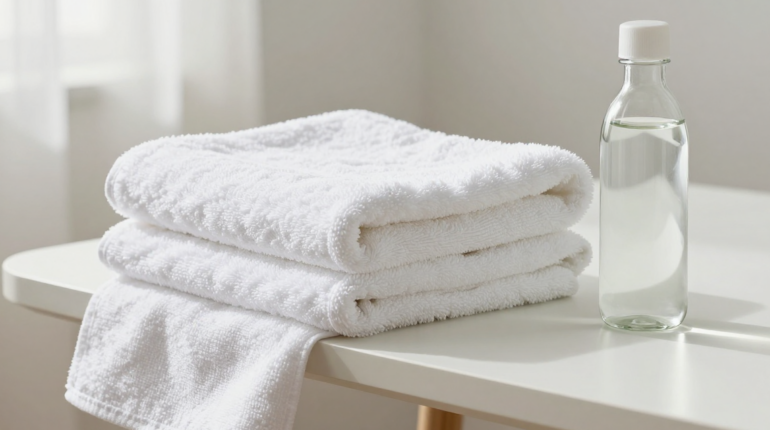
Stiff and scratchy towels reveal a more severe accumulation problem that requires radical intervention. Unlike the maintenance treatment for whites, the complete restoration of towels requires totally replacing the detergent with 1 cup of white vinegar for an entire cycle. This substitution may seem counterintuitive, but it triggers a deep de-scaling process that detergent cannot accomplish.
Run a full hot water cycle with only vinegar in the washing compartment. The acetic acid then penetrates every fiber of the terry cloth, dissolving the layered buildup of softener and lime residues that stifle the cotton’s natural absorption. This shock treatment simultaneously eliminates stubborn musty odors that even scented detergents can no longer mask.
The results are apparent from the first drying: the towels regain their original fluffiness and their ability to absorb water instantly. For extremely soiled textiles, a second cycle with classic detergent can follow, but most regain their optimal performance after this single vinegar purge. Repeat this treatment every three months to maintain this rediscovered softness and preserve the investment that quality bath textiles represent.