The term started life as the wash-down closet before everyday usage reshaped it into water closet, which then shortened to the abbreviation WC. History enthusiasts have noted that the Victorian era specifically created the phrase to avoid social embarrassment — discussing toilet facilities directly was considered taboo in polite society. Two letters, sufficiently removed from the bodily function they referenced, were considered acceptably vague.
A 2026 discussion documented by British Brief illustrated just how thoroughly the original meaning has been lost. Social media users across the UK expressed genuine shock when they finally learned what WC meant, with some admitting they had spent years assuming it stood for “wheelchair.”
A Poet, a Queen, and a Scottish Watchmaker’s Crucial Pipe
The first modern flush toilet was described in 1596 by Sir John Harington, an English courtier and godson of Queen Elizabeth I. Harington invented both a valve at the bottom of a water tank and a wash-down system. The queen reportedly had one installed — but the contraption still drained into an open cesspit below, meaning the smell largely defeated the purpose. Without a reliable supply of running water, the invention went largely unused for nearly two centuries.

The breakthrough came in 1775, when Scottish watchmaker Alexander Cumming became the first to patent a flush toilet design. Beyond improving the flush mechanism, Cumming added an S-trap — a curved section of pipe that retains a small pool of water after every flush, permanently blocking sewer gases from entering a building. That design feature is still present in virtually every modern flush toilet.
The S-trap is the reason a bathroom doesn’t smell like a sewer. The visible curve of pipe below or behind a toilet bowl is Cumming’s 250-year-old solution, still doing its job.
The Victorian sanitation revolution
As urban populations exploded during the Victorian era, engineers and inventors developed new ways to manage human waste more efficiently. Water closets were initially exclusive to wealthy families and grand hotels, serving as luxury amenities. Britain’s experience with cholera outbreaks traced to contaminated water supplies gave the push for indoor plumbing an urgent public health dimension that went far beyond social etiquette.
How Two Neutral Letters Crossed Every Language Barrier
Once WC took hold in Britain, it spread quickly through the growth of public facilities — train stations, hotels, and department stores — where clear and polite signage was essential. The abbreviation became a standard marker across the country and persisted even as toilet designs and plumbing systems evolved.
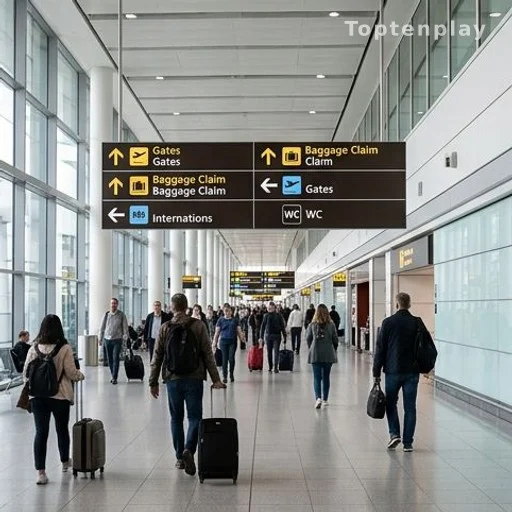
In continental Europe, particularly in Germany, the Netherlands, and Scandinavian countries, WC was widely adopted and eventually became a recognized toilet identifier well beyond the British Isles. Many Asian countries followed, adopting the same abbreviation in public spaces to accommodate international travelers.
Suggested Posts

Egg yolk color doesn’t reveal what you think about your chicken
A deep orange egg yolk is widely taken as a sign of a healthier chicken and a more nutritious egg. That assumption is largely…