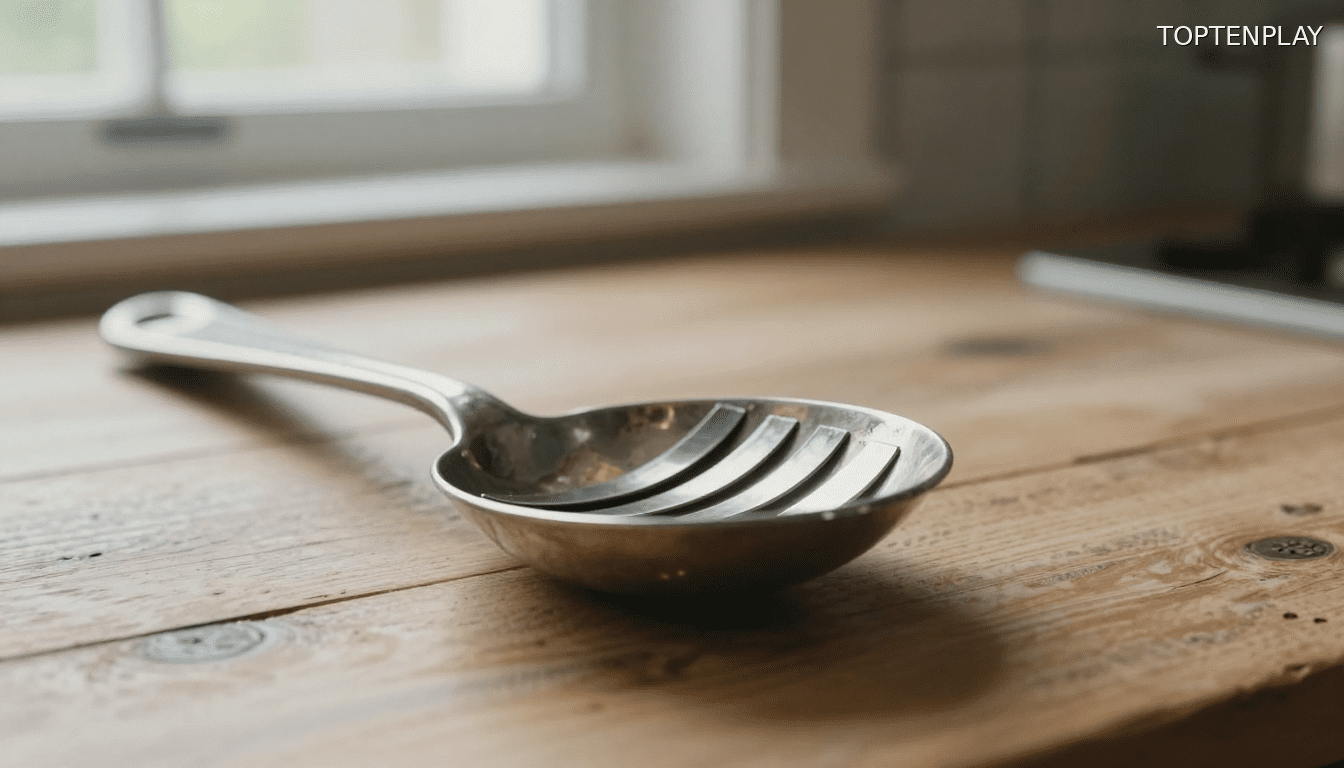
The Mysterious Spoon Lingering In Our Grandparents’ Drawers
At the bottom of inherited kitchen drawers, between rusty whisks and vintage can openers, hides a disconcerting-looking utensil. Its elegant curved shape evokes that of a classic spoon, but the inside of its bowl reveals a troubling peculiarity: fine, parallel, striated metal slats that seem to defy all ergonomic logic.
At first glance, this object looks like a design failure. How to explain these rigid fins that block the inside of the bowl, making any use as a traditional spoon impossible? The aesthetics don’t help: these metal grooves give the utensil a wobbly, almost failed appearance.
Yet, this oddity is not the result of a manufacturing error. Quite the contrary. Each element of this apparently absurd design responds to a precise function, designed to solve a daily problem that our modern kitchens have totally forgotten. The slats that seem so incongruous are actually the very heart of the invention.
This little culinary mystery deserves a closer look. Because behind this strange shape lies an ingenuity typical of an era when kitchen utensils responded to material constraints that have disappeared today.

Hidden Ingenuity: When Hard Butter Met Its Match
These enigmatic slats act as a miniature grater specially designed to tackle refrigerated butter in all its hardness. Their function? To scrape the cold block to extract ultra-fine shavings, immediately spreadable without waiting for any softening.
The mechanism relies on a simple but formidable principle. By passing the spoon over the butter surface with light pressure, the metal ridges scrape off paper-thin layers, naturally curling them into delicate ribbons. These shavings, unlike the compact block, spread easily on bread thanks to their airy structure.
Before the advent of soft butter in tubs and spreadable margarines, this invention solved a real domestic headache. Butter came out of the refrigerator hard as a rock, tearing bread slices and breaking rusks. Cutting pieces with a knife changed nothing: they remained just as compact, just as recalcitrant.
The butter spoon elegantly bypassed this problem by instantly transforming the material. No more need to plan thirty minutes in advance or massacre your toast. The slats created a malleable texture on demand, adapting the product to the immediate need rather than waiting for it to adapt to ambient conditions.

Back To The 50s: The Golden Age Of The Butter Spoon
This ingenuity reached its peak in the mid-20th century in the United States, a time when butter was sold exclusively in massive blocks kept cool. Pre-cut sticks and individual packaging simply did not exist.
The butter spoon then reigned in two distinct territories of the house. At the table, it sat near the butter dish for daily service, allowing guests to serve themselves without waiting or struggling with a recalcitrant block. In the kitchen, bakers used it to precisely dose their preparations, scraping exactly the necessary amount without taking out scales or a knife.