📌 Vegetable Salad and Carrot Tartare, Chef Style
Posted 17 April 2026 by: Admin
This is the kind of dish you prepare on a spring Saturday morning, when the market was well-stocked and you want to make something beautiful without spending the afternoon behind the stove. No cooking involved. Just a knife, common sense, and vegetables treated with respect.
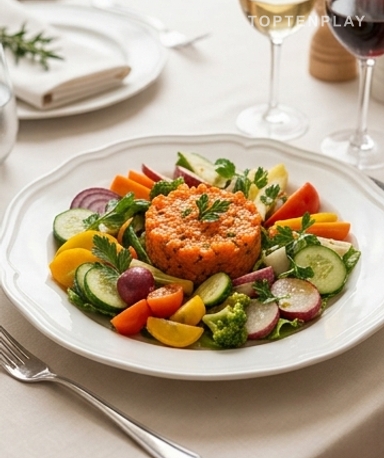
On the plate, five seasonal vegetables — their colors stand out like a painter’s palette: the tender green of zucchinis, the deep red of radishes, the milky white of fennel. In the center, the carrot tartare: a tight brunoise, glistening with vinaigrette, with tiny flecks of fresh herbs peeking through everywhere. It smells of lemon and olive oil. Nothing complicated, but everything is there.
Why you’ll love this recipe
Ingredient Notes
Five seasonal vegetables and a few condiments: everything you need for this generous plant-based dish.
- The carrots : The star of the tartare — choose them well. Sand-grown carrots if you can find them, as they are sweeter and less fibrous. Avoid large, old carrots: they will be woody under the knife and the tartare will be grainy. Ideal size: the small model, the ones bought in bunches with the green tops still on.
- The five seasonal vegetables : No forced list — that’s the principle. Aim for different textures: something crunchy (radish, cucumber), something tender (zucchini, raw asparagus), something sweet (raw grated beet), and something slightly bitter (fennel, endive). The fifth one is up to you, depending on your mood and the market stall.
- The olive oil : Not the industrial bottle from the cupboard. For an entirely raw dish where the seasoning is everything, get a quality fruity oil — something you’d enjoy tasting alone on a piece of bread. It will be visible, dominant, and it defines the character of the tartare.
- The lemon : Classic yellow lemon, no lime — that would lean too much toward the exotic. Squeeze it at the last minute. Lemon juice squeezed 20 minutes ago has already lost some of its vibrancy and starts to oxidize slightly. A detail, but truly noticeable in a raw dish.
- The fresh herbs : Chives and flat-leaf parsley for the tartare, at minimum. But a finely chopped sprig of tarragon completely changes the aromatic profile — more anise-like, more elegant. If you hate anise, stick to chives. If you like surprises, give it a try.
Choose your five vegetables with real intent
It’s Saturday morning. You’re at the market. Don’t just grab the first five vegetables you see — think about textures and colors before filling your bag. One crunchy, one tender, one sweet, one slightly bitter, and a fifth for a surprise. The eye eats before the mouth: a monochrome green plate won’t catch anyone’s eye. Aim for contrast. Radishes of an almost black-red next to a pale green zucchini is already a start. Once home, wash everything and dry carefully — residual water dilutes flavors and creates puddles on the plate at service.
Cut finely — that’s where everything is decided
Carrot tartare is primarily a matter of knife skills. The brunoise must be fine: small cubes of about 3 mm, regular, not coarse chunks cut in a hurry. Under the blade, the raw carrot resists — it makes that little dry, almost snapping sound when cut cleanly. Take your time. It’s a weekend dish precisely because it requires this kind of attention. Once cut, season it like a real meat tartare: salt, lemon, oil, herbs. The lemon juice will slightly “cook” the surface of the carrot and soften its raw bite — this is intentional, it’s the principle.
Treat each vegetable separately, don’t drown them together
Other vegetables are cut differently according to their nature. Harder ones are made into thin slices with a mandoline or a knife: fennel, radish, raw beet. More tender ones stay in more generous pieces: zucchini, asparagus. The idea is that each vegetable keeps its character in the mouth. Don’t season everything in bulk with a uniform sauce — treat each element separately and lightly before plating. A pinch of fleur de sel on the fennel slices, a drizzle of oil on the radishes. Each flavor remains distinct, making the plate interesting to eat until the last bite.
Let it rest ten minutes before serving
This is the rule everyone always forgets. Freshly seasoned carrot tartare is still a bit aggressive in its acidity. Ten minutes in the fridge, and everything relaxes: the salt melts into the flesh, the lemon integrates, the herbs perfume the whole thing deeply. The smell changes too — less sharp, rounder, with that slightly herbaceous background that rises slowly as you approach the plate. Meanwhile, plate the side vegetables. The tartare arrives last, placed in a dome in the center or to the side depending on your mood.
Tips & Tricks
- Make the tartare 15 minutes before serving, no more. Beyond that, the carrots release their water and the brunoise becomes soft. The crunchy texture is precisely what makes the dish interesting — don’t sacrifice that by preparing too far in advance.
- For professional-looking plating with no effort, use a cylindrical plating ring: place it on the plate, fill with tartare, press down slightly, and lift with a clean motion. It stands on its own, it’s clean, and it always impresses.
- A final drizzle of olive oil at the moment of serving — not before. Fresh oil on a cold dish shines differently and boosts the aromas at the very last second. It’s a chef’s detail, and it shows on the plate.
Can I prepare this salad in advance?
The side vegetables can be cut 2 to 3 hours in advance and kept separately in the fridge, unseasoned. The carrot tartare, however, should be prepared at most 20 minutes before serving: beyond that, the carrots release their water and lose their crunch. Season at the last minute for an impeccable result.
Which vegetables can replace the five suggested vegetables?
Absolutely any seasonal vegetable you enjoy eating raw or slightly blanched. In winter: grated celeriac, endive, radicchio. In spring: raw green asparagus, fresh peas, fava beans. In summer: cherry tomatoes, cucumber, corn. The only rule: vary the textures and colors.
How do I achieve a fine brunoise without a professional knife?
A well-sharpened paring knife is more than enough. The key: first cut the carrot into regular sticks 3 mm thick, then cut across into small cubes. Take the time to do it cleanly — a dull knife crushes instead of slicing, and the brunoise will be compressed rather than sharp.
How to store leftovers?
Seasoned vegetables can be stored for up to 24 hours in the refrigerator in an airtight container. The carrot tartare keeps for 12 hours but will be less crunchy the next day. For optimal results, only prepare what you plan to serve.
Can I make this a main dish instead of an appetizer?
Yes, no problem. Add a protein source: soft-boiled eggs cut in half placed on the salad, crumbled feta cheese, or warm red lentils mixed with the vegetables. The portion then serves 4-5 people for a complete meal.
Is a mandoline mandatory for the vegetables?
No, it’s a convenience but not a requirement. A good knife and a little patience give the same result. The mandoline is useful especially for fennel and raw beet, which are hard and require very thin slices. For the rest, a paring knife works just fine.
Vegetable Salad and Carrot Tartare, Chef Style
French
Appetizer
A fresh and colorful plate with five seasonal vegetables and a carrot tartare diced to order. No cooking, plenty of technique.
Ingredients
- 500g carrots (preferably young, in bunches)
- 2 green zucchinis (approx. 400g)
- 200g round radishes
- 1 bulb fennel (approx. 200g)
- 200g raw beet
- 200g green asparagus (or other seasonal vegetable)
- 8 tbsp quality olive oil (approx. 100ml)
- 2 lemons (juice)
- 2 shallots
- 20g fresh chives
- 15g fresh flat-leaf parsley
- 1 tsp Dijon mustard
- 2 tbsp apple cider vinegar
- 1 tsp fleur de sel
- freshly ground black pepper
Instructions
- 1Wash and dry all vegetables carefully. Peel the carrots and raw beet.
- 2Prepare the tartare: cut 500g of carrots into very fine brunoise (3 mm cubes). Finely mince the shallots, and chop the chives and flat-leaf parsley.
- 3Season the tartare: mix the carrots, shallots, herbs, the juice of one lemon, and 3 tbsp of olive oil. Season with salt and pepper. Refrigerate for 15 minutes.
- 4Prepare the side vegetables: slice the fennel and raw beet into very thin slices using a mandoline or knife. Cut the zucchinis into thin ribbons using a peeler. Slice the radishes into rounds. Keep the asparagus whole or cut on an angle.
- 5Prepare the vinaigrette: mix the cider vinegar, mustard, the juice of the second lemon, and 5 tbsp of olive oil. Season with salt and pepper.
- 6Season each vegetable separately with a little vinaigrette. A pinch of fleur de sel on the fennel, a drizzle of oil on the radishes.
- 7Arrange the vegetables on the plates, playing with colors and heights. Place the carrot tartare in a dome in the center using a plating ring. Finish with a drizzle of olive oil and some fresh herbs.
Notes
• Storage: cut vegetables keep for 24h in the refrigerator without seasoning. The seasoned tartare should be consumed within 12h maximum.
• Main course variant: add 2 soft-boiled eggs per person or 150g of crumbled feta over the dish to turn this appetizer into a main course.
• Season: in autumn-winter, replace zucchinis and asparagus with grated celeriac and sliced endive. The structure of the dish remains the same, only the flavors change.
Nutrition Facts (per serving, estimated)
| 175 kcalCalories | 4gProtein | 14gCarbs | 13gFat |