📌 Veal Loaf in Pastry Crust
Posted 3 April 2026 by: Admin
Veal loaf in a pastry crust—people often imagine it’s a specialty dish from a professional deli. A long, technical, intimidating recipe. In reality, it’s thirty minutes of active work, a store-bought puff pastry, and an oven that does 90% of the job.
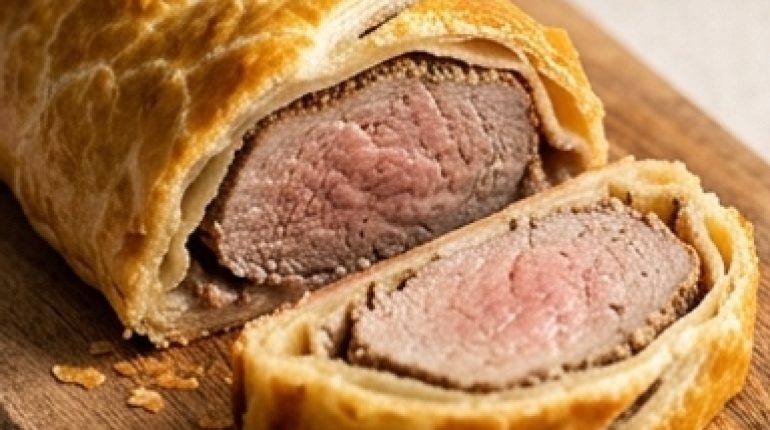
When it comes out of the oven, the crust is a light caramel color, slightly blistered in places. The smell filling the kitchen mixes buttery pastry with thyme, and something savory underneath. The first slice—the knife goes through the pastry with a sharp little crack. Underneath, the filling is rosy, firm, still steaming, and that is exactly where we wanted to be.
Why you’ll love this recipe
Ingredient Notes
All ingredients gathered before starting: veal, turkey bacon, fresh herbs, egg, and puff pastry.
- Ground veal : This is the base, and it deserves some thought. Veal is finer than beef, less fatty, and stays moist even when well-cooked. If you can, ask the butcher for stewing cuts (like for blanquette) and have them ground on the spot. Incomparably better than vacuum-packed ground veal.
- Smoked turkey bacon : It replaces traditional lard and does exactly the same job: a smoky note and a bit of fat so the filling isn’t dry. Get thick slices and chop them in a food processor yourself—pre-cut store-bought matchsticks are too thin and disappear during cooking.
- Soaked breadcrumbs : This isn’t a cheap trick. Breadcrumbs soaked in milk then squeezed dry give the filling that moist texture that melts slightly in the mouth. Without them, you get a compact ball that sticks to the palate.
- All-butter puff pastry : No need to make it from scratch, seriously. A good store-bought all-butter puff pastry gives a crust that cracks under the teeth just right. If you prefer something more rustic and dense, shortcrust pastry also works.
- Sage powder : The underrated ingredient of the recipe. It pairs with veal in a way that rosemary doesn’t—softer, almost floral. A pinch is enough. No need to go heavy.
What people misunderstand at the start
When we say ‘loaf in a crust’, many think of professional charcuterie, jelly, steel molds, and two days of work. It’s not that. Here, it’s a seasoned, fragrant, moist ground meat filling wrapped in pastry and baked in the oven. Simple. What sets it apart from an ordinary meatloaf is the crust: it protects the filling during cooking, retains moisture and aromas, and cracks cleanly under the knife.
The part everyone gets wrong: the texture of the filling
If the filling is too smooth, the veal loaf will be compact, slightly rubbery, and uninteresting. We want some bite. A few seconds in the food processor, just enough to homogenize the meats without turning them into a paste. When you mix everything by hand in the bowl—meats, onion sautéed until translucent and sweet, herbs, well-squeezed breadcrumbs, egg—you’ll feel the filling become supple, slightly sticky, with small pieces still visible. That is exactly when to stop. Season generously.
Why I’ll never make it without turkey bacon again
Coarsely chopped and mixed into the filling, smoked turkey bacon brings that well-rounded taste that you can’t always identify but notice immediately when it’s missing. Veal alone is delicate—sometimes too much. The bacon balances and rounds it out. During cooking, the small pieces release their fat slowly, seasoning the filling from the inside. The result is much more robust without being heavy.
The wrapping—less complicated than it looks
Roll out the pastry on a lightly floured surface into a rectangle. Place the filling in a log shape in the center. Fold over the sides, seal the edges by pressing firmly—not just a light touch, really press so the pastry adheres. Flip the loaf over so the seam is underneath and the top is smooth. Brush with egg yolk using a pastry brush, then make a few small diagonal incisions with a sharp knife. These slits allow steam to escape during baking: without them, the pastry puffs up and bursts.
Resting after baking: mandatory, not optional
Take the loaf out of the oven when the crust is a golden hazelnut color, firm and resistant under the finger. Resist the urge to cut it immediately. Ten to fifteen minutes on a wire rack allows the filling to firm up and the juices to redistribute. Cut too early, it collapses and sticks to the knife. After resting, the slice holds, the pastry cracks cleanly when cut, and the center stays hot and fragrant.
Tips & Tricks
- Don’t let the food processor run too long on the meat. The filling must keep some texture. Once it’s too fine, there’s no saving it.
- Prepare it the day before if you’re hosting. Completely cooled, wrapped in plastic film, in the fridge overnight. The next day: 15 minutes at 160°C. The crust becomes crisp again, and the filling is even tastier.
- If the crust browns too quickly, gently place a square of aluminum foil over the top without pressing down. The loaf continues to cook through without burning the surface.
Can I prepare the veal loaf in pastry the day before?
Yes, and it’s even recommended. Assemble it entirely the day before, wrap it raw in the fridge, and bake it the next day directly from the refrigerator, adding 5 minutes to the cooking time. It can also be cooked the day before and reheated for 15 minutes at 160°C before serving—the crust regains all its crunch.
How do I know if the filling is cooked through?
Insert a thin knife into the center and touch it against your wrist: it should be hot, not lukewarm. If you have a meat thermometer, the core temperature should reach 72°C. A golden hazelnut crust is a good indicator, but internal temperature remains the reliable measure.
Which pastry should I choose: puff or shortcrust?
All-butter puff pastry gives a light crust that cracks cleanly when sliced, more elegant for hosting. Shortcrust pastry offers a more rustic, dense result and holds better if you plan to serve the loaf cold. Both work very well—it’s a matter of desired texture.
Can I freeze the veal loaf in pastry?
Yes, once cooked and completely cooled. Wrap it in plastic wrap and then in aluminum foil; it keeps for 2 months in the freezer. Thaw it overnight in the fridge, then reheat for 20 minutes at 160°C uncovered so the crust becomes crispy again.
How do I avoid a dry and compact filling?
Two critical points: don’t overprocess the meat in the food processor (a few seconds are enough) and never skip the milk-soaked breadcrumbs. That’s what brings the moisture. Overcooking is the other frequent mistake—check the core temperature and remove from the oven as soon as it hits 72°C.
I don’t have a meat grinder. How should I prepare the meat?
Ask your butcher to grind the pieces for you—that’s the best option. Otherwise, a food processor on pulse mode (short bursts) works very well. The important thing is not to blend for too long to maintain a texture with some bite.
Veal Loaf in Pastry Crust
French
Main Course
A moist veal filling with herbs, wrapped in a golden and crispy all-butter puff pastry. The family dish that impresses without the effort.
Ingredients
- 500g ground veal (stewing cuts put through the grinder)
- 100g smoked turkey bacon in thick slices, coarsely chopped
- 100g ground turkey
- 1 medium onion
- 20g butter
- 1 tablespoon chopped fresh parsley
- 1 pinch dried thyme
- 1 pinch sage powder
- 1 whole egg
- 80g stale breadcrumbs (about 2 slices without crust)
- 80ml milk (to soak the breadcrumbs)
- 230g all-butter puff pastry (1 roll)
- 1 egg yolk (for the glaze)
- Salt and pepper to taste
Instructions
- 1Preheat the oven to 180°C. Soak the breadcrumbs in the milk, let them swell for 5 minutes, then squeeze firmly to remove excess liquid.
- 2Peel and finely chop the onion. Sauté in butter over low heat until translucent, about 5 minutes. Let cool slightly.
- 3Pulse the veal, turkey bacon, and ground turkey a few times in the food processor—the texture should remain slightly coarse.
- 4In a large bowl, mix the meats with the onion, parsley, thyme, sage, squeezed breadcrumbs, and egg. Season generously with salt and pepper, mix by hand.
- 5Roll out the puff pastry on a floured surface. Place the filling in a regular log shape in the center, leaving a 4 cm border on each side.
- 6Fold the pastry over the filling and seal the edges by pressing firmly. Flip over so the seam is face down, place on a baking sheet lined with parchment paper.
- 7Brush the entire surface with egg yolk. Make 5 to 6 small diagonal incisions on top with a sharp knife.
- 8Bake for 50 to 55 minutes. If the crust browns too quickly after 30 minutes, gently place a square of foil over the top.
- 9Let rest for 15 minutes on a wire rack before slicing. Serve hot with a green salad or roasted vegetables.
Notes
• Prep in advance: assemble the raw loaf the day before, wrap in film in the fridge. The next day, bake directly from cold, adding 5 minutes to the cooking time.
• Storage: 3 days in the refrigerator in an airtight container. Reheat for 15 minutes at 160°C to regain the crust’s crispiness.
• Freezing: freeze once cooked and cooled for up to 2 months. Thaw overnight in the fridge and reheat for 20 minutes at 160°C uncovered.
Nutrition Facts (per serving, estimated)
| 400 kcalCalories | 29gProtein | 21gCarbs | 21gFat |